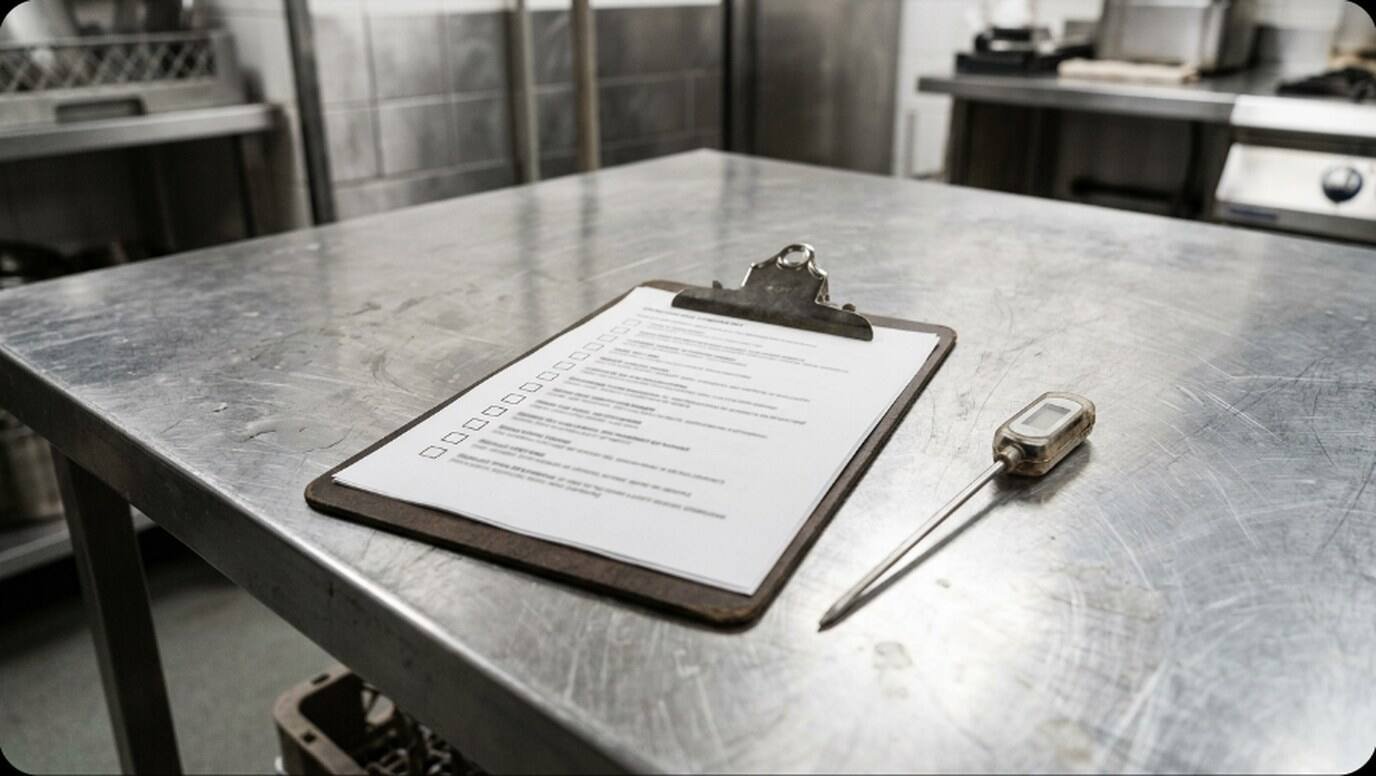
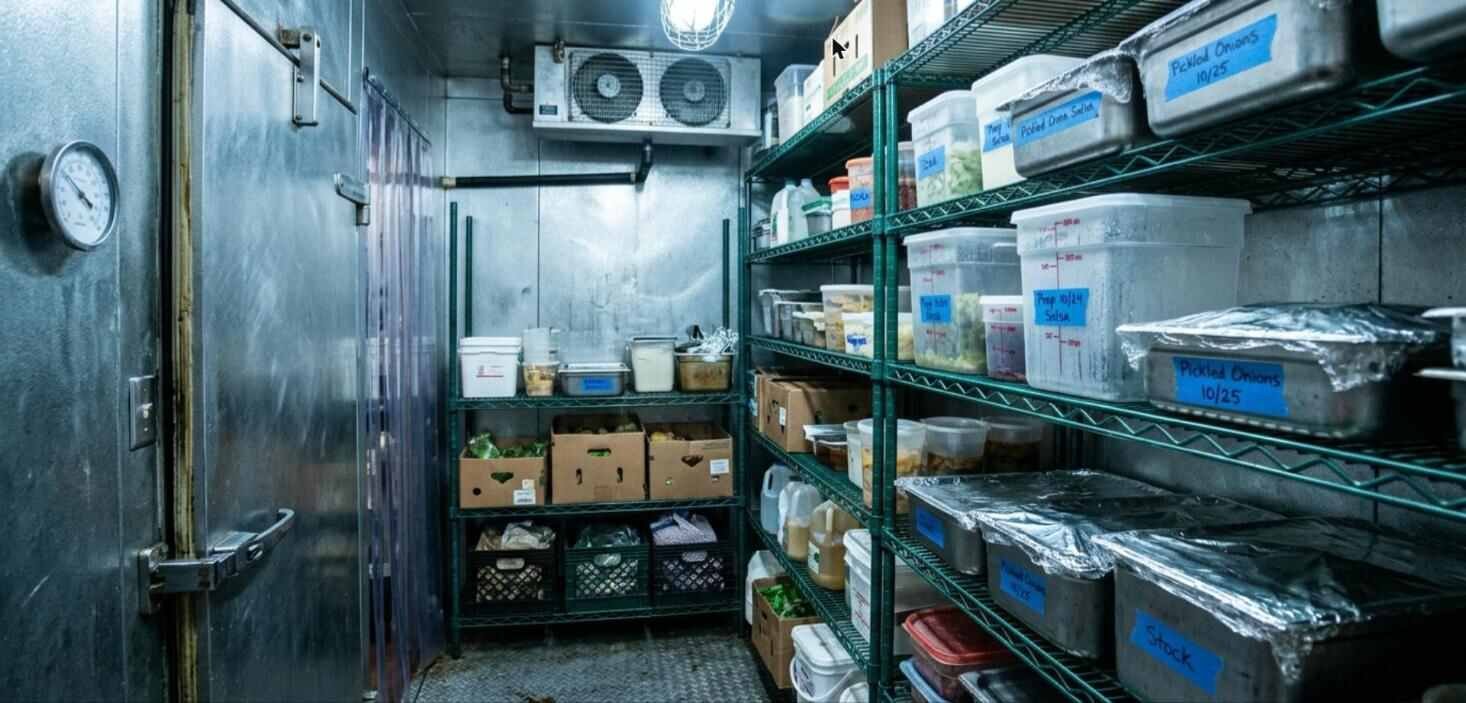
A walk-in cooler that drifts warm overnight has failed by morning, and a written temperature log is the cheapest way to catch the drift. The limits behind such a log come from more than one place. New York’s state sanitary code sets one group of numbers, the FDA’s training material for food employees sets another for cooling, and Suffolk County’s inspectors measure temperatures against the code that applies to a given permit.
The limits in New York’s state code
Section 14-1.40 of the State Sanitary Code covers temperature and refrigeration for potentially hazardous food. As published on the state Department of Health’s regulations site, it says such food “is to be 45 degrees Fahrenheit (7.2 degrees Celsius) or below,” or 140 degrees Fahrenheit (60 degrees Celsius) or above at all times. A limited period is allowed while food is held for service, and that period may not exceed two hours. Intact shell eggs get their own line: the section calls for an ambient storage temperature of 45 degrees or below.

Cooling sits in the same section. Food that has to be refrigerated is to be cooled by an “adequate method,” and the text puts numbers on it: from 120 degrees to 70 degrees within two hours, then to 45 degrees or below within four additional hours. Counted from 120 degrees, that is six hours in all.
The section sets limits. It does not mention thermometers or written records.
What the FDA’s cooling guide says
The FDA publishes the Food Code as a model rather than a binding rule. Its Food Code page describes the 2026 edition as the most recent full edition, and says that “Local, state, tribal, and federal regulators use the FDA Food Code as a model” for their own food safety rules.
A separate FDA publication, a July 2024 guide for food employees titled Cooling Cooked Time/Temperature Control for Safety Foods and the FDA Food Code, describes the same two stages with different numbers. The first is a two-hour rapid cool from 135 degrees to 70 degrees. The second is a four-hour window in which food must reach 41 degrees or less. When 70 degrees is reached before the two hours are up, the unused time carries into the second stage.
| Stage | New York State Sanitary Code, 14-1.40 | FDA employee guide on cooling |
|---|---|---|
| Start of cooling | 120°F | 135°F |
| First stage | To 70°F within two hours | To 70°F within two hours |
| Second stage | To 45°F or below within four additional hours | To 41°F or less within a four-hour window |
The two documents are not interchangeable, and a log sheet that borrows a limit from one and a limit from the other will confuse whoever reads it later. A sheet works better when it names the code it follows and prints that code’s numbers at the top.
What a county inspector measures
Suffolk County’s Food Protection page says routine inspections are unannounced and that delis, diners, catering halls and full-service restaurants are usually inspected at least once a year. Inspectors “measure food temperatures” and look at storage, sanitation and equipment such as refrigeration.
Temperature shows up by name in the county’s list of violations. “Foods that require temperature control for safety not maintained at proper temperatures” is a Risk Factor violation, the category the page ties most closely to foodborne illness and says usually must be fixed during the inspection. The wider picture of what an inspector checks first is laid out in What a Health Inspector Looks at First.
The page lists no temperature values of its own. It says the program enforces Article 13 of the Suffolk County Sanitary Code and that violations are cited under the county and state codes and New York State Public Health Law. A restaurant that wants to know which numbers its permit is judged against can ask the department at (631) 852-5999.
Calibrating the thermometer before trusting it
A log is only as good as the thermometer behind it. Penn State Extension’s page on thermometer use and calibration describes the ice-point method: pack a large glass with crushed ice, add water and stir, wait about a minute, then place the stem in the center of the glass without touching the sides or bottom. After 15 to 30 seconds the dial should read 32°F. If it does not, the calibration nut under the dial is turned with a small wrench or pliers until it does.
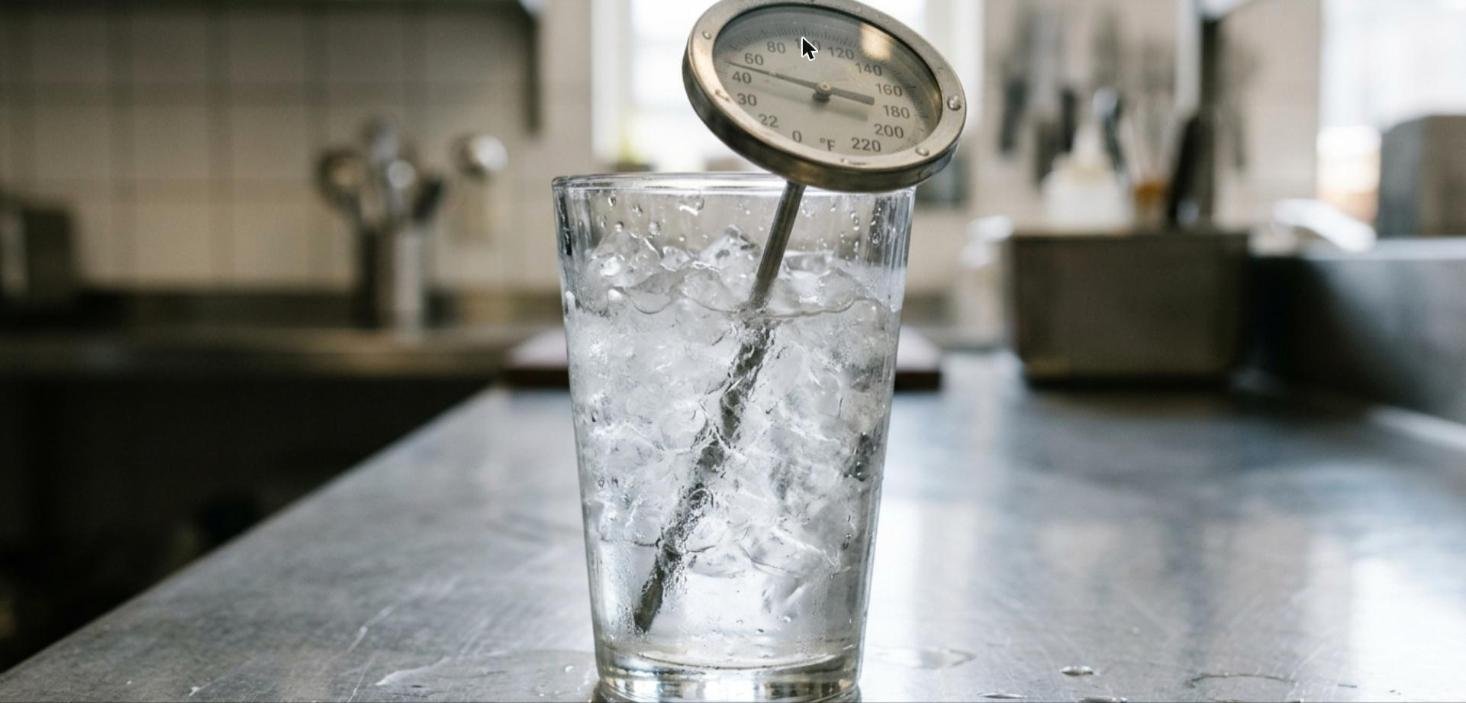
The same page says dial-type (bi-metallic) stem thermometers need calibrating “as often as each day” and any time they are dropped or twisted. Digital instant-read thermometers generally cannot be calibrated, so their accuracy is checked occasionally with the same ice-water test. The accuracy target given for food thermometers is plus or minus two degrees Fahrenheit, and the page suggests looking for the NSF mark when buying either type. The video above, from Ohio State University Extension, shows the ice-water check being done.
What a log sheet holds
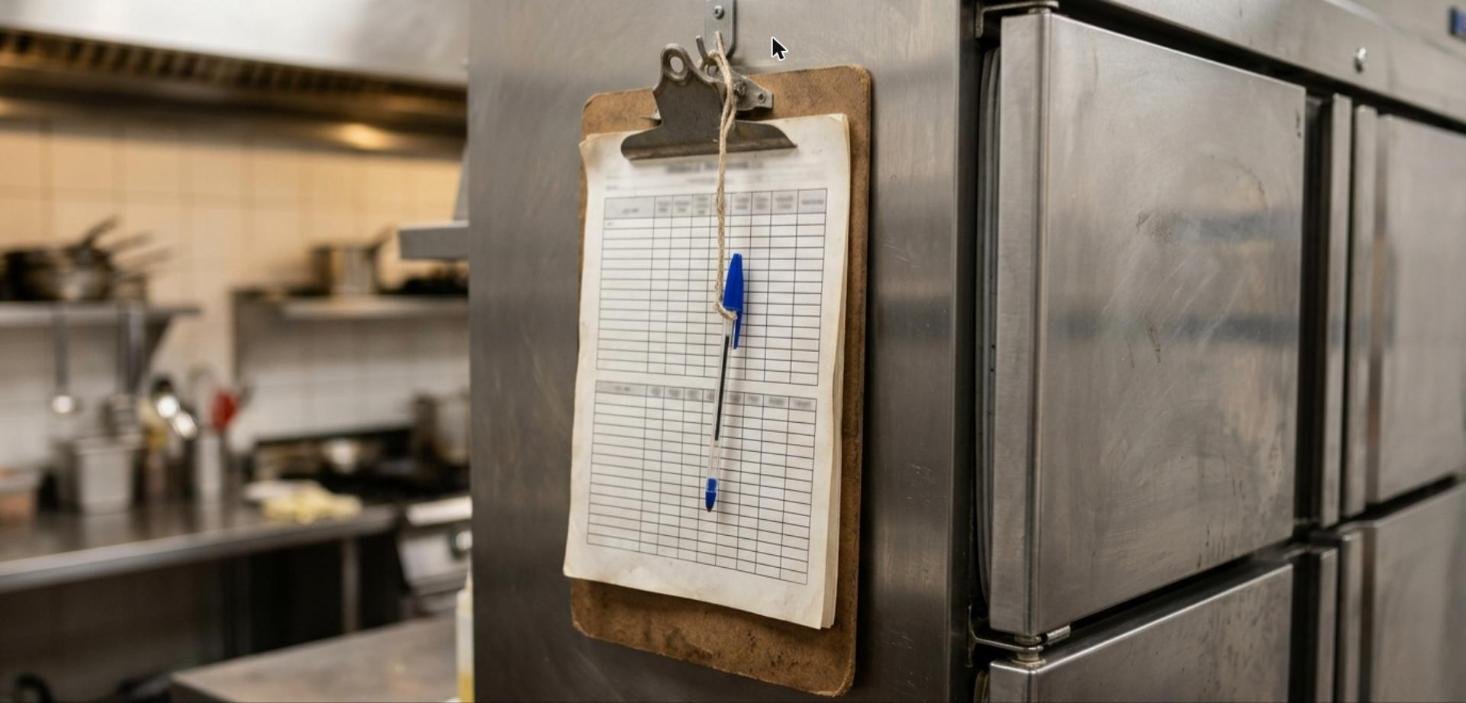
A temperature log is a table that someone fills in at set times. The columns that make it useful are few:
- Date and time of each reading
- The unit by name: walk-in, reach-in, prep cooler, hot well
- The reading itself, taken with a thermometer that has passed its calibration check
- The limit for that unit, printed on the sheet
- Initials of whoever took the reading
- What was done when a reading fell outside the limit
For shell eggs the state section speaks of ambient temperature, so the unit’s air reading is the number that matters there. Hot-held food is judged against the 140-degree limit in the state text. A second, shorter sheet can follow cooked food through cooling: the time and temperature at the start, the reading at two hours, and the reading at six. That layout follows the state section’s two stages, and a restaurant working from the FDA’s numbers would adjust the limits at the top of the sheet.
Temperatures are also checked at the back door, which Receiving a Delivery: What to Check Before You Sign covers, and the same sheet habits carry over to a weekly routine such as How to Build a Weekly Prep List for a Restaurant Kitchen.
When a unit fails or the power goes out
The last column of the sheet, the one for action taken, is the part that records judgment. Moving food, calling for service and discarding product all belong there, with the time.
The county page names one failure that cannot be handled by a note on a sheet. Lack of refrigeration during an extended power outage is a condition that requires closure, and an establishment ordered closed for an imminent health hazard cannot reopen until the hazard is resolved. A written record of readings before and after an outage does not change that rule, but it gives an owner a dated account of what the equipment was doing.
For informational purposes only — consult a licensed attorney or financial advisor. This post summarizes published regulations and agency guidance and does not replace the health department’s own instructions for a specific permit.
Sources
- New York State Department of Health, 10 NYCRR 14-1.40, Food protection; potentially hazardous food, temperature and refrigeration requirements: https://regs.health.ny.gov/node/48381
- U.S. Food and Drug Administration, FDA Food Code: https://www.fda.gov/food/retail-food-protection/fda-food-code
- U.S. Food and Drug Administration, Cooling Cooked Time/Temperature Control for Safety Foods and the FDA Food Code, for Food Employees (July 2024): https://fda.gov/media/181882/download
- Suffolk County Department of Health Services, Food Protection: https://suffolkcountyny.gov/Departments/Health-Services/Public-Health-Protection/Food-Protection
- Penn State Extension, Thermometer Use and Calibration: https://extension.psu.edu/thermometer-use-and-calibration
- Ohio State University Extension, Calibrating a Food Thermometer (YouTube): https://www.youtube.com/watch?v=JdW5gbSa_dQ