
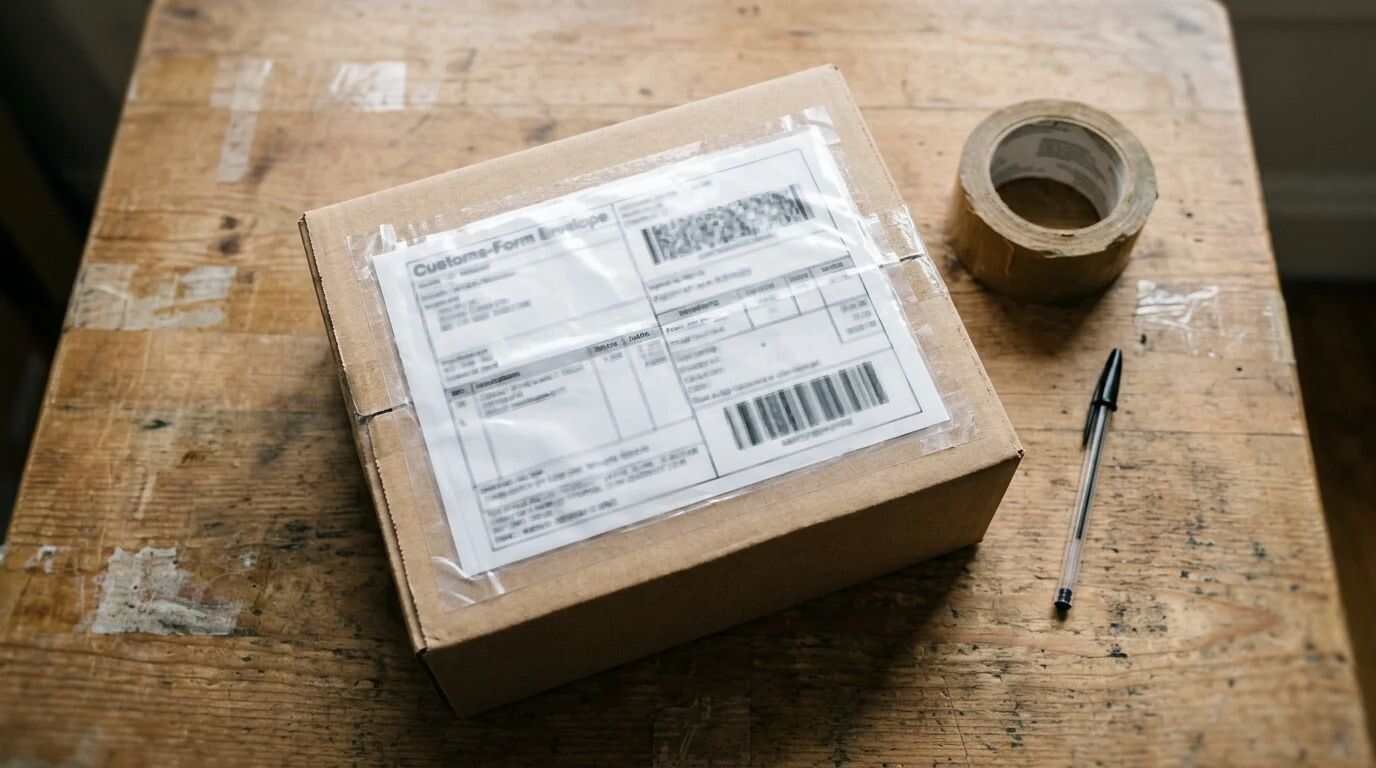
The signature at the bottom of a USPS customs form carries the whole parcel. Under the International Mail Manual, the mailer stays solely responsible for the accuracy of every line, and the Postal Service is not liable for a wrong tariff code or for anything a foreign customs office decides. A domestic package needs an address and postage. An international one needs a declaration that describes the contents, states a value and usually carries a classification code, with export filing rules from the Census Bureau and the Commerce Department sitting behind it.
The rules here are for United States exports mailed through USPS. Other carriers use their own documents, and each destination country applies its own rules on arrival. The postal pages cited here show no revision date, and one of them mentions a service suspension as of September 29, 2024, so they reflect content at least that recent. Rules change, and the linked pages are the place to confirm the current version before shipping.
Which USPS customs form goes with which service

Section 123 of the International Mail Manual, titled Customs Forms and Online Shipping Labels, assigns a form to each mail category. The names come from numbers. PS Form 2976 is the Customs Declaration, also known as CN 22. PS Form 2976-A is the Customs Declaration and Dispatch Note, known as CN 72. PS Form 2976-B is the Priority Mail Express International shipping label and customs form in one.
The table in Section 123.61 pairs those forms with services. Priority Mail Express International takes PS Form 2976-B for all items. Priority Mail International takes PS Form 2976-A for all items. First-Class Package International Service takes PS Form 2976 or 2976-A when the contents are valued at $400 or less, and the manual lists packages above $400 as prohibited in that service, so higher-value goods have to move by a higher-tier service. First-Class Mail International letters and flats under 16 ounces carry no form when they hold documents only, with some exceptions. Between 16 and 17.6 ounces, a form is required and merchandise is prohibited. Global Express Guaranteed uses PS Form 6182, a commercial invoice, for certain commodities and destinations, though the page lists that service as suspended as of September 29, 2024.
Section 123.623 adds a short list of items that need a customs form even when sent as letter-post, including CDs, books, periodicals and commercial photographs. Section 123.61 also requires PS Form 2976-A or 2976-B for any item containing articles that need an export license, whatever the table otherwise says.
First-Class Package International Service is the category with the $400 limit. The post on setting shipping costs covers the rate side of that choice, and the post on packing a high-value item covers goods that sit above it.
What the form has to say
Section 123.711 lists the required elements. Each form needs the sender’s full name and address, the recipient’s full name and address, a category for the contents such as document, gift or merchandise, and a detailed description with quantity, net weight and value for each item. The form also needs a Harmonized System, Harmonized Tariff Schedule or Schedule B code, and the manual sets the floor at a six-digit World Customs Organization HS code unless a country listing says otherwise. The sender signs and dates the form.
Some elements are conditional. Phone numbers and email addresses for both parties, a license or permit number, the country of origin of the goods, and an Automated Export System filing number or exemption citation appear where they apply. Everything on the form has to appear in Roman letters and Arabic numerals, and a translation can be added alongside.
Responsibility for accuracy sits with the mailer. Section 123.711 states that the mailer remains solely responsible for the accuracy and completeness of the customs information, and that the Postal Service is not liable for an incorrect HS classification or for any decision by a customs authority. Section 123.712 tells acceptance employees to check that a form is complete and signed, and adds that the Postal Service assumes no responsibility for what the sender wrote.
The Census Bureau’s Schedule B Commodity Search Tool is the lookup that its page names for export classification. A shop that sells a handful of product types can look each one up once and keep the codes with the product record, so the same description and code appear every time.
Electronic customs data, labels and where the form goes

The manual has largely moved customs forms online. Section 123.11 lists the sources of an electronically generated form: Click-N-Ship, the Customs Form Online application, or USPS-approved vendor software. Section 123.61 states that all USPS-supplied hard copies are obsolete and prohibited from use. PS Form 2976-R, a handwritten worksheet, exists only for use at a retail counter, and Section 123.11 says it cannot serve as a stand-alone customs form.
A shop that prints its own forms has an added step. Section 123.32 requires electronic transmission of the declaration data through USPS Global Shipping Software, version 1.7 or higher, or another USPS-approved program. It warns that failing to transmit the data may lead to refusal at acceptance, processing delays or return of the mail.
Placement is specified too. A plastic envelope, PS Form 2976-E, is affixed to the address side of the mailpiece, and Section 123.722 says not to wrap it around the package. An electronically generated form goes on the face of the mailpiece. Section 123.61 also requires the address side to be large enough for the form, the postage and the markings together. The post on thermal label printers covers the label side of shipping.
When an export filing is required
The customs form is not the only export paperwork. The Commerce Department’s trade site explains that Electronic Export Information, known as EEI, is filed in the Census Bureau’s Automated Export System when the value of the goods under each Schedule B number is over $2,500, or when a mandatory filing requirement applies, such as an export license. Postal shipments follow the same conditions. The filing is not required for shipments valued at $2,500 or less with no mandatory filing, and the page says shipments to Canada of any value need none unless a mandatory requirement applies. Shipments between the United States and Puerto Rico, and from the United States to the U.S. Virgin Islands, are cases where EEI is required.
USPS Publication 699 describes the same threshold for mailers. It says to file for one item, or a group of items under the same Schedule B code, valued at more than $2,500 to any country other than Canada, and for any defense article whether or not a license is required.
The exemption itself is in 15 CFR 30.37(a). It applies when the commodities shipped from one U.S. seller to one ultimate consignee on a single conveyance, under an individual Schedule B number, are valued at $2,500 or less. The test runs by Schedule B number and not by the total order value, and items that share a number count together. In a mixed shipment, only the numbers valued over $2,500 must be reported. The filer is the U.S. principal party in interest or an authorized agent, and for a postal shipment the exporter gives the post office the filing number or the exemption citation if one applies.
The per-number test cuts both ways. A $3,000 order of twenty items, each under its own Schedule B code, can need no filing at all when no license or other mandatory requirement applies, while a dozen of one product at $250 each crosses the line in a single order, because those units all add up under the same code.
Duties and taxes at the destination

A parcel that clears the sender’s side can still meet charges in the destination country. USPS describes the default on its Delivered Duty Paid page: without prepayment, the recipient usually pays import duties, taxes and fees before receiving the package, and some countries require prepayment before postage can be bought at all.
The Delivered Duty Paid service lets the sender prepay those charges. The sender can opt in through Click-N-Ship, retail Post Office counters, certain USPS programming interfaces or Global Shipping Software, and the system calculates the amount and adds it to the postage. USPS charges no fee for the service. A third-party provider charges a service fee that is included in the quoted total, and its guarantee covers the difference if customs charges more than the quote, within limits. If customs charges less, the sender receives no refund of the excess. The page lists eligible services as Priority Mail Express International, Priority Mail International and First-Class Package International Service, and lists countries including Canada, the United Kingdom, Germany, France, Italy, Spain and the Netherlands, with more expected.
The USPS page also lists two European Union charges. One is a €3 import duty per line item, effective July 1, 2026, for certain low-value business-to-consumer packages up to €150 and for consumer-to-consumer gifts over €45 up to €150. The other is a nonrefundable €2 handling fee per line item, effective November 1, 2026, for business-to-consumer packages of any value. Business senders also have to provide Product Identifiers for business-to-consumer shipments to the EU.
Section 360 of the manual explains why the amounts vary. Duties depend on the item’s value, country of origin and classification, and on trade agreements and each country’s de minimis threshold. Taxes such as VAT or GST are calculated differently by country. In some countries a seller must register for VAT or GST and collect and remit the tax on low-value goods. The duties, taxes and fees paid are generally nonrefundable, including on undeliverable or refused packages, so a refused parcel can leave a sender who prepaid with the charge and no sale.
Prohibited items and country rules
Section 131 of the manual sets the baseline for what can be mailed. Anything nonmailable domestically is also nonmailable internationally, and many articles that are mailable at home are nonmailable abroad. Country-specific prohibitions are listed under Prohibitions and Restrictions in each Individual Country Listing, and Section 113 describes those listings as the source of conditions of mailing, postage prices and extra services for each country.
The manual’s chapter on mailability also points to USPS Publication 52 for more detail, and a Post Office can answer questions about specific restrictions. None of that moves the weight. Articles the destination country prohibits are nonmailable, a country may return or seize mail that holds prohibited or restricted articles, and the manual puts the burden of compliance on the mailer, the same person whose name is already signed at the bottom of the form.
For informational purposes only — consult a licensed attorney or financial advisor.
Sources
- IMM 123, Customs Forms and Online Shipping Labels, USPS Postal Explorer
- IMM 131, Mailability: General, USPS Postal Explorer
- IMM 360, USPS Delivered Duty Paid (DDP), USPS Postal Explorer
- USPS Delivered Duty Paid (DDP) Service, USPS
- Electronic Export Information (EEI), International Trade Administration
- Census Filing Requirements, Electronic Export Information, USPS Publication 699
- 15 CFR 30.37, Miscellaneous exemptions, Electronic Code of Federal Regulations
- Schedule B, U.S. Census Bureau
- How to Fill Out the online USPS Customs Form | Step-by-Step Guide, Customs Breeze (YouTube)