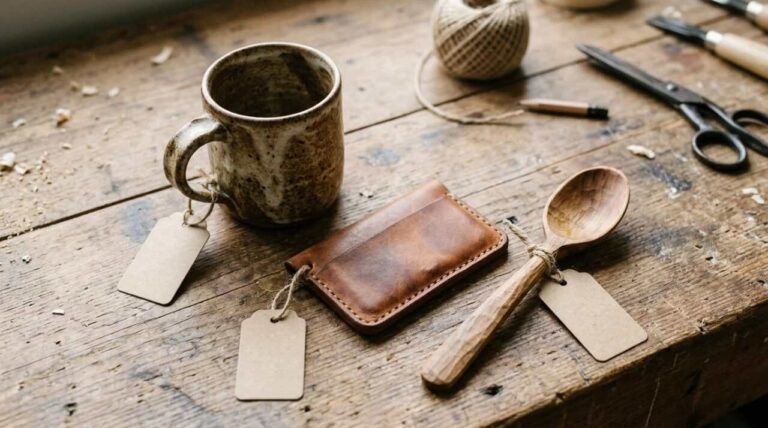


The advice on writing product descriptions for handmade goods splits in two. One camp says to sell the story of who made the thing and how, and the other says to describe the product and nothing else. Both camps have a point, and which one applies depends on where the description is going to be read.
A disclosure first. I own Marcellino NY, which has made handmade English bridle leather briefcases, with bespoke customization, as my own business since 2010, and I use its product pages as the examples below because they are the descriptions I can look at without guessing. I am not a copywriter, I do not have conversion data to share, and this post does not say which of my descriptions sold more briefcases than others. It reports what the pages contain and what published guidance says about pages like them.
What a Marcellino description looks like
Open the page for the Wallace 2220b and the description is mostly a specification list. It gives the size, 16 by 12 by 4 inches, with a note of 2 x 2 after it, then a bottom cross stitch handle with a support bar, front buckle straps that come off, inside pockets, a newspaper pocket on the back, a naturally unlined interior, and an adjustable shoulder strap with a 20-inch drop. It says the briefcase is traditionally hand saddle stitched and made to order, that the logo lands in a random place on each one, and that the build lead could run up to six months. Colors, hardware and edge paint are chosen at checkout in the notes.
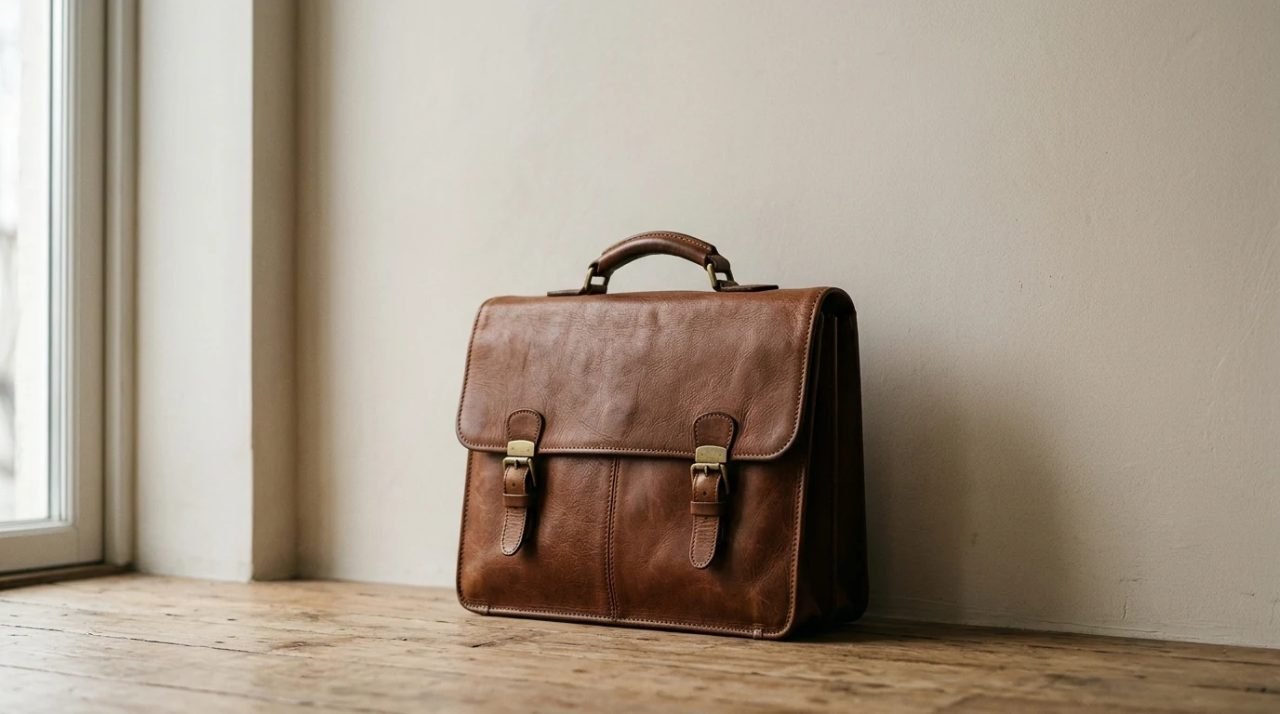
Under that list sits a one-line description tab: “The Alfred Wallace is a classic English briefcase style.” The tab goes on to say that the center lock and suede lining are no longer included in this style, and that the double buckle straps are unlined, with no stitching on the edges. A page like that records a change the maker made to the design, which is the sort of fact a buyer would otherwise learn by email after paying.
The Wallace 2088 page follows the same pattern, a spec list with a short tab beneath it that says the briefcase “is made with Hermann Oak Old World Harness leather.”
That is a particular way to write, and it comes from the product more than from any theory. A bespoke briefcase raises questions that a mug or a candle never does: how deep, how many sections, which hardware, how long until it arrives. So the page answers those and leaves the lyrical part to other posts and to photographs. I am describing a habit, and I am not claiming it is the right one.
Two schools of advice
Nathalie Poulin, a copywriter and craft artist, argues in a guide for the Academy of Handmade that buyers want the story: who made it, how, and what it feels like in use. She suggests a description of about 50 to 150 words, with the basic details such as size and materials moved to the bottom. Her phrase is that people want to buy an experience, not just things.
A later guide from Main Street Co, a retailer that lists handmade sellers, published in April 2026, structures a description as a headline, a short maker story, key specs, benefits, care notes and a call to action, in about 150 to 300 words. It also warns against vague openers such as “beautiful handmade item” and asks for something concrete about how the piece was made.
Google’s instructions for sellers take close to the opposite line. In Merchant Center’s guidance for the product description field, the text should describe only the product itself. It should cover size, material, texture, design and variant details, and for customized goods, the customization options, while leaving out prices, shipping information, comparisons with other products, and the seller’s business history or policies. It also asks sellers to put the most important details in the first 160 to 500 characters, since a shopper may not see the rest without clicking.
These do not contradict each other as much as they first appear to. The story belongs on a page where a person is reading at leisure, and the clean description belongs in a feed that a machine will chop into a listing. A seller who writes for both ends up with a short factual block for the feed and a longer account on the page.
The facts a buyer cannot guess
Shopify’s guide to writing product descriptions, last updated in July 2026, opens with what the product is, then leads with benefits supported by features. It says length should match how familiar the buyer is with the item and how complicated the purchase is, so that unfamiliar or technical products get more explanation than familiar basics. It also asks sellers to rewrite manufacturer text in their own words, and to describe the detail that changes between variants, such as color or size, instead of reusing the same boilerplate.

For handmade goods the facts a buyer cannot guess are the ones that need the most care. Dimensions, weights, the exact leather, how long the thing takes to arrive, what can be changed and what cannot. The 2220b page covers the lead time and the customization route in plain words, and a buyer spending a large sum on a made-to-order object is reading for exactly those facts. Main Street Co lists the same group, measurements, weight, care instructions and lead times, and says they reduce questions and returns.
There is also a mobile angle. Shopify suggests starting with a short overview and then using bullet points and short labels so a shopper can find the specifications quickly on a phone. A spec list is already close to that shape, which is one thing in its favor.
Claims you have to be able to prove
A handmade seller is tempted by three words in particular: handmade, custom and American. The first two describe a process and are easy to substantiate if you are the one doing the work. The third is a legal claim.
The Federal Trade Commission’s guidance on the Made in USA standard says an unqualified claim requires that a product be “all or virtually all” made in the United States, with final assembly in the U.S., all significant processing in the U.S., and negligible foreign content. Marketers need a reasonable basis for the claim and have to keep checking it as sourcing changes. A qualified claim, such as a stated percentage of U.S. content, must also be truthful.
I bring this up because my own pages show why it matters. The 2220b description lists English bridle leather as “UK” or “USA” depending on availability. That is accurate, and it is also the kind of detail that makes a blanket claim about origin something to check against the actual hide in the actual order. If you sell handmade goods and your supplies come from several places, write the origin claim the way the facts allow, and ask a lawyer before using words the FTC treats strictly.
Words for search, words for people
Both Shopify and Main Street Co say to use the words a shopper types, the material, the use, the style, without stuffing the page with repeated keywords. Shopify adds that the keyword belongs in the title, the opening copy, the image alt text and the meta description, and that alt text should describe what is visible in the photograph.

For structured data, Google’s product markup documentation distinguishes product snippets, for pages where a visitor cannot buy, from merchant listings, for pages where the visitor can, and recommends pairing on-page markup with a Merchant Center feed. The details of the markup are on other Google pages, and a small shop usually gets them through its store software or an add-on instead of writing them by hand.
Photographs do work that no sentence can. If you are short on a studio, I wrote about product photography without a studio.
A plain method
Pull the facts first, in a list, before any prose: size, material, weight, how it closes, what the buyer can change, how long it takes to arrive and how it is cared for. Everything else has to earn its place against that list.
Then write the opening for a person, with one concrete detail about how the thing was made, as Main Street Co advises. Put the longer maker’s story somewhere it will be read slowly, and keep the version that goes to a feed free of promotion, prices and shipping terms, as Google asks.
Handmade pieces tend to come in variants that the maker treats as one product and the buyer treats as several. Shopify’s advice is to describe the detail that changes, the color or the size, instead of pasting the same paragraph under every variant, and Google asks for the variant details in the description as well. On a made-to-order page, that means saying plainly which choices exist, which ones are made at checkout, and which ones are gone.
Last, read it as the buyer. Does the page answer the question you would ask before spending real money? If it does not, add the answer, even if it makes the page less pretty.
For informational purposes only. Origin, “handmade” and similar claims can carry legal obligations, so consult a licensed attorney before relying on this post for any marketing claim.
Sources
- Marcellino NY, Wallace 2220b Bridle Leather Briefcase: https://marcellinony.com/product/wallace-2220b/
- Marcellino NY, Wallace 2088 Harness Leather Briefcase: https://marcellinony.com/product/hermann-oak-harness-leather-single-section-briefcase/
- A Guide for Writing Great Product Descriptions, Nathalie Poulin, Academy of Handmade: https://academy-ofhandmade.squarespace.com/blog/2014/11/11/a-guide-for-writing-great-product-descriptions
- Product description guide for handmade sellers, Main Street Co: https://www.mainstreetco.us/blogs/vendor-spotlight/product-description-guide-for-handmade-sellers
- Product description attribute, Google Merchant Center Help: https://support.google.com/merchants/answer/6324468?hl=en
- How to write product descriptions, Shopify: https://www.shopify.com/blog/product-descriptions
- Product structured data, Google Search Central: https://developers.google.com/search/docs/appearance/structured-data/product
- Complying with the Made in USA Standard, Federal Trade Commission: https://www.ftc.gov/business-guidance/resources/complying-made-usa-standard
- How to Write Handmade Product Descriptions That Actually Sell… In 5 Minutes or Less, Handmade Success Secrets on YouTube: https://www.youtube.com/watch?v=v5_1aplHw1s
- Product photography for a small shop without a studio, Till Post: https://tillpost.com/product-photography-small-shop-no-studio/