
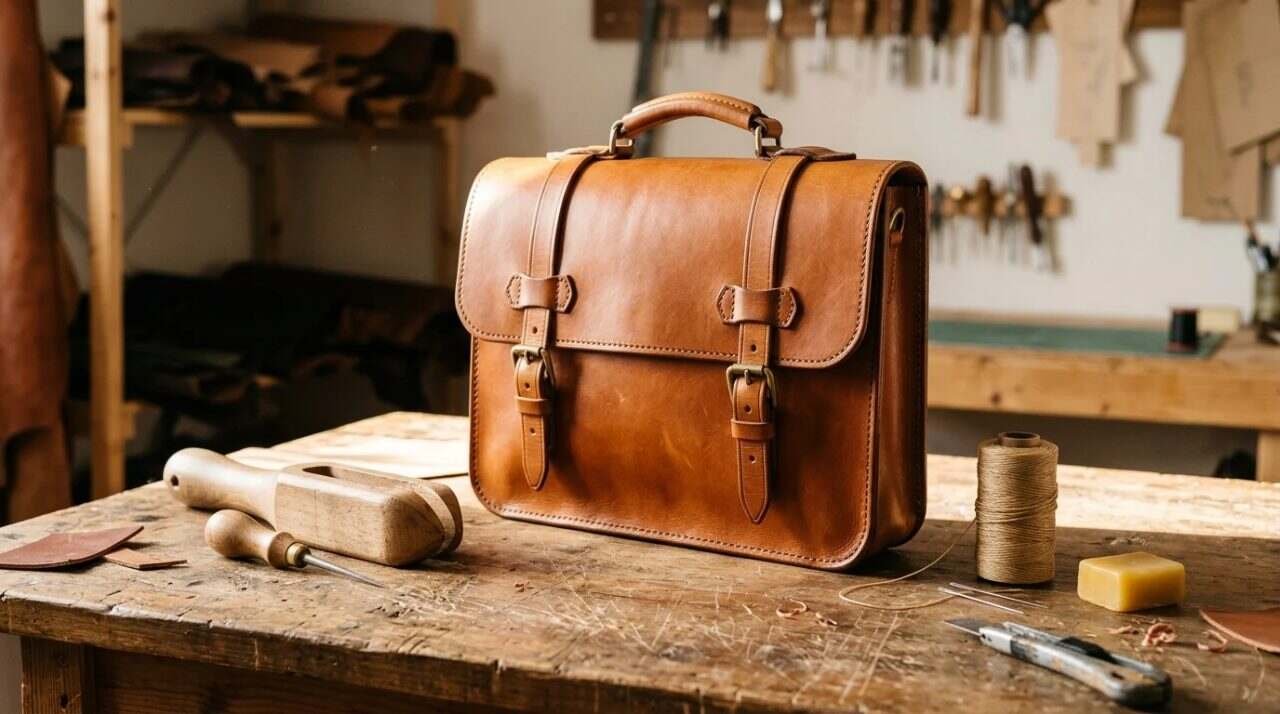
Marcellino NY is my own business, and it has been since 2010. It sells handmade English bridle leather briefcases online. That has put me up against the one problem every maker faces on the internet: how do you let a stranger order something that does not exist yet?
This post covers what Marcellino NY sold first, the mistake I made early, and the numbers that explain why that mistake is so easy to make. Disclosure: Marcellino NY is mine, so everything here comes from running it, and I link to my own site where it helps.
What Marcellino NY sold first online
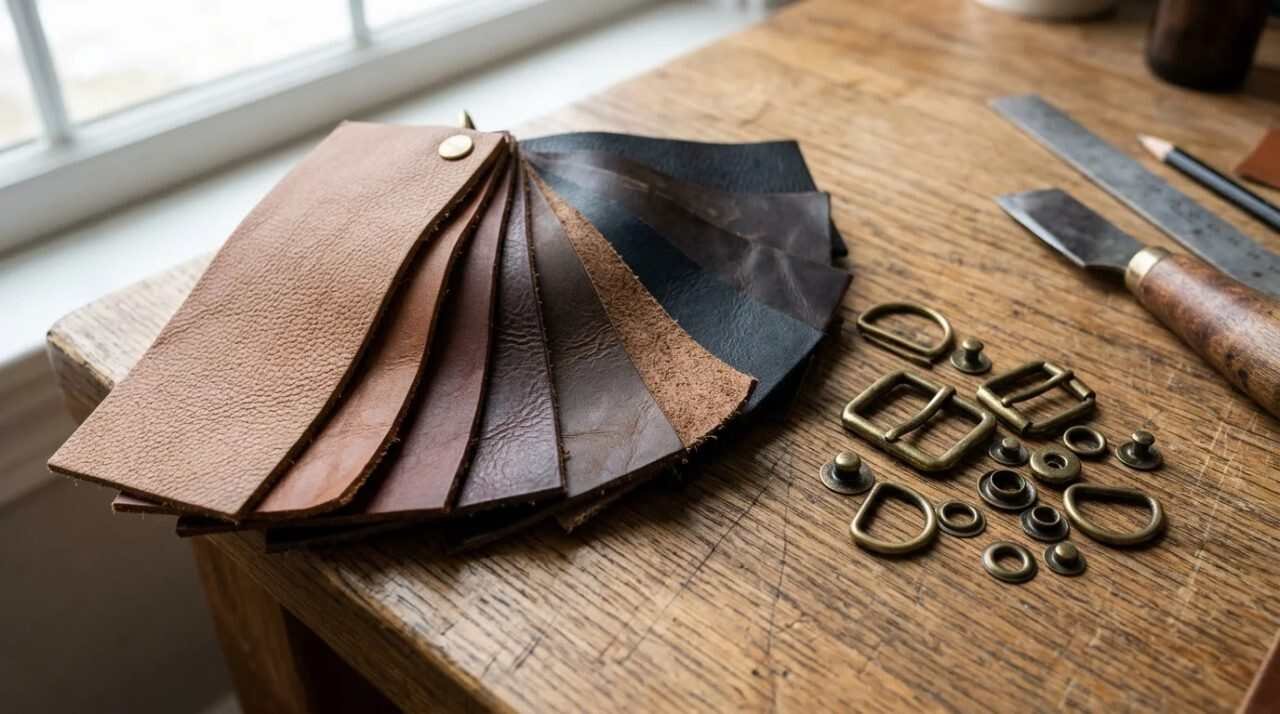
The first thing Marcellino NY sold was the ability to customize a high-end briefcase. Not many places in America offered that. A lawyer who wanted a serious briefcase, fully customized down to the size, the color, the pockets and the style, had very few shops to go to. Most briefcases at that level were finished products you took as you found them.
So the shop’s pitch was the opposite: tell me what you need and I will build it. For the right customer that was exactly the reason to buy. It was also, I found, a lot to carry.
Why a custom product is hard to sell on a screen
A normal online store sells a thing that exists. The photo shows the thing, the price attaches to it, the buyer clicks, and a box leaves the warehouse. A bespoke briefcase works the other way around. The buyer is ordering a decision, and every decision has to be described, priced and written down before any leather gets cut.
The current site shows how much there is to describe. Its bespoke ordering section lists leather choices, an Italian calf suede lining, front straps, high-end handmade locks, pocket layouts for briefcases and mini cases, a natural leather lining, and handle and latch styles. Each of those is a question the customer answers, and every answer changes the build.
The early mistake
The mistake was saying yes to too much.
When customization is the product, the temptation is to give every customer exactly what they ask for. It feels like good service. It is also how every briefcase and every leather piece you make ends up being a different one.
That has a cost, and it comes later. Different pieces are hard to keep track of, because there is no single design to keep notes on. They are hard to price, since each one needs its own estimate. And they are hard to remake. I learned that part from social media: a customer sees a briefcase I made for someone else and wants one exactly like it. If it was one of many one-off combinations, nobody could say precisely what went into it.
The arithmetic of options
The scale of the problem is simple multiplication. Take a short list of choices, with numbers I am inventing to make the point:
| Choice | Options |
|---|---|
| Leather and color | 6 |
| Lining | 3 |
| Pocket layout | 4 |
| Lock or latch | 3 |
| Handle style | 3 |
| Size | 3 |
| Possible briefcases | 1,944 |
Six times three times four times three times three times three is 1,944. Six modest menus of choices produce nearly two thousand different bags, and that is before the customer asks for something not on any menu.
Online-store software runs into the same wall. In its documentation on variable products, WooCommerce explains that a product’s attributes combine into variations, and each variation can have its own image, SKU, price and stock. Variations without prices do not show in the store. Dynamic dropdowns that narrow the options as a buyer chooses apply only to products with 30 or fewer variations; above that, every option displays and unavailable combinations produce an error message. The software, in other words, is built for a product with a few dozen versions, not a couple of thousand.
I am not saying a custom shop cannot run on a platform like that. I am saying that the platform will show you where your own limits are, which is useful.
The customer who wants it exact
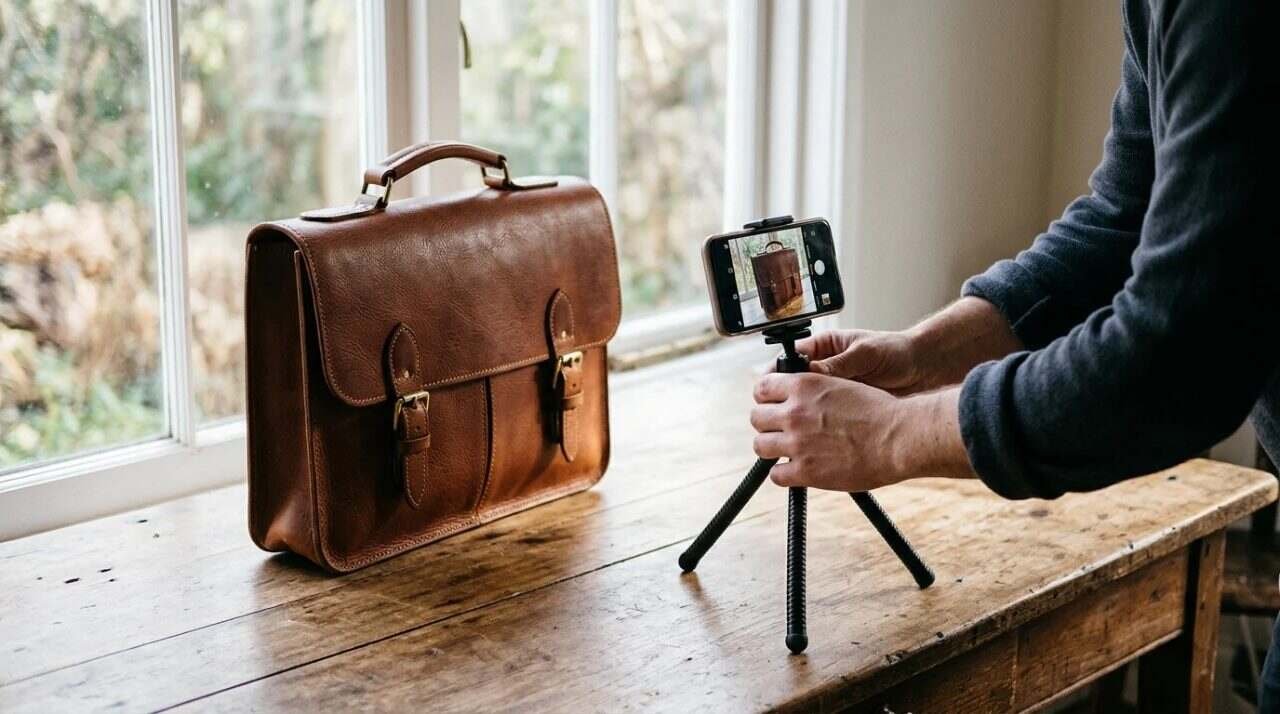
Social media made the remake problem worse, and it is a problem a maker in 2010 would not have predicted. A photo of a finished briefcase now travels. Someone I have never met sees it, writes to ask for the same one, and expects the same bag, the same stitching and the same details, because the photo shows them all.
If I made that bag to a custom spec and never wrote the spec down anywhere I can find, I am guessing at my own work. I can get close. The customer wanted exact.
What I would tell any maker is to treat every finished piece as something you may be asked to make again. Photograph it from every side. Record the leather, the hardware, the lining, the dimensions and the stitching. Keep that record with the order. It costs ten minutes at the end of a build and saves an afternoon of reconstruction later.
What a spec sheet holds
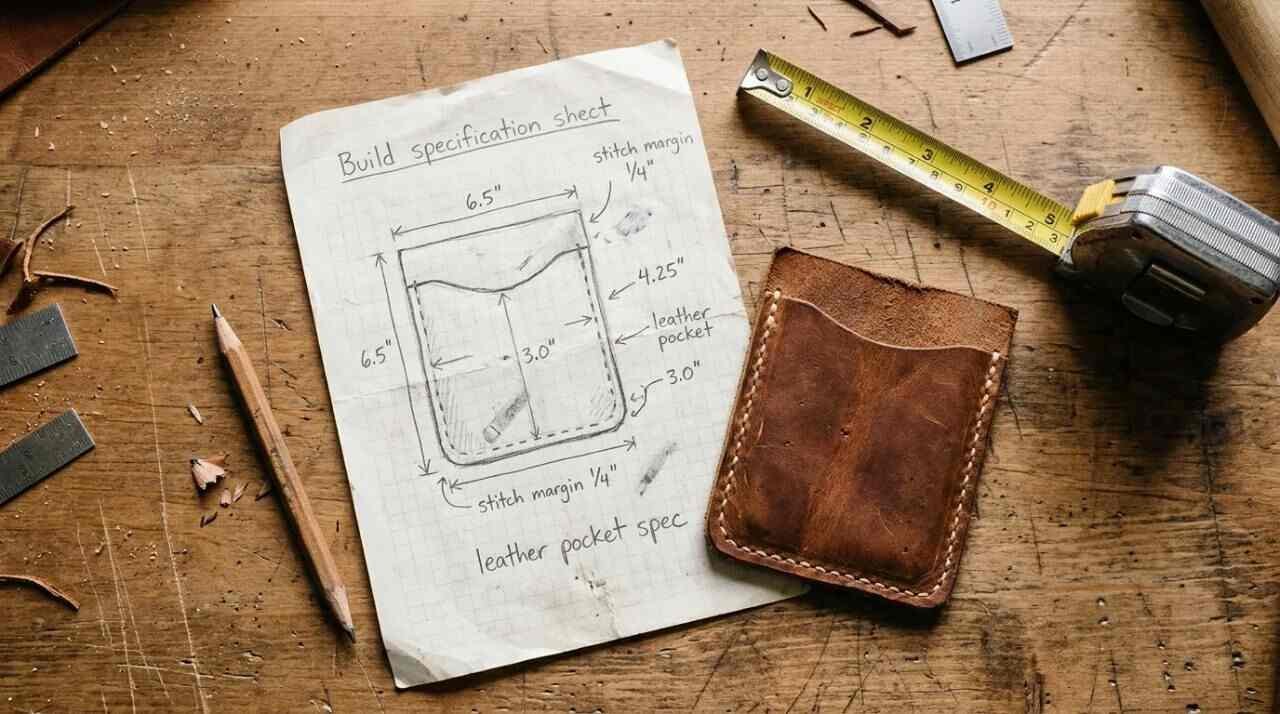
A written spec is the cheapest insurance a custom shop can buy, and it is short. For a briefcase it covers the base design, the leather and its color, the lining, the hardware, the pocket layout, the handle, the finished dimensions and any change from the standard pattern. It carries the order date and the customer’s name, plus photographs taken before it ships.
The same discipline shows up in how store software treats products. WooCommerce gives each variation its own SKU and lets you track stock at the variation level, so every version of a product has an identity you can look up. A workshop can do the same on paper. Give each repeatable design a name and a number, and give each one-off a record, and a request that arrives two years later starts from the file instead of from memory.
What the site offers now
The way the shop is organized today answers some of this. The site’s homepage lists three signature styles, The Wallace, The Habermas and The Woodhull, a ready-to-ship section, and Marcellino Originals, which collects past briefcase designs, handbags, mini cases, portfolios and small goods. Its invitation reads, “Choose a signature style, or commission one made to your needs.”
That structure sorts customers into two groups. Some want a defined design they can see, buy and receive. Others want to commission something, and for them the conversation starts from a base design rather than a blank page. A customer who begins with a signature style is choosing from a short list. The custom work starts from something that already exists, so it can be recorded and repeated.
Limiting the customization without losing it
For a small maker thinking about this, a few practical rules follow from the arithmetic.
- Pick a handful of base designs and name them. Each one can be photographed, priced, described and remade.
- Offer a short list of options on each base design, not a blank page. Six leathers are plenty.
- Keep a written spec for every piece you ship, filed where you can find it by customer and by date.
- Say no to the request that would turn one piece into an unrepeatable one-off, or price it as the one-off it is.
- Reserve true bespoke for the customer who wants it and will pay for the extra hours.
None of this makes a shop less custom. It makes the custom part something you can run.
Questions to ask before offering custom options
- How many versions of this product will the customer be able to order, and can my software and my workshop handle that many?
- Can I write down exactly how each one is made, well enough that I could make it again a year from now?
- What does the customer’s most unusual request cost me in time, and have I charged for it?
- If someone sees a finished piece online and asks for one like it, what do I tell them?
The last question decides how the shop feels to the customer who writes in. If the answer is “I can make you that exact one,” the earlier work was done right.
For informational purposes only. Product options and software limits are as described on the cited pages and can change.
Sources
- Marcellino NY, homepage and bespoke ordering: https://marcellinony.com
- WooCommerce, Variable product documentation: https://woocommerce.com/document/variable-product/
- Marcellino NY Briefcase Maker on YouTube, Classic English bridle leather briefcase with no lining: https://www.youtube.com/watch?v=4alnAtIzuLs