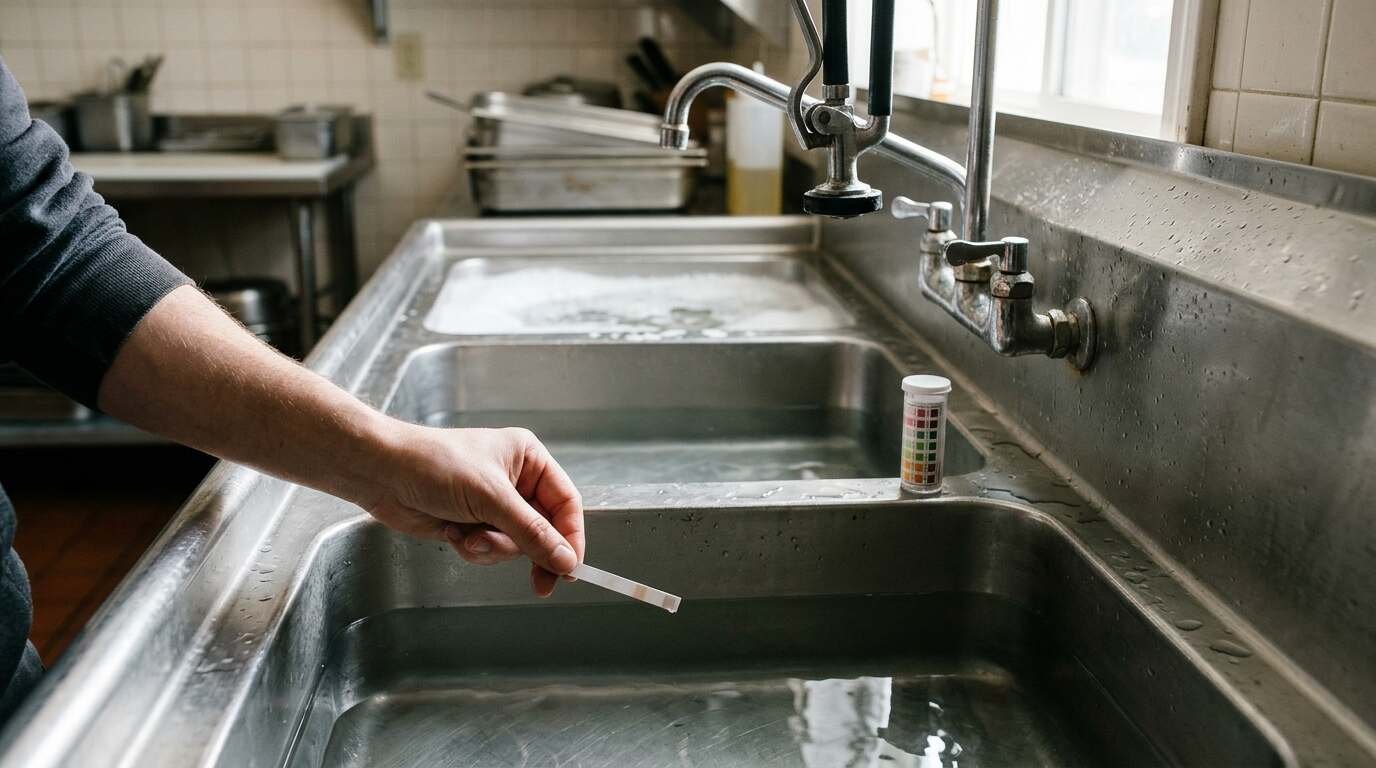
A sanitizer bucket that smells strongly of bleach can still be too weak to do its job, and one that smells like nothing can be exactly right. Smell does not measure concentration. A test strip does, and New York’s sanitary code for food service establishments requires that a test kit or similar device be provided and used.
What the New York code requires of a three-compartment sink
The state’s rules for manual dishwashing sit in Subpart 14-1 of the New York State Sanitary Code. Section 14-1.111 describes the standard setup: a first compartment for washing in hot water with detergent, a second for rinsing in clean hot water, and a third for sanitizing by an accepted procedure. Other methods are allowed when the permit-issuing official accepts them. The measure of success is stated plainly. Cleaned and sanitized utensils should show an average plate count of no more than 100 colonies per surface examined, with no coliform bacteria.
The order is not a suggestion. Sanitizer works on a surface that has already been cleaned, and the county health guidance reproduced below says so directly: cleaning products may be used before sanitizing, but sanitizing must follow cleaning. A sink that skips the wash step, or rinses in water that has turned cloudy with detergent and food, hands the sanitizer a job it cannot do.
Justia flags that its copy of the code may trail the current text, so the permit-issuing health department stays the final word for any given kitchen.
Approved sanitizers and their strengths
Section 14-1.112 defines sanitization as effective bactericidal treatment by heat or chemical means and lists the accepted methods:
- Hot water immersion for at least 30 seconds in clean water at 170°F or higher.
- Chlorine for at least 1 minute in a clean solution holding at least 50 ppm available chlorine, at 75°F or higher.
- Iodine for at least 1 minute at 12.5 ppm, with a pH no higher than 5.0, at 75°F or higher.
- Another chemical the permit-issuing official approves, with an effect equivalent to 50 ppm chlorine at 75°F or higher for 1 minute.
- Culinary-quality steam for equipment too large to immerse.
- Swabbing of fixed equipment with a solution at twice the immersion strength.
Quaternary ammonium sanitizers, the “quats” found in many dispensed products, are not named in that list. A Tompkins County, New York Health Department sanitizing sheet gives working numbers for NSF-approved agents. For immersion, the minimums are 50 ppm for chlorine bleach, 12.5 ppm for iodine and 200 ppm for quats. For spray, wiping cloths or cleaning in place, the minimums double: 100 ppm, 25 ppm and 400 ppm. Chlorine solutions should sit between 75°F and 115°F, and quats above 75°F. Immersion contact time is one minute, though some quat products need longer, so the label governs.
Mixing bleach and why chlorine drifts
The same Tompkins County sheet gives mixing examples per gallon of water. With 5.25 percent sodium hypochlorite bleach, half a teaspoon makes 50 ppm and one teaspoon makes 100 ppm. With 6.0 percent bleach, a quarter teaspoon makes 50 ppm and half a teaspoon makes 100 ppm. The sheet adds a caution that matters more than the arithmetic: chlorine bleach loses strength over time, while quats are more stable. A bucket mixed at the start of service may read low by the middle of it.
Two habits follow. First, the percentage printed on the jug decides the amount, and a jug that gets swapped for a different brand changes the math. Second, a strip belongs in the solution at the start of the shift and again after heavy use, not once in the morning. A sanitizer that looked correct at 10 a.m. says nothing about 3 p.m.
Testing: strips, kits and what to write down

A test kit measures the solution the sink actually holds. The Tompkins sheet calls for a test kit for chlorine and for quats, and notes that iodine’s amber color shows only that it is present, so a kit is still needed to find its concentration. The kit has to match the sanitizer in the bucket, which is worth rechecking whenever a kitchen changes products.
Paper strips that read both chemistries come in vials of 100 or more. The Bartovation quat and chlorine test paper kit covers quat up to 500 ppm and chlorine up to 200 ppm, and a kitchen that uses only quat can buy a quat-only pack such as the 200-strip quaternary test strips. See them on Amazon (affiliate links).
As an Amazon Associate I earn from qualifying purchases. A commission may be earned if you buy through this link, at no extra cost to you.
Northern Nevada Public Health publishes a three-compartment sink standard operating procedure that shows how the check becomes a routine. Its daily monitoring covers three items: visually confirming the water in each compartment is clean, checking the wash compartment’s temperature with a calibrated thermometer, and testing sanitizer concentration, with chlorine at 50 to 100 ppm and quat at 200 to 400 ppm or the manufacturer’s recommended level. The procedure sets the wash water at 110°F or the temperature the detergent manufacturer specifies. That is a Nevada document, not a New York rule, but the structure translates to any kitchen.
The same procedure lists corrective actions. Drain and refill compartments when the water gets dirty, add hot water when the wash is too cool, and add sanitizer or water until the reading is right. A manager verifies by watching the shift and confirming staff test results. A clipboard by the sink with columns for time, reading and initials turns this into evidence, and it connects naturally to what a health inspector looks at first.
Wiping cloths and the bucket on the line
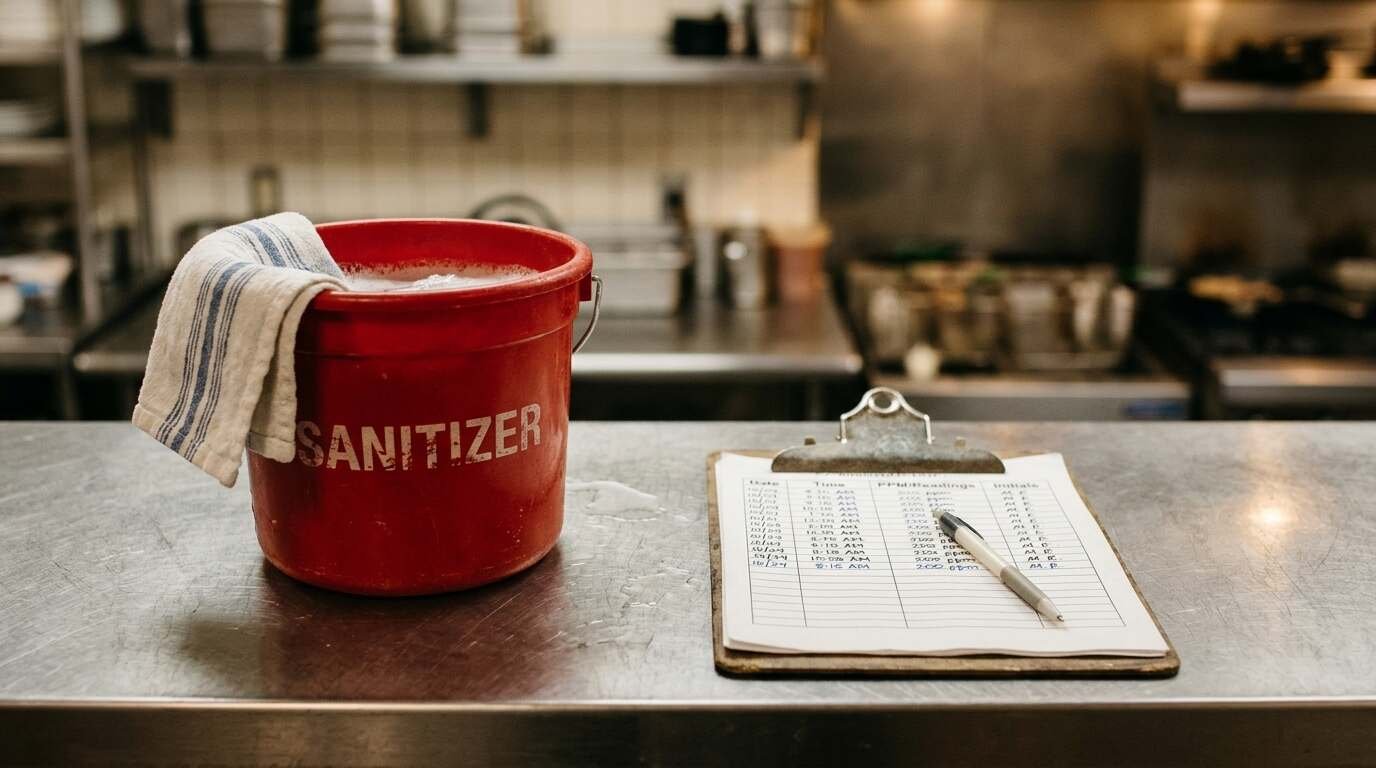
Cloths drag food into the line bucket all shift, which is why it has rules of its own. Section 14-1.117 covers wiping cloths, as summarized in the Tompkins sheet. Moist cloths for non-food-contact surfaces such as counters, dining tables and shelves are stored in sanitizing solution between uses and used only for that purpose. Moist cloths for food-contact surfaces and food spills on kitchenware or equipment are used only for that purpose, kept separate from other cloths, and also stored in sanitizing solution. Clean, dry cloths are for wiping spills from tableware that goes to a customer, and they are not for the kitchen.
Because spray and wiping-cloth use needs a higher concentration than immersion (100 ppm of chlorine or 400 ppm of quat in the Tompkins figures), the bucket and the sink are not the same target. A single strip reading that passes at the sink may be too weak for the line bucket. A separate test for each target keeps the readings honest.
Setting up the habit for a whole crew

Equipment and a posted procedure matter less than whether every dishwasher and line cook can run the test the same way. The steps below fit on a laminated card at the sink:
- Fill the first compartment with hot water and detergent at the temperature the detergent maker specifies.
- Fill the second with clean water for rinsing, and the third with sanitizer mixed to the product label.
- Dip a strip, compare it to the color chart in the time the strip package states, and write the reading down.
- Remix if the reading is low, and drain and refill when the water is dirty.
- Let items air dry rather than wiping them with a towel.
Sanitizer checks fit into the weekly cleaning checklist for a restaurant as a daily line item, and the training belongs with the other first-week lessons covered in cross-training restaurant staff. The test that counts comes on a busy Friday, when a new hire runs the sink alone and the bleach in the bucket has been losing strength since lunch.
General information only. Sanitizer concentrations and contact times depend on the product label and on the rules of the permit-issuing health department, which can confirm what applies to a specific kitchen.
Sources
- New York State Sanitary Code, Section 14-1.111, Manual facilities (via Justia)
- New York State Sanitary Code, Section 14-1.112, Definition of sanitization; general requirements (via Justia)
- Tompkins County Health Department, Chemical Sanitizing
- Northern Nevada Public Health, Three Compartment Sink SOP
- DuPage County Health Department on YouTube, 3-Compartment Sink