
The Heritage Diner at 275 Route 25A in Mount Sinai, New York, has run on Square for about 2 years. I own the diner along with my parents. Before that it ran NextPOS and later Aldelo, on Windows, for 20 years. The rest of this post comes from Square’s own pages, read at the time of writing, and the arithmetic is mine.
Disclosure: Peter Kalafatis has a financial interest in Square referrals; the referral link on this site earns a reward when a referred business takes its first payment.
Why the diner left a server
I ran Nanos Media, a restaurant POS installation and training company, and I was a reseller of NextPOS, which eventually became Aldelo. Through Nanos Media I installed POS and security systems for many restaurants in my area.
The diner’s system was one server holding all the data, with 7 touchscreen clients, printers, scanners and kitchen printers. It was quick and reliable for 20 years, even as the diner got very busy. Its flaw was the server. When the server went down, the diner could not process checks or run credit cards at the register. When it died for good, the database was lost, because in the early days it was not backed up. Aldelo also changed little over the years and eventually ended support, since it had become a legacy product.
I watched cloud POS develop and judged it could handle a very high volume restaurant, one with multimillion in sales a year and dozens and dozens of orders at once going to the kitchen display screens. After evaluating a few other companies, I switched to Square about 2 years ago.
What I value is that there is no server to go down. Square keeps taking card payments in offline mode, with limits. Its help page on offline payments says the point of sale apps require an internet connection at all times to function optimally, that the seller is responsible for expired, declined or disputed payments accepted offline, and that pending offline payments expire after 72 hours on Square Register, Terminal and Handheld, with Square Reader and Stand sessions ending after 24 hours. It also sets a per-transaction maximum the seller chooses, between $1 and $50,000. Offline mode softens an outage. It does not remove the dependence on a connection.
The account is also reachable from home or a phone, and Square is updated constantly. Other parts of the business integrate with it: Square Payroll, Loyalty, gift cards, time tracking, marketing and online ordering through the diner’s website. Delivery platforms (DoorDash, Uber Eats, Grubhub) send orders straight into the kitchen. The pricing page text read for this post does not tie delivery order intake to any one plan, so which plan carries it is a question for Square. The Square KDS app is priced by device on the page, as covered below.
What the three plans cost per location
Square’s restaurant pricing page lists three tiers, each priced per location per month. Free is $0. Plus is $49. Premium is $149. Plus and Premium both carry a 30-day trial on the page as fetched.
Card rates move with the tier. For a tapped, dipped or swiped card the page lists 2.6% + 15¢ on Free, 2.5% + 15¢ on Plus and 2.4% + 15¢ on Premium. Online sales are 3.3% + 30¢ on Free and 2.9% + 30¢ on Plus and Premium.
A fourth card sits beside them. Square Pro has no price, only a prompt to talk to the sales team if a business processes over $250,000 a year, and that is where custom pricing starts.
Every price in this post is as listed on the page fetched. Square changes them, and a restaurant should read the live page before deciding anything.
What each step up adds
Free covers the counter and the menu. The page headlines item and menu management, pickup and local delivery, and a branded online ordering page for the Free tier. For a single-location place with a short menu that is a workable register.
Plus adds reporting and a few staff tools. The headline items on the Plus card are integrated inventory tracking and close of day reports. The longer comparison table further down the page shows a dash in the Free column, meaning not included, for close of day procedures and reporting, menu reports, kitchen performance reporting, timecards with break and overtime, tip pooling and commissions tracking, labor cost reporting, shift scheduling, and the Loyalty program. Everything on that list sits in the paid tiers.
Support changes as well. The table shows phone support from 6 a.m. to 6 p.m. Pacific, Monday through Friday, for the first 90 days on Free, the same weekday hours on Plus, and 24/7 on Premium.
Premium adds coursing and seat management, 24/7 phone support and bigger marketing allowances. The page lists a text message allowance of 500 messages on Plus and 2,500 on Premium, with overage priced at 3¢ and 1.5¢ a message. Physical and eGift cards carry a 2.5% load fee on Free and Plus and a 0% load fee on Premium.
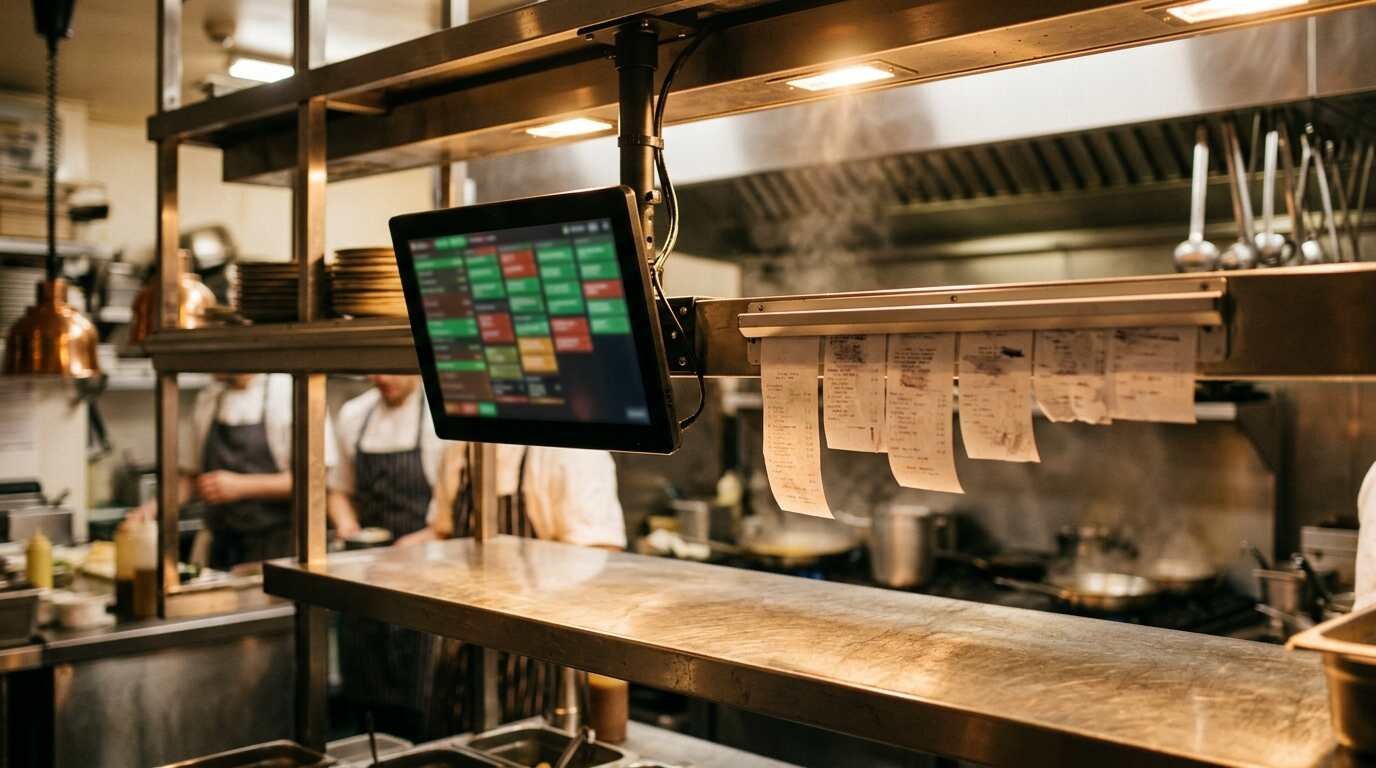
Kitchen and kiosk software is priced by tier too. The Square KDS app, the kitchen display, is $30 a month per device on Plus and $20 on Premium. Square Kiosk is $99 a month per device on both, and Kiosk Lite, the iOS version, is $50 on Plus and $30 on Premium.
What every plan includes
The same page lists four things under every plan: end-to-end encrypted payments, active fraud prevention, next day transfers, and offline payments. The offline line carries a footnote worth reading before a dinner rush, because it sets the terms. Offline payments are processed automatically when the device reconnects, and they are declined if the device does not reconnect to the internet within 24 hours of the first offline payment. By turning the setting on, the restaurant becomes responsible for any expired, declined or disputed payments accepted while offline, and Square says it cannot provide customer contact information for payments declined that way.
That is a rule about risk, and it is identical on Free and Premium. A paid tier does not buy a longer offline window. Anyone planning for an internet outage should treat that 24-hour limit as the working number, whatever the plan.
The restaurant overview page adds a second constant: its plans carry no locked-in contracts, and a plan can be upgraded or cancelled at any time, per the restaurant overview page. Picking the wrong tier is therefore a cheap mistake in the first month, a point in favor of starting on a lower plan and moving up after a full month of reports.

Where the lower rate pays for the plan
The subscription is a flat charge. The rate cut is a percentage. Somewhere between the two sits a break-even volume, and it is simple to find.
Free to Plus drops the in-person rate by 0.1 percentage point for $49 a month. Divide $49 by 0.001 and the answer is $49,000 of monthly in-person card volume per location, or $588,000 a year. Below that, Plus costs more than it saves on in-person rates alone.
Free to Premium drops the rate by 0.2 points for $149. That works out to $74,500 a month, or $894,000 a year. Plus to Premium is another 0.1 point for $100 more, which is $100,000 a month, or $1.2 million a year.
Online sales run on a different curve. Free to Plus drops the rate from 3.3% to 2.9%, a 0.4-point cut. At $49 that breaks even at $12,250 a month in online volume. Plus and Premium share the same online rate, so Premium never wins on online sales alone.
The per-transaction 15¢ on in-person cards is the same on all three tiers, so it plays no part in the comparison. Nor does the 30¢ online fee between Plus and Premium.
Those figures cover rates only. A restaurant that needs close of day reporting or timecards with overtime and breaks is not buying the tier for the rate, and the math above does not price that.
What the numbers say about a small restaurant
Take a counter-service place that books $15,000 a week in card sales at one location. That is about $65,000 a month, assuming 52 weeks spread over 12 months. On those figures Plus saves about $65 a month in rate against a $49 subscription, a gain of roughly $16 before counting anything the tier adds. Premium would save $130 on rate against $149, a loss of about $19 on rate alone.
Those are illustrative numbers, not anyone’s actual sales, and a mix of cash and card changes them, since only card volume carries the rate.
The shape of the result is the useful part. For a restaurant under about $50,000 a month in card volume per location, the rate savings alone do not carry Plus. The case for it rests on the tools. Between $50,000 and $100,000 a month, Plus pays for itself on rate and Premium does not. Above $100,000 a month in a single location, every step up pays for itself on rate alone, and the plan decision becomes a question of whether the extra tools are wanted.
Multiple locations change the fixed side of the sum. The page prices each plan per location, so a restaurant with three locations on Plus is paying $147 a month before any KDS devices.
Checking the plan against the sales report
A plan choice is an annual number, and the register’s own sales report is where that number comes from. Pull the card total for a typical month, split in-person from online, and run both through the formulas above.
That order of operations matters. Reading the rate table first and the sales report second leads a restaurant to buy a tier because the percentage looks small. Reading the report first shows how large the percentage actually is.
The customer tools deserve a separate line in the same exercise. The Loyalty program sits in the paid tiers, and a counter that already struggles to capture a phone number or an email address, a problem covered in collecting email addresses at the counter, will not fix it by buying the tier. The same goes for the leaks described in where small shops lose customers at checkout. Software that rewards repeat visits assumes the visits are being recorded in the first place.

The honest part
The pricing page is built to make the paid tiers look like the obvious step. The label on the Plus card is “best value.” On rate alone, at lower volumes, that label is not true. At $588,000 a year in card volume the Plus rate cut earns back its own $588 subscription, and not a dollar sooner.
The diner is a multimillion-dollar-a-year business, so the published rate table is a starting point for us, not the price we pay. The diner has special custom pricing and processing fees from Square because of its volume, and I will not state the numbers. What the published table gives a smaller restaurant is a ceiling. No volume tier on the page shows a rate below 2.4% + 15¢ in person.
That makes the break-even figures above the hard part of the decision. A restaurant that does $20,000 a month and buys Premium for the support line is paying $149 for 24/7 phone support, and should know that is the product.
For informational purposes only — consult a licensed attorney, tax professional or financial advisor.
Referral: The Heritage Diner runs its register, loyalty program and payroll on Square. A business that signs up through this Square referral link and takes its first payment earns a reward for both sides. Disclosure: Peter Kalafatis has a financial interest in Square referrals.
Sources
- https://squareup.com/us/en/point-of-sale/restaurants/pricing
- https://squareup.com/us/en/point-of-sale/restaurants
- https://squareup.com/help/us/en/article/7777-process-card-payments-with-offline-mode
- https://www.youtube.com/watch?v=sTohIQZC1QQ
All pages fetched at the time of writing.


