A New York business that throws a customer’s check copy into the recycling bin whole can face a civil penalty of up to $5,000. The rule is section 399-h of the state’s General Business Law, and it applies to any business holding records with a person’s name next to a Social Security number, a driver’s license number or a bank account number.
Most small businesses have that kind of paper without thinking of it as sensitive: a W-9 from a contractor, a job application, a returned check, a copy of a customer’s ID for a large order. The law says what to do with it when it is time to throw it out.
What New York requires
Under § 399-h, a business may not dispose of a record containing “personal identifying information” unless it does one of four things: shreds the record, destroys the personal identifying information in it, modifies the record to make that information unreadable, or takes actions consistent with “commonly accepted industry practices” that it reasonably believes will keep unauthorized people from getting the information.
The law defines personal identifying information as a person’s name or other identifier combined with any of these, when either piece is unencrypted:
- A Social Security number.
- A driver’s license or non-driver ID number.
- A mother’s maiden name, or a financial account number or code, including savings, checking, debit card and ATM numbers.
- An electronic serial number or personal identification number.
The Attorney General enforces it. A court may impose a civil penalty “of not more than five thousand dollars,” acts from the same incident count as a single violation, and a business that can show it used due diligence in trying to dispose of the records properly has a defense. Individuals are exempt unless they are conducting business for profit.
The federal rule for consumer reports
A second rule reaches businesses that pull credit or background checks. The FTC’s Disposal Rule applies to “Any business or individual who uses a consumer report for a business purpose,” and the FTC’s list includes employers, landlords and individuals who get reports on prospective contractors or tenants. A small landlord running a tenant screening is covered.
The required standard is disposal that is “reasonable and appropriate.” For paper, the FTC gives burning, pulverizing or shredding so the information “cannot be read or reconstructed.” For electronic files, destroying or erasing them to the same standard. A business that hires a shredding company is expected to check it first, by reviewing an independent audit, checking references, requiring trade association certification or reviewing its security policies.
Strip-cut, cross-cut and micro-cut
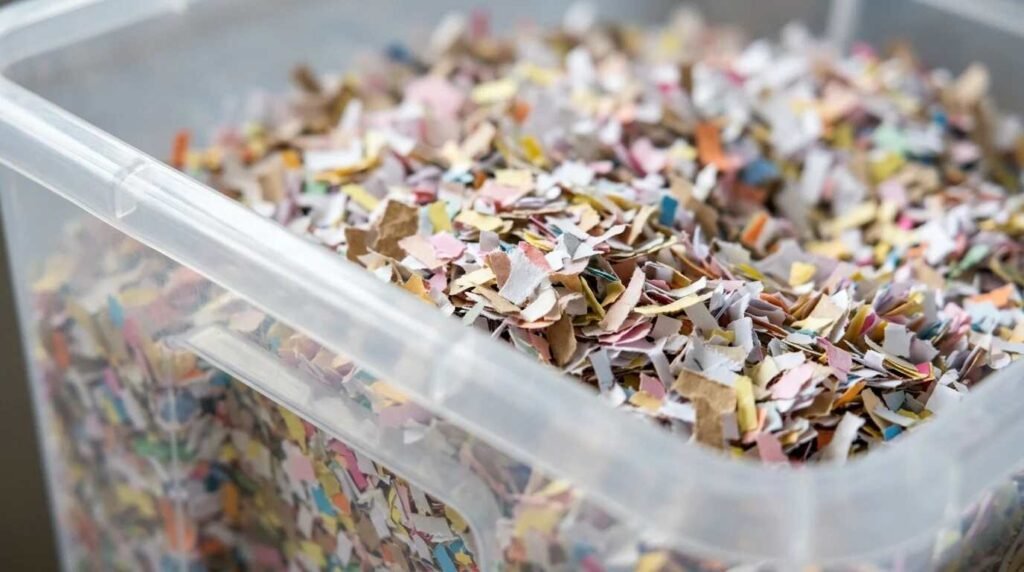
Shredders are rated under a standard called DIN 66399, now also published as ISO/IEC 21964. For paper, the levels run from P-1 to P-7, and the higher the number, the smaller the pieces. The shredder maker HSM’s summary of the levels describes P-3 as particles no larger than 320 square millimeters, suitable for personal data, and P-4 as particles no larger than 160 square millimeters.
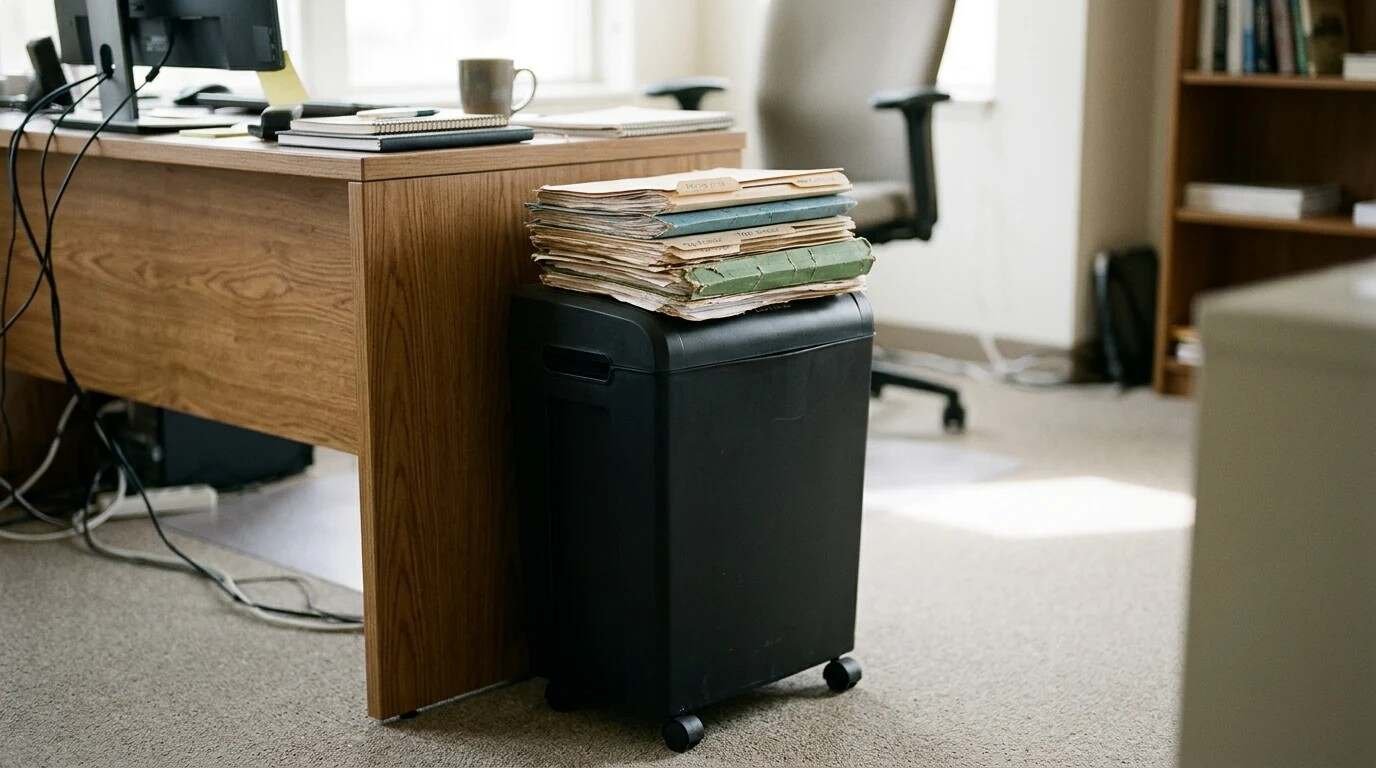
A strip-cut shredder, the cheapest kind, slices paper into long ribbons that a patient person can tape back together. Cross-cut and micro-cut machines cut in two directions. For anything covered by § 399-h, a micro-cut machine rated P-4 is the comfortable choice, since both laws speak of information that cannot be read or reconstructed.

Four shredders for a small office
The machines below are sold on Amazon under the titles shown. Sheet capacity matters more than motor size for most small offices; a machine that takes only six sheets at a time turns a box of old files into an afternoon.
- Bonsaii 6-Sheet Micro Cut Paper Shredder for Home, High Security Level P-4: A small six-sheet micro-cut machine that the listing rates at security level P-4, sized for occasional use. See it on Amazon (affiliate link)
- Amazon Basics 12 Sheet High Security Micro Cut Paper, Credit Card and CD Shredder with 6 Gallon Easy Emptying Bin, Casters, Black: A 12-sheet micro-cut machine that also takes credit cards and CDs, on casters with a six-gallon bin. See it on Amazon (affiliate link)
- Fellowes Powershred LX220 Micro-Cut Paper Shredder, White: A micro-cut model from Fellowes’ Powershred line for a home or small office. See it on Amazon (affiliate link)
- Fellowes AutoMax Micro-Cut 100M Commercial Office Auto Feed 2-in-1 Paper Shredder with 100-Sheet Capacity, Black: An auto-feed micro-cut machine that holds up to 100 sheets, for an office that shreds in batches. See it on Amazon (affiliate link)
As an Amazon Associate I earn from qualifying purchases. A commission may be earned if you buy through this link, at no extra cost to you.
Drives, phones and old computers
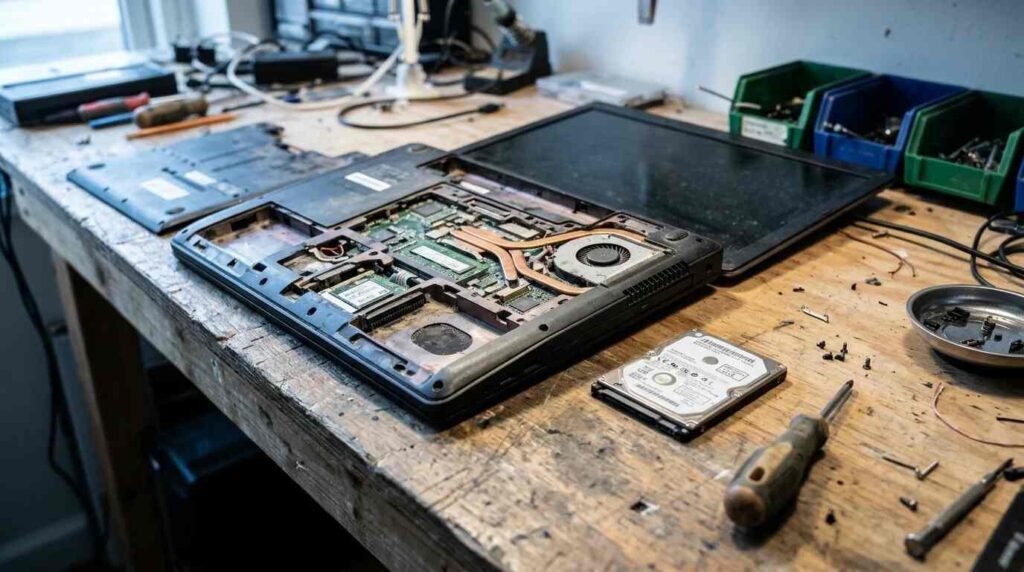
A paper shredder does nothing for a laptop. Both laws treat electronic records the same way as paper: the information has to be destroyed or made unreadable. That means wiping a drive with software built for the purpose, or physically destroying it, before a computer, phone or external drive is sold, donated or recycled. Simply deleting files is not enough.
A disposal routine that holds up
The due diligence defense in § 399-h rewards having a routine. A short written policy, a shredder near the desk where sensitive paper lands, and a yearly purge of records past their retention date cover it. The retention dates themselves are in what records a small business keeps and for how long and business records and the IRS; customer records kept in a spreadsheet, as described in a simple customer spreadsheet for a small shop, should get the same purge.
For informational purposes only — consult a licensed attorney or financial advisor.