
Clover sells point-of-sale software in tiers tied to the hardware chosen, and its restaurant plans come in two families: full-service dining and quick-service. The software is separate from the card processing in principle, though the contract terms attached to each differ in practice. Prices below were read from Clover’s restaurant pricing pages and from one independent review at the time of writing; Clover’s own pages carry the note that “prices shown are only available on Clover.com,” so they may change.
Plan tiers for quick-service and full-service restaurants
Clover’s quick-service pricing page lists three tiers, Starter, Standard and Advanced, each built around a device. Starter uses the Mini, an 8-inch touchscreen with a built-in receipt printer, and displays $135 a month for 36 months, or $849 plus $89.95 a month. Standard uses the Station Duo, a 14-inch merchant-facing screen with an 8-inch customer display, at $185 a month for 36 months, or $1,899 plus $89.95 a month. Advanced adds the Flex handheld alongside the Duo, at $245 a month for 36 months, or $2,648 plus $109.90 a month.
All three run the same software plan, labeled Restaurant Growth. What changes between tiers is mostly hardware and a few capabilities. Line busting appears only in Advanced. The customer database, promotions, loyalty program, private feedback and gift cards are marked “Not Included” on Starter and included on Standard and Advanced.
The full-service page follows the same Starter, Standard and Advanced pattern with a different device mix: the 14-inch Station Solo appears across the tiers, the Flex handheld is marked “Not Included” on Starter, and the Station Duo is marked “Not Included” on Starter and Standard. Dollar amounts did not appear in the text of that page as fetched; its buttons read “Contact sales” and “Add software plan to cart.” A cash drawer and receipt printer are listed as included in every full-service tier. Tableside ordering and firing is included from Standard upward.
One detail on that page affects restaurant layouts. Tapping cards and mobile wallets is listed as “Not Included” on Starter, “Flex only” on Standard, and “Flex and Station Duo only” on Advanced, so the tier determines which device can take a contactless payment.
What the monthly price does and does not show
Clover’s pages display two ways to pay: a monthly figure for 36 months, or an upfront hardware price plus a software subscription. The pages do not itemize what the 36-month figure contains. Treat the following as arithmetic on displayed numbers only. The Starter quick-service monthly option totals $4,860 over 36 months ($135 x 36), while the purchase route totals $4,087.20 over the same span ($849 plus $89.95 x 36). The difference of about $773 might reflect financing, bundled services or both, but the page does not say.
The Station Duo page shows Restaurant Growth at $185 a month for 36 months or $1,899 plus $89.95 a month, matching the quick-service Standard tier. The same page prices Retail Growth at $180 a month or $1,899 plus $84.95 a month, a reminder that the identical device carries different software fees by business type.
NerdWallet’s Clover review, last updated May 20, 2026 according to the page, lists monthly software fees of $89.95 for Full-Service Dining Starter and for Quick-Service Dining Starter and Standard, $109.90 for Full-Service Dining Standard and Quick-Service Dining Advanced, and $129.85 for Full-Service Dining Advanced. The quick-service numbers match Clover’s own page.
Processing rates
For quick-service restaurants, Clover’s pricing page shows card-present payments (tapped, swiped or inserted) at 2.3% + 10¢ on all three tiers and keyed-in payments at 3.5% + 10¢. NerdWallet reports the same 2.3% + $0.10 in-person rate for full-service and quick-service restaurant plans and 3.5% + $0.10 for online or keyed-in, and notes that the rates assume Fiserv, Clover’s parent company, as the processor.
A quick comparison shows the scale. On $20,000 of in-person card sales, the percentage portion at 2.3% is $460, and with a 10¢ fee on, say, 800 transactions, another $80, for roughly $540 before any monthly software fee. The transaction count is an assumption made for the sum, not a figure from any source, and average ticket size moves it.
The same card-fee logic applies to any processor, as the post on taking card payments with Square lays out with that vendor’s rates.
Hardware prices and the third-party list
The device list prices come from NerdWallet rather than Clover’s pages. It lists the Clover Go card reader at $199, a countertop card reader at $349, the Flex with receipt printer at $749, Flex Pocket (no printer) at $699, the Mini at $849, Station Solo at $1,799, Station Duo at $1,899, a kitchen display system at $799 to $899 plus $25 a month, and a self-ordering kiosk at $3,499 plus $34.95 a month. The $849 Mini and $1,899 Duo figures agree with Clover’s own purchase prices above.
Kitchen printers are listed as available accessories on every restaurant tier, with prices behind a “See details” link not captured here. The Mini includes its printer, while the Starter quick-service tier treats a cash drawer and a swivel stand as optional add-ons.
Reading the tiers against a small restaurant’s layout
Clover’s pages make the choice of tier a choice of layout as much as price. A counter-service shop with one register fits the Starter tier’s Mini, which has the receipt printer built in. A shop that wants loyalty points or gift cards, listed as “Not Included” on Starter, needs Standard or above. Servers who take orders at the table need the Flex, which the full-service page marks as unavailable on Starter. Line busting, which moves the order-taker away from the counter during a rush, belongs to Advanced alone.
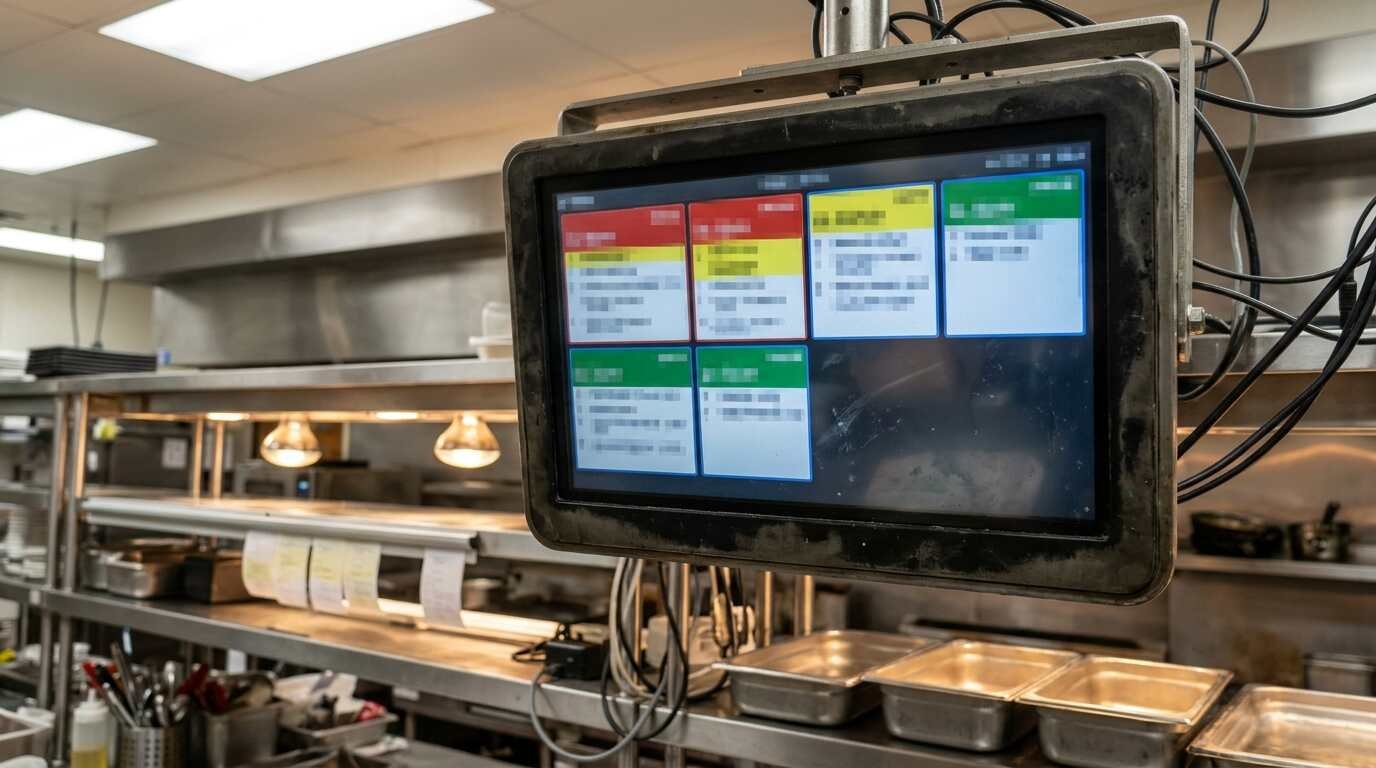
Kitchen display adds a recurring cost. At NerdWallet’s listed $799 to $899 plus $25 a month, a single screen runs $300 a year in subscription alone, on top of the hardware. Operators who already print tickets can keep a kitchen printer instead, though that accessory carries its own price behind Clover’s “See details” link.
Deposits are a final lever. Clover’s pages describe Rapid Deposit as funds within minutes of a card sale at a 1.75% fee, an optional trade of cost for speed that matters most to a business with tight weekly cash.
Add-ons and cash-flow products
Clover’s pages name a few paid extras. Payroll integrations are an “optional add-on” on every restaurant tier, and building a new online store is also an optional add-on on the Station Duo page. Two cash-flow products appear on each page. Rapid Deposit, which delivers funds within minutes of a card sale, carries a 1.75% fee. A fee of that size on a $1,000 card sale is $17.50 for access to money that would otherwise arrive on the normal schedule. Clover Capital is described as an advance based on future sales, “paid through sales made by card,” and the page lists no rate.
Online ordering is listed as no-fee ordering through Clover’s online menu page, with pick-up and delivery order types. Whether third-party delivery marketplaces charge their own commissions is outside what Clover’s pages cover.
Daily results from any of these tools feed the figures covered in reading a restaurant sales report, and labor tracking through shift management connects to the percentages in restaurant labor cost and scheduling.

Contract terms and support
Clover’s pricing pages do not state contract length. NerdWallet reports that POS software plans are month-to-month, that payment processing may require a long-term contract, and that hardware promotions require a three-year contract. A merchant that uses Clover as its processor “may owe an early termination fee” if it cancels within three years, per the review’s wording, and the fee amount depends on the processing agreement signed with the reseller or Fiserv. Terms differ between sales channels, so the processing agreement itself is the document that settles the question.
Support, per NerdWallet, is 24/7 by phone, with chat from 8 a.m. to 6 p.m. Eastern. The reviewer’s verdict calls Clover a “solid option for brick-and-mortar businesses that need an individual merchant account,” adds that Clover’s POS can be paired with a cheaper third-party processor, and says alternatives such as Square offer less expensive POS plans. The drawbacks listed are the three-year hardware contracts, possible early termination fees, high plan and hardware costs, limited free-plan features compared with Square, and basic reporting.
Because the three-year clock runs from hardware and processing agreements rather than from the software plan, a month-to-month software subscription can sit on top of a multi-year commitment. A merchant that pairs Clover hardware with a third-party processor, an arrangement NerdWallet says is possible, changes which agreement carries the early termination fee.
Questions worth answering in writing before committing:
- Which processor and which merchant agreement apply, and what is the early termination fee and the length of the term?
- Does the monthly 36-month figure include software, or hardware only?
- Which tier lets every needed device accept contactless payments?
- What do the kitchen printer, cash drawer and any payroll add-on cost each month?
For informational purposes only — consult a licensed attorney, tax professional or financial advisor.
Sources
- https://www.clover.com/pricing/quick-service-restaurant
- https://www.clover.com/pricing/restaurant
- https://www.clover.com/pricing/station-duo
- https://www.nerdwallet.com/reviews/small-business/clover-pos-review
All pages fetched at the time of writing.
