


Labor cost percentage is a division problem. You take what you paid people, divide it by what you sold, and multiply by one hundred. I work at the family restaurant where my father and I built the Heritage Diner in Mount Sinai, and I am not going to put the diner’s labor numbers in this post or describe how its schedule gets built, because I have not shared those and this site is not the place to start. What I can do is lay out the arithmetic, the published benchmarks, and the wage-hour rules that change what a shift costs, all from sources I have linked.
The arithmetic
Toast’s guide to restaurant labor cost percentage, published July 9, 2026, gives the formula as total labor cost divided by total revenue, times one hundred. Its example is $300,000 in labor against $1,000,000 in sales, which comes to thirty percent. A second version divides labor by total operating costs, which answers a different question and gives a bigger number.
The 7shifts guide to prime cost adds the habit that matters more than the formula: “Check your labor cost percentage against sales every day.” A monthly figure tells you what happened. A daily one still lets you do something about it.
That is the whole calculation. The trouble is in the two numbers you feed it, and in the word “labor.”
What counts as labor
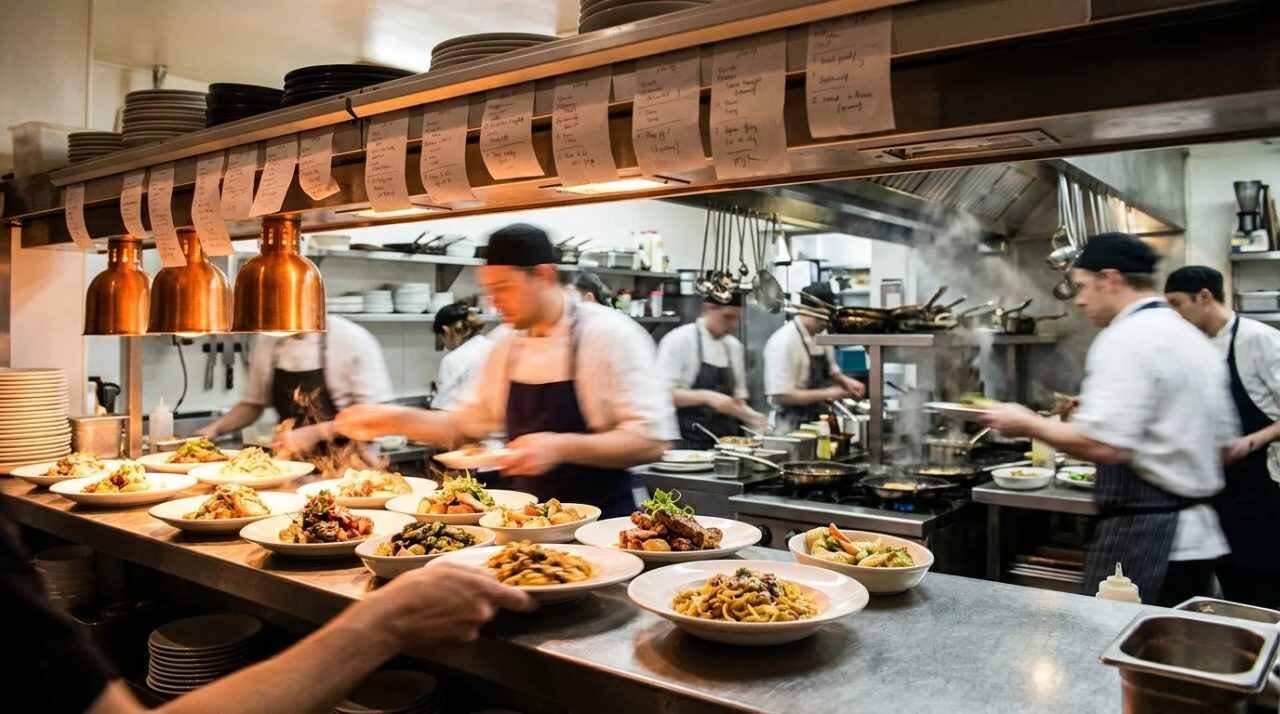
Toast describes labor cost as pay for salaried and hourly staff, plus taxes and benefits, and the list it gives is longer than most people carry in their heads: overtime and premium pay, bonuses, paid time off, uniform and equipment costs. If you leave the payroll taxes out, your percentage looks better than it is, and it will not match anyone else’s.
Owner pay is where the number gets slippery. I did not find either source settling how to treat a working owner’s wages, so I will not pretend they do. Whatever you decide, decide it once and keep it the same, because a percentage you recalculate by a different rule each quarter says nothing about whether you are improving.
Prime cost is the larger frame. According to 7shifts, it is labor plus cost of goods sold as a share of sales, and its general range is 55 to 65 percent, with little left over for rent, utilities and profit above 65. It also mentions a “30 30 30” rule of thumb, roughly thirty percent each for labor, cost of goods and overhead, and calls it a loose guideline, which is how I would treat it too.
Benchmarks, and the trouble with them

Both guides give ranges by type of restaurant, and they do not agree exactly. 7shifts puts quick service at about 20 to 25 percent of sales and full service at often 28 to 35 percent. Toast calls about 30 percent of gross revenue the typical benchmark and gives fine dining as 35 to 45 percent, casual dining 30 to 35, fast casual 25 to 30 and quick service 20 to 25.
The two sets overlap on quick service and drift apart elsewhere, and neither says how many restaurants went into its numbers. That matters less than it sounds. A benchmark is a place to start the question, not an answer, and a place doing breakfast and lunch with a full counter has a different shape than a dinner room with a bar.
There is also an honest argument against watching the percentage at all. It rises when sales fall even if you paid exactly the same people exactly the same hours, so a slow Tuesday looks like a labor problem when it was a sales problem. The dollar figure and the hours tell you what you did. The percentage tells you what the day did to you. You need both in front of you.
Scheduling against sales

The scheduling advice in both guides comes down to the same idea, which is to use what already happened. 7shifts recommends building schedules “around expected demand, not gut feeling,” using historical point-of-sale data broken out by day, daypart or hour. Toast says the same thing a little more gently: “Advanced scheduling can help restaurateurs forecast and plan for known busy times or downtimes.”
For that to work, the point-of-sale system has to hold sales by the hour and let you read them back. The family restaurant where I work runs on Square’s point of sale, and I covered how a card-payment setup works in the post on taking card payments with Square. I am not claiming any particular report or scheduling tool from that system here, since I have not described one to you and the sources above are talking about restaurants in general.
Toast adds three smaller levers, and they are the ordinary ones. Cross-train people so a host can cover a server who calls out, without adding a body to the payroll. Enforce clock-in and clock-out rules so nobody is paid for time that was not worked. Reduce overstaffing without cutting the coverage the floor needs. The last one is the hardest sentence in the list, because the floor does not tell you in advance which half-hour it will fill up.
Scheduling to forecast has a limit that neither guide spells out. A forecast built from last month’s Thursdays cannot see the Thursday the road is closed, and you need someone with authority to cut or add a person at four in the afternoon. Whether that is practical depends on how your people feel about being sent home, and the next section is where the rules on that begin.
Pay rules that change what a shift costs
New York’s Department of Labor publishes a hospitality wage order FAQ that reads like a list of reasons a schedule costs more than the hours on it.
Call-in pay. An employee who reports for a shift and is sent home early is owed a minimum payment: three hours for one shift, six hours for two shifts totaling six hours or less, eight hours for three shifts totaling eight hours or less. The time actually worked is paid at the regular or overtime rate less any tip credit, and the rest of the call-in period is paid at minimum wage with no tip credit. The FAQ adds that “Call-in pay cannot be offset by credits for meals or lodging provided to the employee.” A manager who cuts a server at the first slow hour has not saved the full hour, and in some cases has saved nothing.
Spread of hours. When the time from the start to the end of the workday is more than ten hours, the employee gets one additional hour at the minimum wage for that day. Split shifts are where this shows up.
Uniform maintenance. An employer that does not maintain required uniforms owes uniform-maintenance pay based on actual hours worked, with exceptions such as wash-and-wear uniforms.
Overtime and pay structure. Non-exempt employees get time and a half over forty hours in a workweek. The FAQ also says non-exempt employees must be paid an hourly rate, and that salaries, day rates and piece rates are not permitted, with an exception for commissioned salespeople.
The FAQ does not print current dollar rates. It sends the reader to the Department of Labor’s rates-and-credits summary, so I am leaving the figures out. They change, and a number copied into a post goes stale faster than the post does.
Tipped employees under federal rules
The federal side is in the Department of Labor’s Fact Sheet 15 on tipped employees. It says employers must pay tipped workers at least $2.13 an hour in direct wages, and that the maximum tip credit is $5.12 an hour, the difference between that and the $7.25 federal minimum. If tips plus direct wages do not reach $7.25 in a workweek, the employer makes up the difference.
Before taking the credit, the employer has to tell the worker the direct wage, the amount of the credit, that the credit cannot exceed the tips actually received, that tips belong to the employee except in a valid pool, and that the credit applies only if the worker was told all of this. The notice can be oral or written. Pools that include non-tipped workers such as cooks are allowed only if everyone gets at least $7.25 in cash wages, and managers and supervisors cannot take from the pool.
The fact sheet also covers a worker holding two jobs, a tipped one and a non-tipped one, where the tip credit cannot be applied to the non-tipped hours. Related duties in the tipped job “need not by themselves be directed toward producing tips,” in its words. Employers taking a credit have to keep records of reported tips and of hours and earnings in both kinds of work.
The federal figures are floors. New York has its own order, and the fact sheet does not say which one governs a given New York shift. I read it as the stricter rule winning, but that is a reading, and it belongs in front of an accountant or an attorney, not in a blog post.
What I cannot tell you
I do not have a clean method of my own to hand over. I can say how the percentage is calculated and what the published ranges are. I can list the pay rules that make a cut shift cost more than the clock suggests. What I cannot do is tell you what your number should be, or what mine is, because I have not shared it and none of the sources above know your menu, your rent or your room.
For informational purposes only; wage-hour and tip rules are specific to your situation, so consult a licensed attorney or accountant before changing how you schedule or pay.
Sources
- Toast, Restaurant Labor Cost Percentage (published July 9, 2026): https://pos.toasttab.com/th-us/blog/on-the-line/restaurant-labor-cost-percentage
- 7shifts, Restaurant Prime Cost Guide: https://7shifts.com/blog/restaurant-prime-cost-guide/
- New York State Department of Labor, Hospitality Wage Order FAQ: https://dol.ny.gov/hospitality-wage-order-faq
- U.S. Department of Labor, Fact Sheet 15, Tipped Employees Under the FLSA: https://www.dol.gov/agencies/whd/fact-sheets/15-tipped-employees-flsa
- Video: https://www.youtube.com/watch?v=l_FmCAkGvt0


