In Suffolk County a backflow test that is not done within the 60 days the water authority allows can end with the water turned off. The Suffolk County Water Authority says so plainly in its cross-connection control booklet: miss the window and the account “will be slated for shut off.”
The person who has to do that test needs a specific New York credential, and on Long Island, a few local ones on top of it.
What the state requires
New York’s cross-connection rule, 10 NYCRR section 5-1.31, requires protective devices on service connections according to the hazard, and requires them to be tested and inspected at installation, after every repair and annually after that, per the regulation. Only a certified backflow prevention device tester may do those tests. Test records go to the water supplier, which reviews and keeps them.

How a tester gets certified
Since 2011 the Department of Health has not issued tester certificates itself; approved training providers issue them after the course, per the Department’s cross-connection program page.
| Item | Rule |
|---|---|
| Initial certification | Complete a state-approved initial course from an approved training provider |
| Validity | Three years, unless suspended or revoked |
| Renewal | State-approved renewal course before expiration; the three-year cycle stays fixed |
| Expired under one year | Take a renewal course; no testing until recertified |
| Expired over one year | Repeat the 32-hour initial course |
| Changes | Notify the Department and the approving entity within 30 days of an address or employment change |
The renewal, lapse and course-length details come from the Department’s FAQ; the 30-day notice rule and grounds for suspension, such as false records, from the regulation. The Department can also require written, oral or practical exams.

Suffolk adds a plumbing license
On Suffolk County Water Authority’s test form, the instructions say Suffolk County law 37-2011 requires a certified tester to be a licensed master plumber or employed by a licensed master plumber who is also a certified tester, and both must be registered with Suffolk County Consumer Affairs, per the SCWA form. Completed reports go to the health department representative and to SCWA within 30 days of the test.
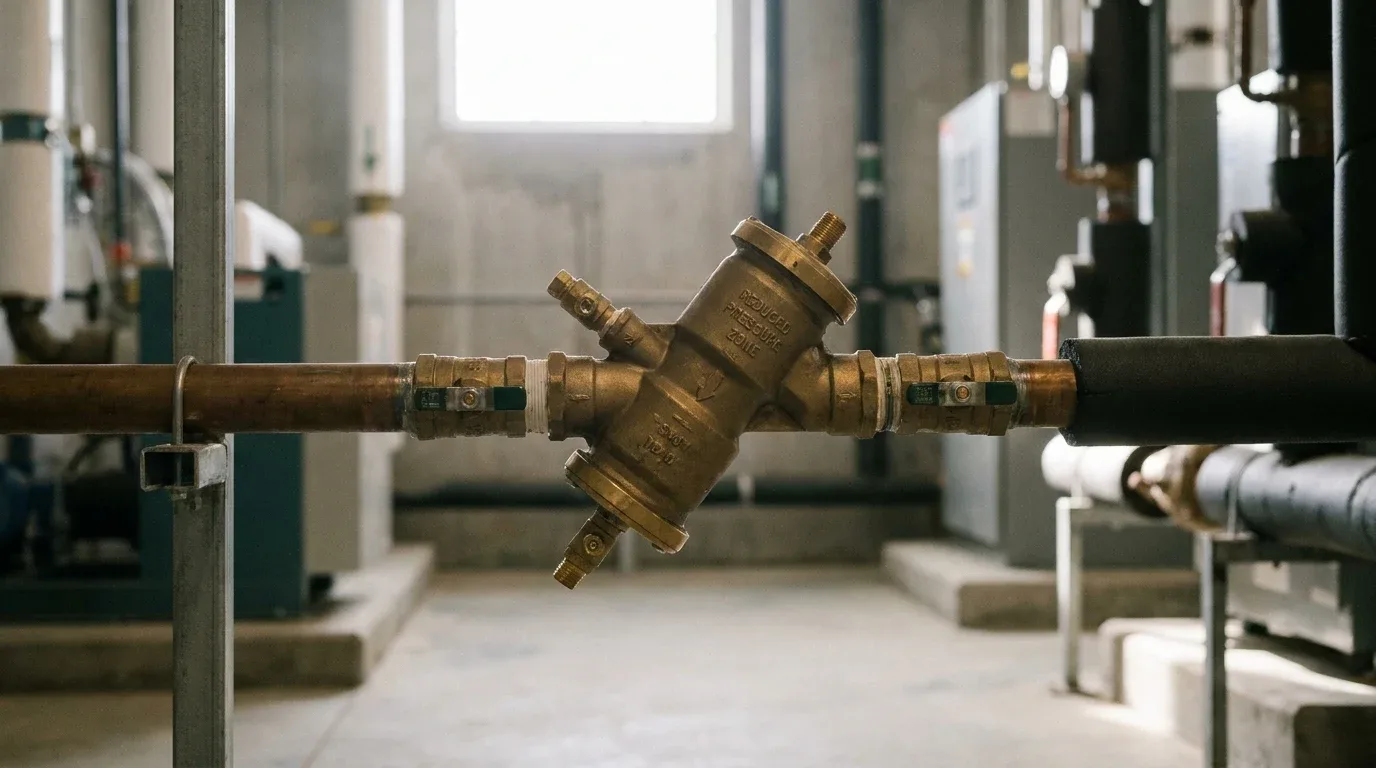
SCWA’s booklet says all new commercial buildings need a reduced pressure zone (RPZ) device, existing commercial accounts need an RPZ or double check valve depending on the hazard, plan review costs $170 and a failed installation inspection costs $25.
New York City works the same way
NYC’s Department of Environmental Protection requires a New York State certified tester to test a newly installed device and then every 12 months, and warns that skipping the annual test can mean fines or disconnection, per its cross-connection page. Plumbing licensing on Long Island and in the city is covered in the post on plumber licenses on Long Island.
- For testers: approved initial course, three-year certificate, renew before it lapses.
- In Suffolk: master plumber license or work for one, plus Consumer Affairs registration.
- For property owners: annual test, report to the water supplier, keep a copy.
- Missed test? SCWA allows 60 days before shutoff.
General information only. Confirm requirements with the New York State Department of Health, the local water supplier and county consumer affairs.
Sources
- 10 NYCRR 5-1.31, Cross-connection control (NYS Department of Health regulations)
- NYS Department of Health, FAQ About Backflow Prevention Assembly Testing and Certification
- NYS Department of Health, Cross-Connection Control Program
- Suffolk County Water Authority, Report on Test and Maintenance of Backflow Prevention Device (Form 215B)
- Suffolk County Water Authority, Cross Connection Control booklet (2025)
- NYC Department of Environmental Protection, Cross Connection Controls