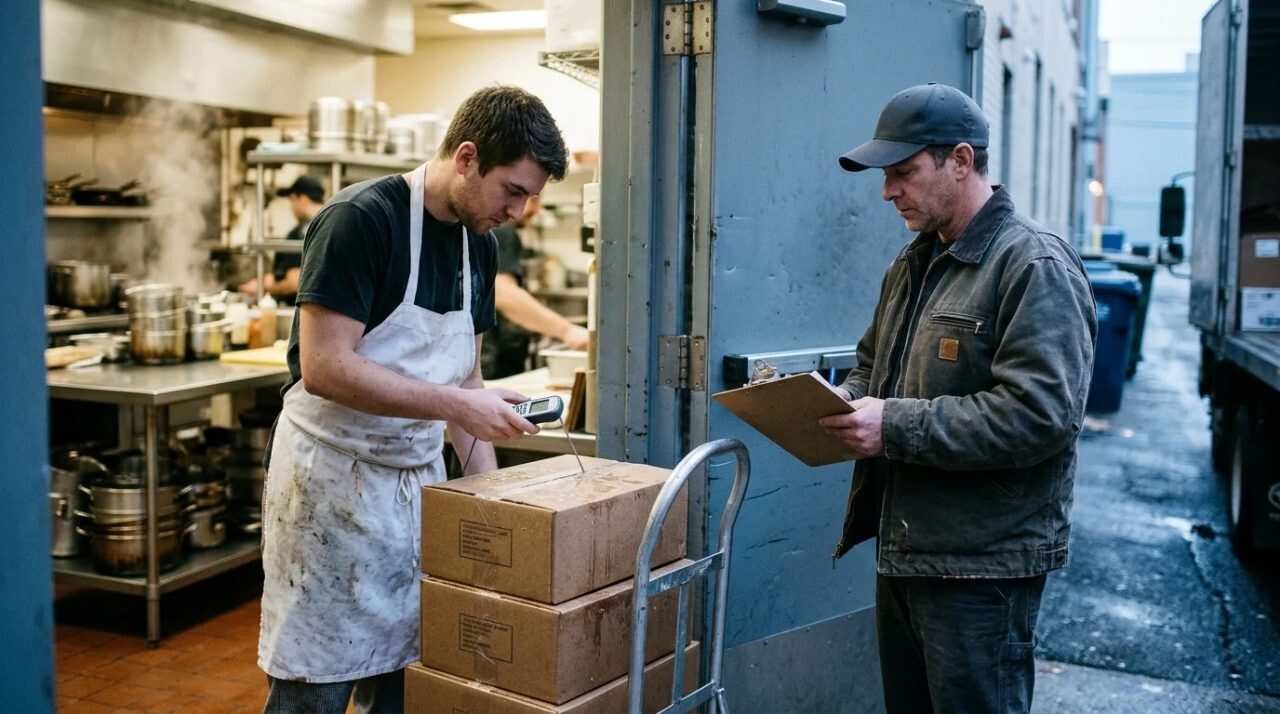
A signature tells the vendor the order arrived. Anything wrong with the order is easier to raise while the truck is still at the back door, with the driver standing there and the product on the dolly, than it is after the cases have been shelved and the dock has cleared.
Nothing below is a report of something tested firsthand. Every figure and every rule comes from the pages linked inline, and where a page does not say something, this post says so instead of filling the gap.
Before the truck arrives
The first check happens before anyone backs in. The Institute of Child Nutrition, based at the University of Mississippi and funded in part by USDA’s Food and Nutrition Service, says deliveries should be inspected and accepted or rejected only during operational hours. That sounds obvious until a vendor shows up at the hour when the whole kitchen is on the line and the only person near the door is the dishwasher.
The same fact sheet suggests posting a delivery schedule with vendor names, delivery days and times, and driver names, and telling the vendor when any of those change. A posted schedule does two jobs. It tells the cook on the line who is supposed to be at the door, and it makes a stranger with a hand truck and no name on the list stand out.
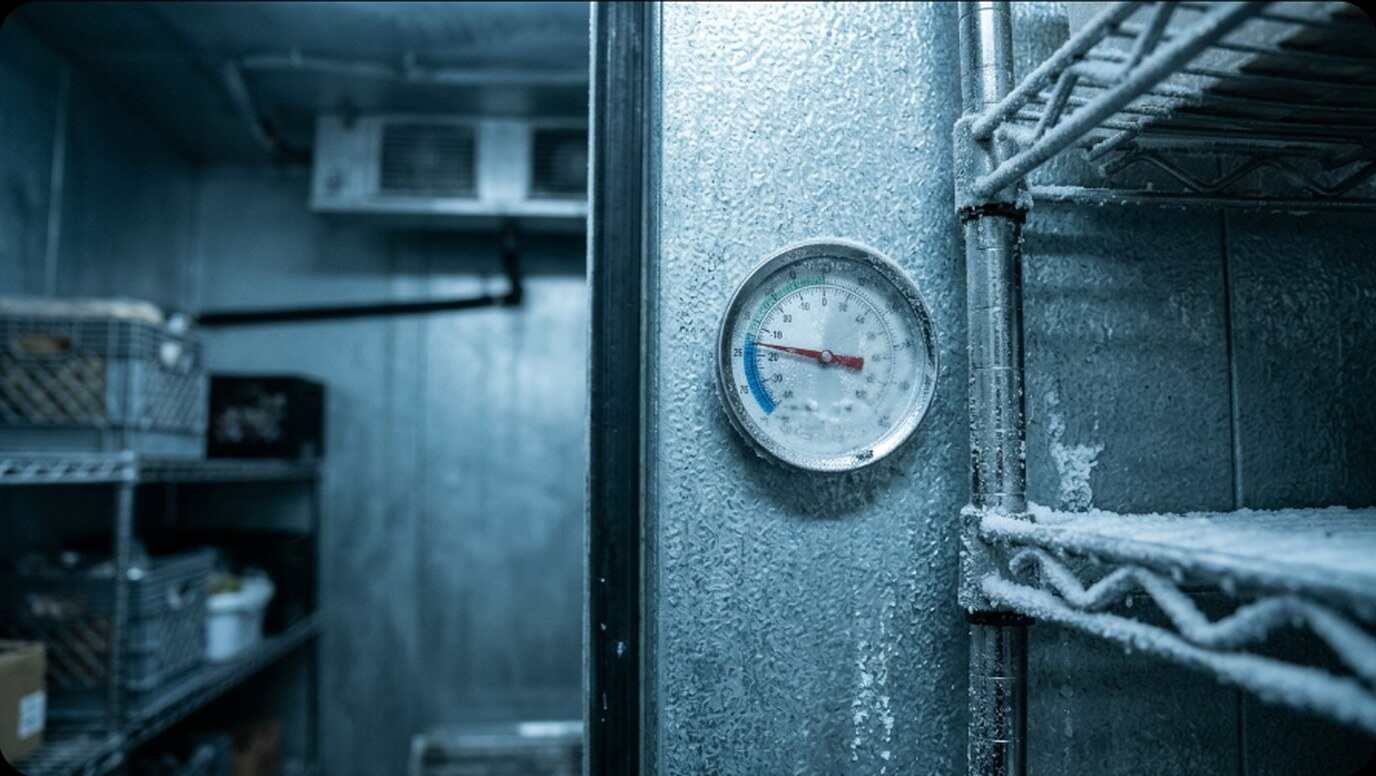
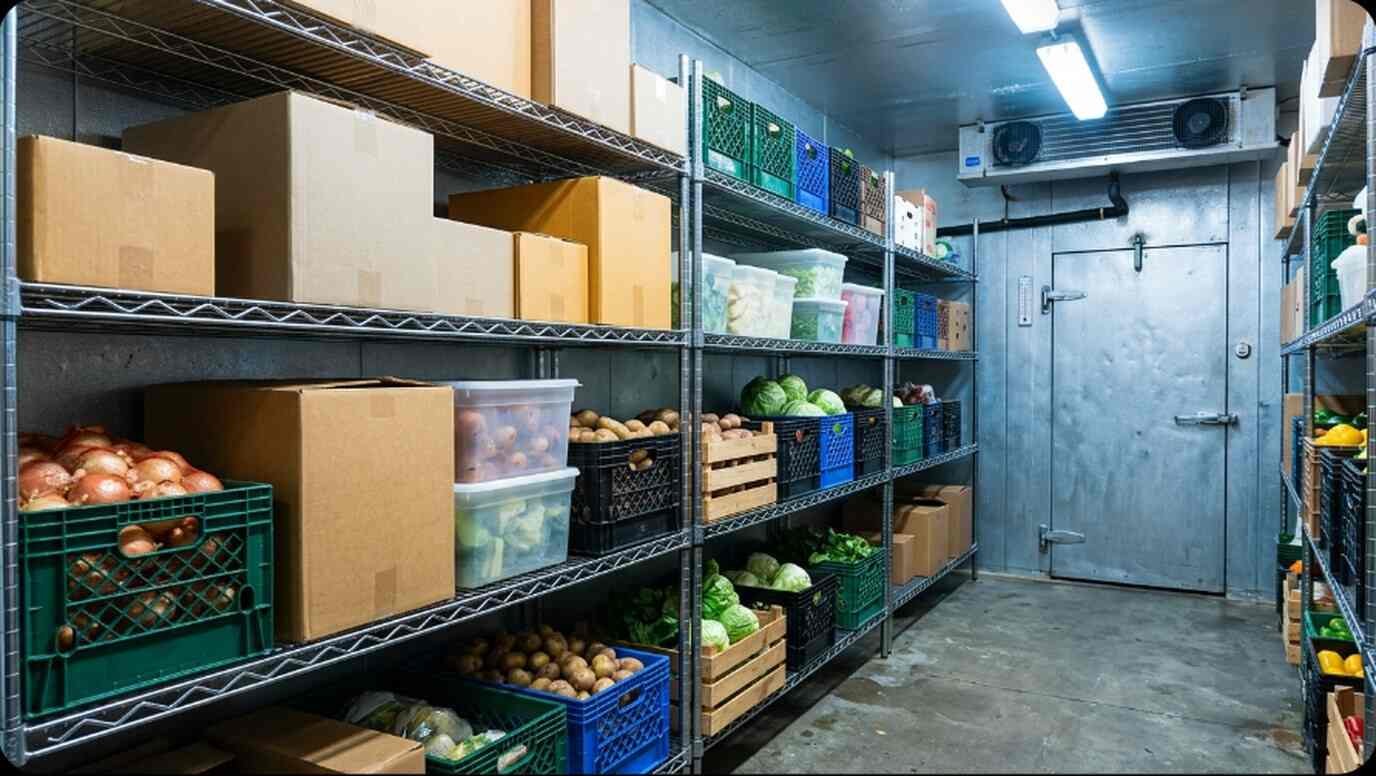
Then there is the room itself. The order sits on the invoice, the invoice sits on a clipboard, and the clipboard needs a thermometer next to it. Cold space has to be waiting too: the walk-in with a clear shelf, the freezer with a gap. A delivery that arrives into a packed cooler gets checked in a hurry, and a check done in a hurry is the one that misses the carton with ice crystals on it.
The order guide is the other half of this. If the guide says what was ordered, the invoice says what the vendor believes it sent, and the boxes say what actually showed up, then three documents get compared instead of one. The weekly order guide post covers the first of those.
The truck and the cartons

Start with the vehicle, not the food. The ICN fact sheet lists the cleanliness and organization of the delivery truck and the cleanliness of the shipping containers as things to look at, with cross-contamination as the stated reason, since a dirty or jumbled truck puts one kind of product against another. It also says to check refrigerated trucks and trucks carrying refrigerated products.
Then the packaging. The ICN sheet and the Gordon Food Service guide on when to reject items agree on most of the list:
- Packages that are punctured or torn, or have holes
- Cans with dents, rust, flawed seals or seams, or swollen or bulging ends
- Broken seals and missing labels
- Dirty packaging, or anything that looks tampered with
- Frozen cartons with large ice crystals, or liquid pooled on the bottom
Gordon Food Service adds a group that is about the food itself: mold, a texture that does not fit the product (a moist item that arrives dry, for example), pest damage, and an abnormal smell or color. That guide is a food distributor’s published advice, not a regulation.
Frozen food gets its own test. The ICN sheet says it must be frozen solid with no signs of thawing or refreezing. A case that is hard on top and soft in the middle is not the same thing as a case that is frozen solid.
Temperatures at the door
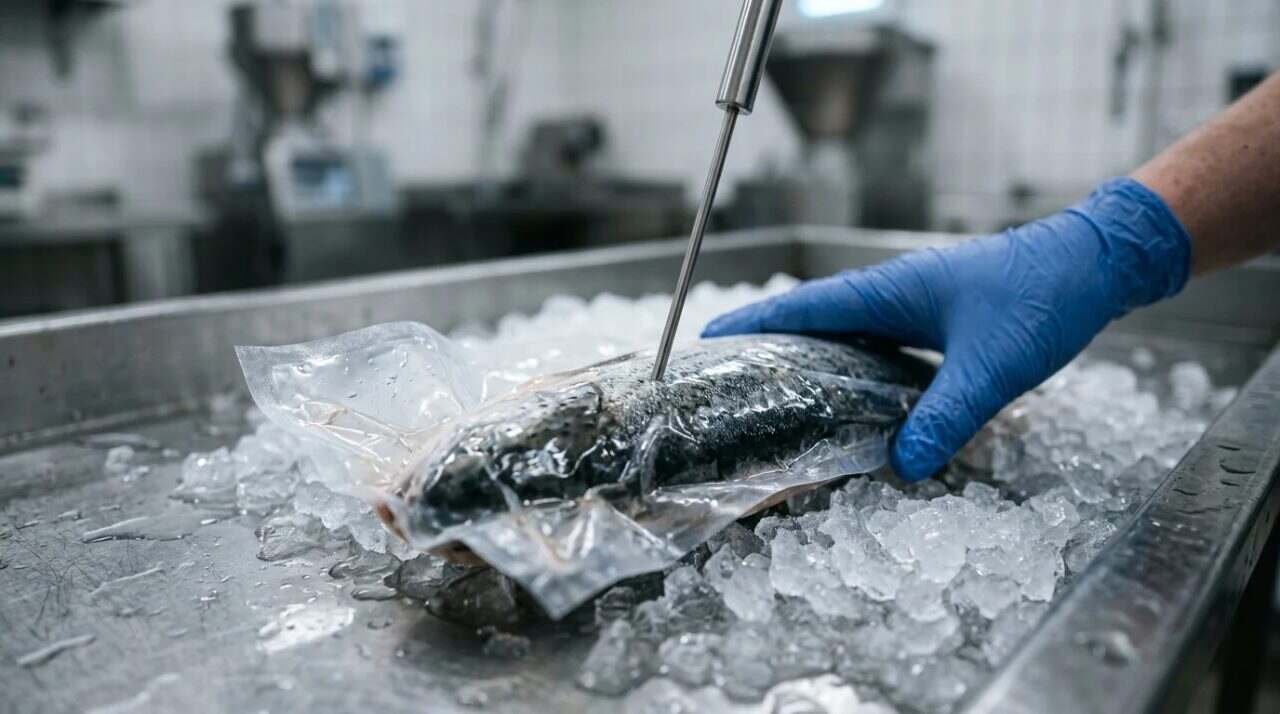
Numbers are where receiving gets precise, and also where a New York operator has to be careful about whose numbers they are. The figures below come from three places: the ICN fact sheet, the Gordon Food Service guide, and the Minnesota rule on receiving temperatures, which the Minnesota revisor’s page labels as corresponding to Food Code section 3-202.11. The FDA’s own Food Code page describes the Food Code as a model that regulators at all levels use to build or update their own retail and food service rules, so a state rule that tracks it is a fair picture of the model but not a statement of New York law.
| Item | Figure at receipt | Where it comes from |
|---|---|---|
| Refrigerated food needing cold control (cold TCS food) | 41°F or below | Minnesota rule, ICN, Gordon Food Service |
| Raw shell eggs | Delivered in refrigerated equipment holding air at 45°F or below (Minnesota); eggs at 45°F or below (ICN, Gordon Food Service) | Minnesota rule, ICN, Gordon Food Service |
| Milk | 45°F or below at the door, then into a cooler at 41°F or below | ICN, Gordon Food Service |
| Hot food needing heat control (hot TCS food) | 135°F or above | Minnesota rule, Gordon Food Service |
| Frozen food | Received frozen, no signs of thawing | Minnesota rule, ICN, Gordon Food Service |
Two details in that table are easy to slide past. The ICN fact sheet says milk must go into a cooler at 41°F or lower right after receiving, and Gordon Food Service puts a clock on it: cooled to 41°F or below within four hours. The two do not match in how fast they want it, so the safe reading is the faster one.
The Minnesota rule also asks for something no thermometer reads. Cold food has to arrive free of evidence of previous temperature abuse. A probe can say a carton of chicken is 39°F. It cannot say whether the carton spent an hour at 60°F on a loading dock earlier in the day, which is why the ice crystals, the liquid in the bottom of the case and the soft spot in the frozen block count as findings of their own.
Dates, tags and labels
Temperature gets most of the attention, but the paperwork at the door matters just as much.
The ICN sheet says to date products when they are delivered, and to check expiration dates on milk, eggs and other perishables. It also says to compare the invoice against what was delivered and to confirm the product is the one that was ordered. That comparison is dull work, and it is the step that catches a wrong substitution or a short case while the driver is still there to hear about it.
New York’s food service regulation adds specific labeling rules for a few products. Under section 14-1.33 of the state’s food supplies rules, as published on Justia:
- Fresh, frozen and shucked shellfish must be identified with the name and address of the original processor, shucker-packer or repacker, and carry a certification number.
- The text on that page says “Tags are to be retained for 90 days after use of shellfish.” That puts the tag on a shelf, in a folder, after the last oyster is gone.
- Eggs must be clean, whole and free of cracks, or be pasteurized liquid, frozen or dry egg products, and every container of shell eggs received must identify its source.
- Milk and milk products must be pasteurized and meet the standards set by law.
Justia carries a warning that its page may not be the current version of the regulation. For anything that will be used in an inspection or a dispute, the official New York State text is the one to read.
Refusing a delivery
Refusal is a decision, and decisions are easier when the criteria are already written down. The lists above are those criteria: temperature above the line for cold food, frozen product that has thawed, a can that bulges, a torn package, a date that has passed, a label that is missing.
New York’s own rule puts the rest of the weight on the food. Section 14-1.31 says that food has to be free of adulteration, spoilage, filth or other contamination and suitable for human consumption, and that it must come from approved sources that comply with all laws relating to food and food labeling. The same section bans home-canned foods in food service establishments. A box of anything a cook would call questionable has a regulatory answer as well as a kitchen one.
There is a gap here that should be stated plainly. The Gordon Food Service guide tells operators to follow their own receiving standards, and none of the pages read for this post describes what to write on an invoice, how to hand a refused case back to a driver, or how a vendor issues credit. Those steps come from the vendor, and a vendor can be asked directly. It is a better question for a rep on a quiet morning than for a driver on a Friday at eleven.
The honest complication is staffing. Every list in this post assumes a person standing at the door with a thermometer and the authority to say no. A small restaurant often has a cook, a prep person and a dishwasher, none of them with a spare minute, and the check gets done at whatever speed the line allows. The sources do not solve that. They only say the check belongs during operating hours and that somebody has to do it.
Putting it away

The ICN fact sheet gives an order for storage: refrigerated first, then frozen, then dry. Food that can spoil goes first, and the canned goods can wait on the dolly. Nothing on the sheet says to hurry the temperature check to get there, which is the temptation: the hot pan on the stove, the driver tapping a pen, and the cold product sitting on the dock while the paperwork gets finished.
New York’s rules, as published by Justia in section 14-1.31, treat potentially hazardous food held between 45°F and 140°F as contaminated if it is held longer than preparation reasonably requires or longer than two hours. That page sets no temperature for food at delivery. It does set the clock that runs once the food is out in the open, so the minutes between the dock and the walk-in are not free.
What the New York pages read here do not say is the receiving temperature itself. Section 14-1.31 as shown does not set one, and the Minnesota figures are Minnesota’s. A restaurant in Suffolk County is regulated by its county health department, and the right place to confirm the number is that office, not a post written from other states’ rule text.
For informational purposes only. This post summarizes published guidance and is not a substitute for the health code that applies to a specific restaurant, and the figures above should be confirmed with the local health department.
Sources
- Institute of Child Nutrition, Receiving Deliveries fact sheet: https://theicn.org/resources/521/food-safety-fact-sheets/107142/receiving-deliveries.pdf
- Gordon Food Service, Food Service Delivery: Guidelines on When to Reject Items: https://www.gfs.com/en-us/ideas/food-service-delivery-guidelines-when-reject-items
- Minnesota Rules 4626.0165, Food Temperatures; Receiving: https://www.revisor.mn.gov/rules/4626.0165/
- 10 NYCRR 14-1.31 (Justia): https://regulations.justia.com/states/new-york/title-10/chapter-i/part-14/subpart-14-1/food-supplies/section-14-1-31
- 10 NYCRR 14-1.33 (Justia): https://regulations.justia.com/states/new-york/title-10/chapter-i/part-14/subpart-14-1/food-supplies/section-14-1-33
- FDA, FDA Food Code: https://www.fda.gov/food/retail-food-protection/fda-food-code
- Video: https://www.youtube.com/watch?v=uTm3-Uo6W-s