
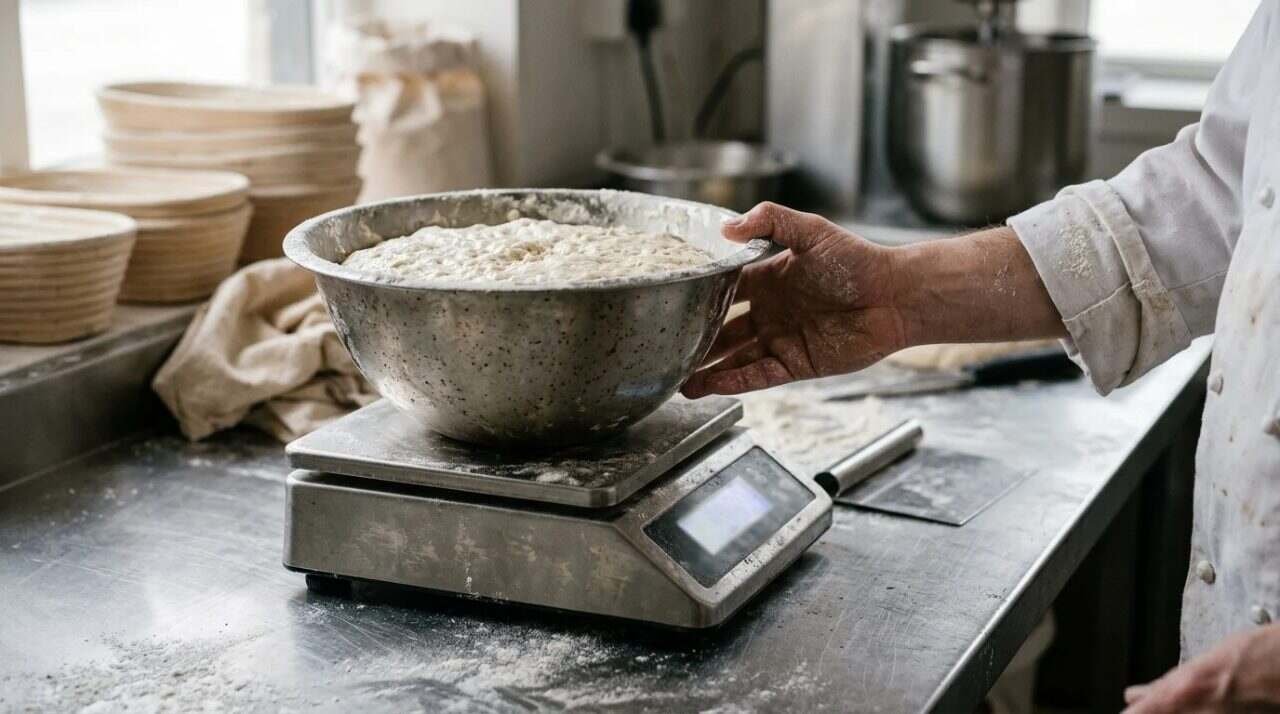
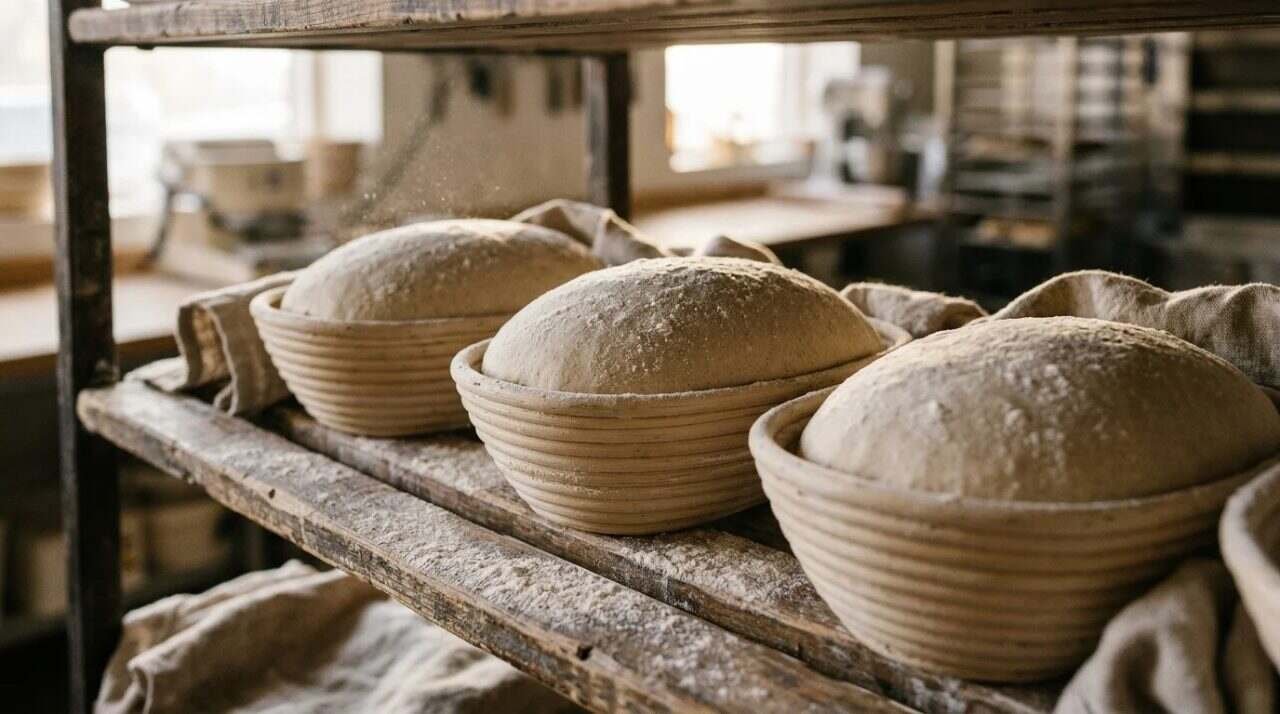
At the diner, precision is everything, and nowhere more than in the slow-fermented 3 lb sourdough loaves. A high-capacity scale like the My Weigh KD-8000 is essential for heavy doughs. For temperatures, whether it is meat or the water going into a bake, you cannot beat the speed and accuracy of a Thermapen. That is the short version, and the rest of this is the reasoning, with the sources.
Why the scale comes first
A measuring cup is a guess with a handle. King Arthur Baking, which publishes recipes by weight, says in its guide to measuring flour that cups are “wildly inconsistent” because the result depends on how tightly the flour is packed. A packed cup of all-purpose flour can hold up to 160 grams, while a cup that has been fluffed, scooped and leveled comes to about 120. That is a third more flour in the same cup, and a recipe cannot absorb a mistake that size without telling you about it.
The same article says that being within 5 grams of the recipe amount generally will not affect the result. Read that sentence against the cup numbers. The tolerance is 5 grams; the cup swings by 40. A scale is the only tool in the room that lives inside the tolerance.
The case for a big scale is separate from the case for any scale, and it comes down to arithmetic. A 3 lb loaf is a little over 1,360 grams of dough before the bowl goes on the platform. Add a heavy mixing bowl or a proofing tub, add the starter and the flour you are weighing into the same container, and a small scale runs out of room faster than people expect. Capacity is the number to check first, and the number most buyers read last.
What to look for in a scale
Capacity comes first, for the reason above. Then units, since a kitchen working in grams and a recipe written in ounces will meet sooner or later. Then the platform, which should wipe clean without a fight, because flour and dough get everywhere. After those, the features that sound like extras and turn out to be habits: a tare button that zeroes the container, an auto-off that can be set long enough to survive a long mix, and a display you can read from where you actually stand.
Percentage weighing deserves a line of its own. Bread recipes are often written as ratios against the weight of the flour, and a scale with a percentage function lets you enter the flour and read the other ingredients as ratios, which saves a calculator and a smear of dough on the screen. The Amazon listing for the KD-8000 names that function among its features. I leave it to the baker to decide whether it matters; a recipe converted once and written on a card does the same job.
Thermometers, and why the label matters

On temperature, the U.S. Department of Agriculture is blunt. Its food thermometer page says using a food thermometer is the only reliable way to ensure that foods have been cooked to a safe minimum internal temperature, and that color and firmness are not reliable indicators. It cites a USDA study in which 21 percent of participants relied on visual cues such as color and grill marks to judge whether hamburger patties were cooked. The agency’s temperature chart sets 165 degrees Fahrenheit for poultry, 160 for ground meats and 145 for steaks, chops and roasts, with a rest of at least three minutes.
That is meat, and a restaurant will argue about whether a rule written for home cooks needs repeating in a kitchen that does this all day. It does, for the plain reason that a kitchen that does it all day does it a thousand times, and one habit of guessing is a thousand chances to be wrong.
Bread has its own use for a thermometer. King Arthur’s article on baking thermometers says its author checks baked goods to make sure they are cooked all the way through, and measures flour, water and air temperature to hit a desired dough temperature. The page gives no target numbers, and I will not supply any. The point is that water temperature is an ingredient, and it should be measured the way flour is.
The USDA page also lists the types of thermometer by speed. A thermocouple gives a reading in two to five seconds, which the agency calls the fastest, while a thermistor takes about ten and an instant-read dial takes fifteen to twenty. It adds that most food thermometers read accurately within 2 to 4 degrees, that placement in the thickest part of the food, away from bone and fat, is what makes the reading true, and that thermocouples cost more and may be harder to find in stores. Speed is not a luxury in a busy kitchen. It is the difference between checking a tray and not bothering.
ThermoWorks makes the Thermapen. Its Thermapen ONE page lists a reading in one second or less, accuracy of plus or minus 0.5 degrees Fahrenheit across a stated working range, a measurement range from minus 58 to 572 degrees, an IP67 rating for water and dust, and a calibration certificate. The page names grilling, frying, baking and candy making among its uses, which covers more or less everything a kitchen asks of a probe.
King Arthur’s thermometer article names the Thermapen ONE as its recommendation too, and says some competing thermometers can be off by as much as eight degrees. That is one more voice on the subject, and an unmeasured claim about rivals, so I treat it as a pointer toward checking any thermometer rather than as a verdict.
The two I would buy
- Bakers Math Kitchen Scale by My Weight – KD8000 , Silver: an 8,000 gram capacity scale with a percentage function, a stainless platform and a hinged shield against mess. See it on Amazon (affiliate link)
- ThermoWorks Thermapen ONE, No. 1 Recommended Instant-Read Thermometer – Cayenne Pepper Red: a one-second instant-read thermometer with an IP67 rating and a five-year warranty, according to its listing. See it on Amazon (affiliate link)
As an Amazon Associate I earn from qualifying purchases. A commission may be earned if you buy through this link, at no extra cost to you.
| Tool | What the sources say |
|---|---|
| My Weigh KD-8000 | 8,000 gram capacity, percentage weighing, stainless platform, hinged shield (Amazon listing) |
| Thermapen ONE | Reading in one second or less, plus or minus 0.5 degrees Fahrenheit in its stated range, IP67 (ThermoWorks) |
| A cup of flour | About 120 grams fluffed and leveled, up to 160 grams packed (King Arthur Baking) |
Care, calibration and the staff who use them

An instrument is only as good as the habit around it. The USDA page says calibration is the process of checking a thermometer’s accuracy, that many thermometers have a calibration nut under the dial, and that two methods exist, one with ice water and one with boiling water. It also notes that some types cannot be calibrated at all, which is worth knowing before you buy one. The same page covers care: wash the probe with hot soapy water or by the maker’s instructions, because most thermometers should not be immersed, store probes in their sheath because they are sharp, and do not leave a thermometer in food while it cooks unless the manufacturer says it is built for that.
Those are small rules, and small rules are the ones that slip when a shift gets busy. Developing training sessions for managers and staff was part of the work at Nanos Media, the restaurant technology consulting group I used to own. A tool nobody is trained on gets used three different ways. A scale and a probe should come with a written standard: where the probe goes, what the target is, who records it, where the scale gets zeroed. The standard takes ten minutes to write and saves an argument every week.
The turn against my own advice
Neither of these is cheap next to the alternatives. The USDA page itself lists thermistors and thermocouples as the more costly types. A dial thermometer from a restaurant supply store will tell a cook the truth if it is calibrated and used well, and the agency describes calibration with ice water or boiling water as the routine check for most thermometers. A cheaper scale will weigh a 500 gram loaf as precisely as an expensive one.
The case for the better tools rests on what the work demands. Heavy doughs need capacity, and a kitchen that checks temperatures many times a day gets value from speed. A home baker making one loaf on a Sunday can reasonably spend less, and nobody should buy a precision instrument and then skip the discipline that makes it precise. Weigh everything, probe the thick part, and write down what you got.
For informational purposes only. Food safety temperatures and product specifications change, so check the current USDA guidance and the manufacturer’s pages, and follow your local health department’s rules for any commercial kitchen.
Sources
- King Arthur Baking, How to measure flour the right way: https://www.kingarthurbaking.com/blog/2023/10/13/how-to-measure-flour
- King Arthur Baking, Thermometers for baking: https://www.kingarthurbaking.com/blog/2024/05/31/thermometer-baking
- USDA FSIS, Food Thermometers: https://www.fsis.usda.gov/food-safety/safe-food-handling-and-preparation/food-safety-basics/food-thermometers
- USDA FSIS, Safe Minimum Internal Temperature Chart: https://www.fsis.usda.gov/food-safety/safe-food-handling-and-preparation/food-safety-basics/safe-temperature-chart
- ThermoWorks, Thermapen ONE: https://www.thermoworks.com/thermapen-one/
- Amazon, Bakers Math Kitchen Scale by My Weight – KD8000 , Silver (affiliate link): https://www.amazon.com/dp/B00VEKX35Y?tag=x9m8-20
- Amazon, ThermoWorks Thermapen ONE, No. 1 Recommended Instant-Read Thermometer – Cayenne Pepper Red (affiliate link): https://www.amazon.com/dp/B0DC8MWQ8K?tag=x9m8-20