

Every business mile driven in 2026 is worth 72.5 cents as a deduction, up 2.5 cents from 2025. The IRS set the rate in a December 29, 2025 announcement, and it applies to electric, hybrid, gasoline and diesel vehicles alike. A consultant who logs 6,000 business miles this year has a $4,350 deduction, provided the log exists.
That last condition is where most mileage deductions fall apart. The rate is generous, the arithmetic is simple, and the record behind it is the part the IRS checks.
The 2026 rates
| Use | 2026 rate per mile |
|---|---|
| Business | 72.5 cents |
| Medical, and moving for certain active-duty military | 20.5 cents |
| Charitable | 14 cents |
Source: IRS news release IR-2025-128. Of the 72.5 cents, 35 cents a mile is treated as depreciation for figuring the vehicle’s basis, according to the Journal of Accountancy’s report on the accompanying IRS notice. That matters later, when the car is sold or traded.
Standard rate or actual expenses
The IRS topic on business use of a car allows either method and suggests figuring both. Actual expenses means gas, oil, repairs, tires, insurance, registration, licenses and depreciation or lease payments, multiplied by the business share of total miles. The standard rate replaces all of those with one number.
The choice has a timing trap. For a car the business owns, the standard rate has to be chosen in “the first year the car is available for use in your business.” After that, the owner can switch to actual expenses in later years. For a leased car, choosing the standard rate locks it in for “the entire lease period (including renewals).” And the standard rate is off the table for anyone running five or more cars at once, or who has already claimed accelerated depreciation or Section 179 on the vehicle.
Business parking fees and tolls are “separately deductible” under either method. They go on top of the mileage figure, so the receipts are worth keeping.

Which trips count
Commuting does not. IRS Publication 463 treats daily travel between home and the main or regular workplace as a personal expense regardless of distance, even if work gets done on the way. Parking at the regular workplace is not deductible either.
The exceptions are where small businesses usually sit:
- When a home office qualifies as the principal place of business, travel from home to another work location in the same business is deductible, temporary or permanent.
- Someone with a regular work location can deduct trips between home and a temporary work location in the same business. Work is temporary if it is realistically expected to last a year or less.
- Someone with no regular workplace who usually works within one metropolitan area can deduct trips to temporary sites outside that area, but not inside it.
The first exception is why the home office question and the mileage question are linked. A contractor whose office qualifies under the rules in the home office deduction turns the drive to the first job of the day into a business trip.
What the log has to show
Publication 463 lists the elements: the mileage for each business use and the total miles for the year, the date of each use, the destination, and the business purpose. The purpose can be brief, and the IRS does not demand a written explanation when it is obvious from the circumstances, but “client meeting, Hauppauge” is better than nothing and better than memory.
Timing matters as much as content. Records should be made “at or near the time of the expense or use,” and the publication says “A timely kept record has more value than a statement prepared later.” A weekly log counts as timely. A spreadsheet assembled in April from a calendar is the kind of record that loses arguments.

The sampling shortcut
An owner whose driving follows the same pattern all year does not have to log every week. The publication allows adequate records for part of the year to prove business use for the whole year, as long as other evidence shows the sample is representative. Its example uses the first week of each month. The catch is that a sample only works for a steady pattern; a business with a busy season needs the full log.
The publication’s general rule is to keep these records for three years from the date the return claiming them is filed, and to keep the records of a car’s business use for each year of its recovery period.
Phone app or glove-box book
An app that tracks trips by GPS removes most of the work, and many accounting programs include one. A paper log still has two advantages: it works without a phone battery, and it does not need a subscription. Either satisfies the rules if it records the four elements above at or near the time of the trip. The book below is one paper option sold on Amazon.
- Adams ABFAFR12 Vehicle Mileage and Expense Journal, 5-1/4″ x 8-1/2″, Fits the Glove Box, Spiral Bound, 588 Mileage Entries, 6 Receipt Pockets,White: A spiral-bound glove-box journal with 588 mileage entries and six pockets for toll and parking receipts. See it on Amazon (affiliate link)
As an Amazon Associate I earn from qualifying purchases. A commission may be earned if you buy through this link, at no extra cost to you.
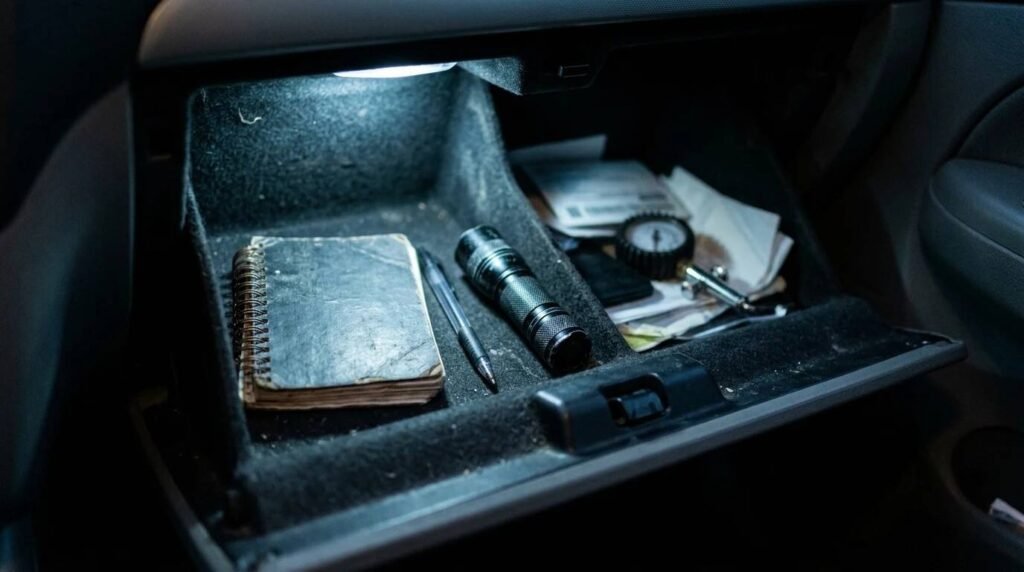
The deduction lowers both income tax and self-employment tax for a sole proprietor, so it also shrinks the quarterly payments discussed in estimated taxes for a sole proprietor. A log kept from the first week of January is worth more than one rebuilt in March.
For informational purposes only — consult a licensed attorney or financial advisor.