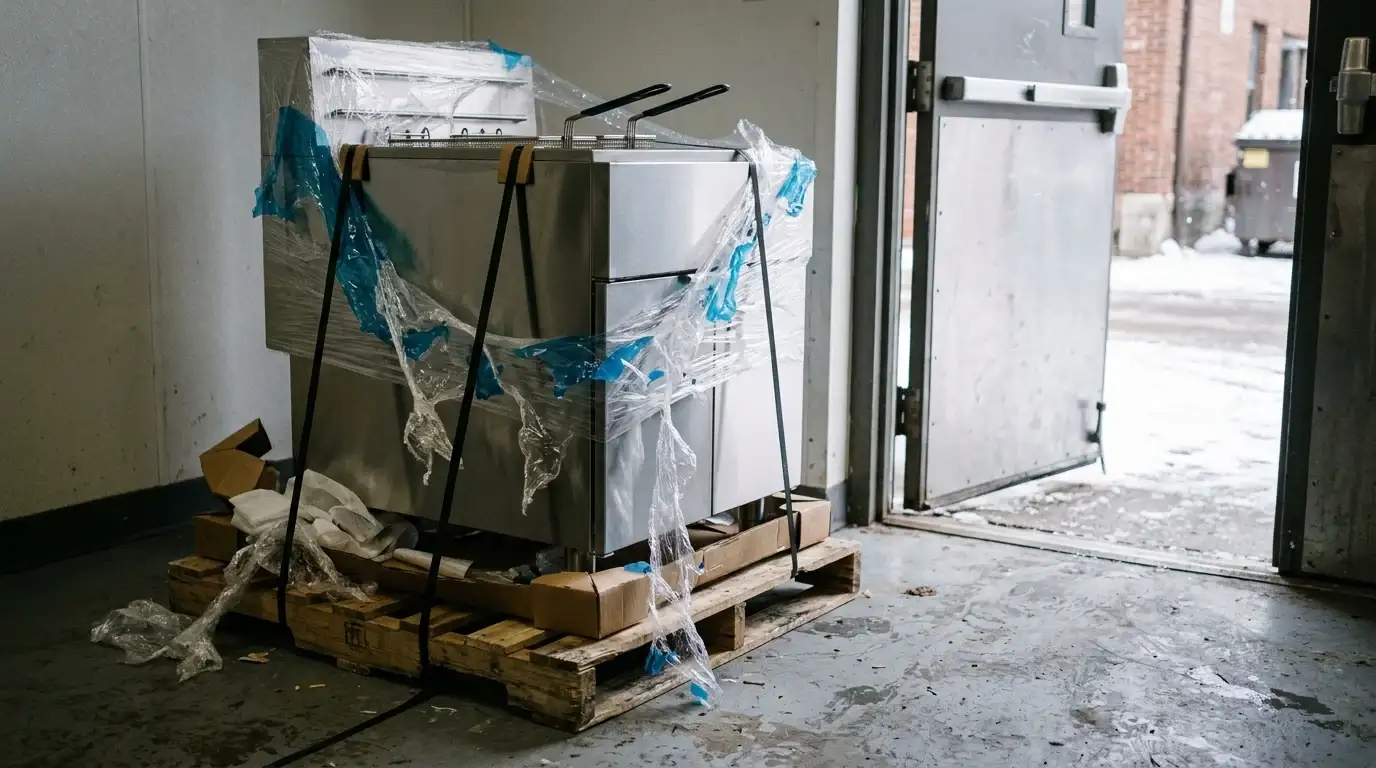
A new fryer sitting on a pallet by the back door on December 30 is, as far as the IRS is concerned, a large box. It does not become a deduction for 2026 because the invoice is dated December, or because the card was charged in December, or because the delivery driver got a signature in December. It becomes a 2026 deduction when it is ready and available to fry, and if the gas line goes on January 3, the box belongs to 2027.
That date matters far more to a small restaurant than the headline numbers the IRS released this month. The fryer here is an example, priced at $9,000 to keep the arithmetic clean, but the rule applies to a walk-in compressor, a POS terminal, a slicer or a delivery van just the same.
Delivered is not the same as placed in service
IRS Publication 946 puts the test in one line: “The placed in service date for your property is the date the property is ready and available for a specific use.” The Section 179 deduction follows that date. The same publication says the cost is recovered “by deducting it in the year you place the property in service,” and the election is made on Form 4562.
The publication’s own first example reads like a kitchen story with the names filed off. “You bought a machine for your business. The machine was delivered last year.” Then the turn: “However, it was not installed and operational until this year.” The verdict is that the machine “is considered placed in service this year.” Pub 946 adds the other side of the coin: had the machine been ready and available for use when it was delivered, it would have counted in the earlier year even if nobody switched it on until later.
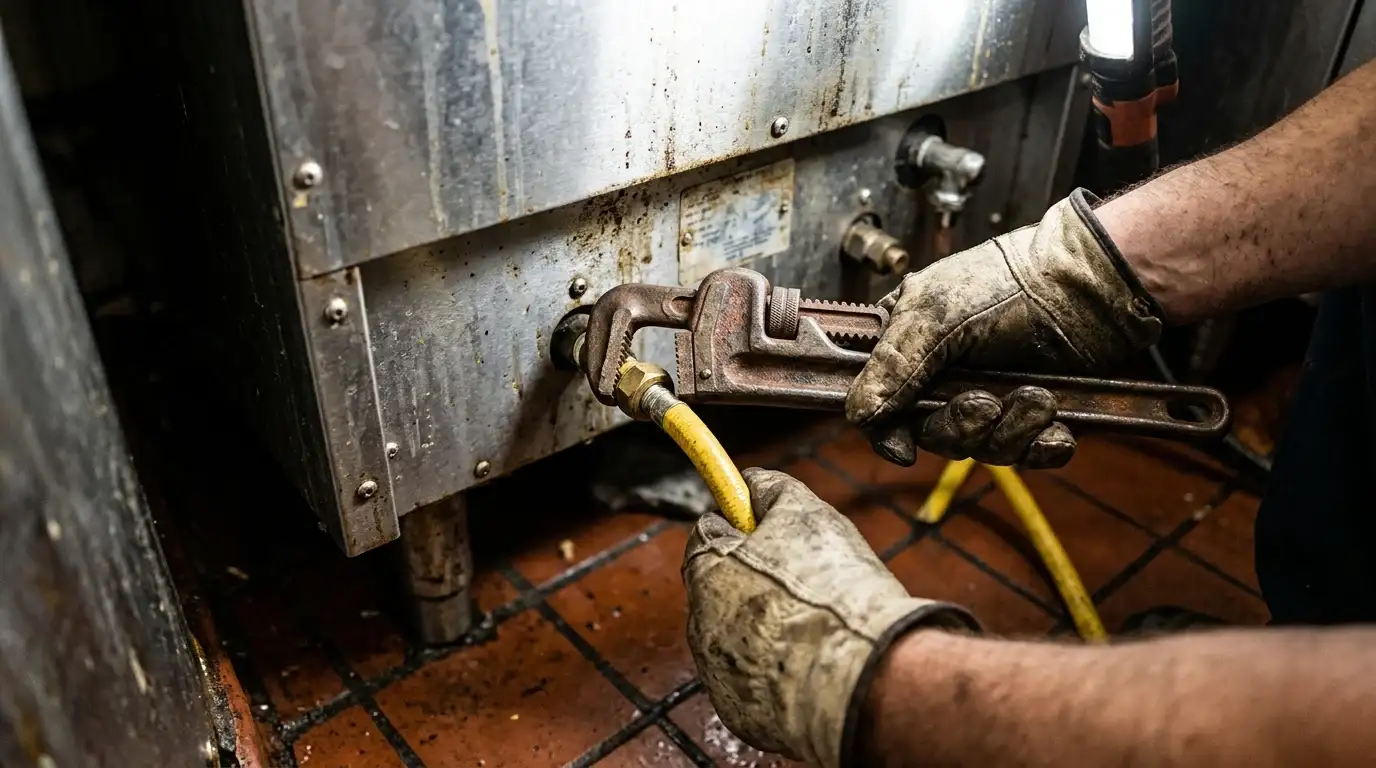
That split sorts kitchen equipment into two piles. A countertop unit that plugs into an existing outlet can be ready the hour it comes off the truck. A gas fryer that needs a plumber, a hood that needs an inspection, or a walk-in that needs a refrigeration tech is not ready until the tradesman packs up. In the last week of December, the tradesman’s calendar, not the salesman’s, sets the tax year.
Limits measured in millions, purchases measured in thousands
On November 5, the IRS announced the 2027 figures in IR-2026-133 and Revenue Procedure 2026-35: “For tax year 2027 taxpayers can expense up to $2,640,000 of section 179 property, up from $2,560,000 for tax year 2026.” The cap for sport utility vehicles rises to $33,100 from $32,000. Pub 946 lists the 2026 phase-out threshold at $4,090,000 of qualifying property placed in service in a year.
Those are numbers for trucking fleets and manufacturers. At $9,000 apiece, a diner would need to put about 284 fryers into service in 2026 to reach the cap, at which point the deduction would be the least of its problems.
The limit that actually binds a small shop sits lower and quieter. Pub 946 says the amount deductible after the dollar limit “is limited to the taxable income” from the active conduct of a trade or business for the year. A shop that earns $6,000 of business taxable income cannot use Section 179 to deduct a $9,000 fryer in full that year. The leftover is not lost; the publication says “Any cost not deductible in 1 year under section 179 because of this limit can be carried to the next year.“
There is also a second route. Pub 946 says the 2025 tax law “reinstated the 100% special depreciation allowance for certain qualified property” acquired and placed in service after January 19, 2025, with an election to take 40 percent instead in the first tax year ending after that date. It carries its own rules, and an accountant will pick between the two routes, but both doors open on the same date: placed in service.
What a $9,000 deduction is worth in cash
A deduction does not refund the purchase. It lowers taxable income, and the savings equal the tax that income would have carried. For an owner reporting business income on a personal return, that means the marginal bracket. The 2026 brackets come from the IRS’s October 2025 release, IR-2025-103, where the 22 percent rate covers single filers “for incomes over $50,400” and the 24 percent rate starts “for incomes over $105,700.” For 2027, the 22 percent rate starts above $52,025 and 24 percent above $109,125, per the November 2026 release.
The table runs the fryer through those brackets for a single filer. The incomes are examples, chosen to sit inside a bracket and across an edge.
| Example | Taxable income before deduction | Federal income tax saved | Fryer’s cost after that saving |
|---|---|---|---|
| In service 2026 | $60,000 | $1,980.00 | $7,020.00 |
| In service 2026 | $110,000 | $2,066.00 | $6,934.00 |
| In service 2027 (same income) | $110,000 | $1,997.50 | $7,002.50 |
The $110,000 row is the interesting one. In 2026, the first $4,300 of the deduction comes off income taxed at 24 percent and the remaining $4,700 off income taxed at 22 percent. In 2027 the 24 percent line moves up to $109,125, so only $875 of the deduction saves at 24 percent. The same fryer, the same income and a gas line hooked up four days later cost about $68.50 in federal income tax savings in this example. That is real money, though not the kind that justifies rushing an install.
Two things are left out of the table on purpose. The IRS says “The self-employment tax rate is 15.3%” and applies to net earnings from self-employment, so a sole proprietor whose deduction lowers net profit saves some self-employment tax on top of these figures. State and city income tax are also out. Both move the saving up. Neither changes the shape: the owner still pays for most of the fryer.

The honest case for buying in December
The December pitch is familiar: buy now, write it off, the government pays for part of it. Strip off the wrapping and the arithmetic says something less exciting. A deduction is a discount at the marginal rate. At 22 percent, the store is offering 22 percent off, and the shop still pays the other 78 percent with real money that leaves the account in December. Buying a $9,000 fryer that was not needed in order to save $1,980 is spending $7,020 on a fryer that was not needed.
If the old fryer is already limping, though, with a thermostat that drifts and a pilot that needs coaxing every morning, the purchase is coming either way. Then pulling it into December does accelerate a deduction by a full year, and a year earlier is worth something, especially for an owner who has been paying quarterly estimates on income that turned out higher than expected. The Till Post guide to quarterly estimated taxes covers how those payments are figured.
The trade-off runs the other direction too. Expensing the whole fryer in 2026 leaves nothing to depreciate in 2027 and beyond. If next year’s income lands higher, or the brackets treat it worse, a slower write-off could have saved more. Which way that falls depends on income nobody can see yet, and that is a conversation for an accountant with the books open, not a sales floor in late December. A list of questions for a first accountant meeting is a fair starting point.
New York, New York City and the paper trail
New York does not follow every federal depreciation rule. A June 2026 CBIZ summary of the state’s 2026-2027 budget says it decouples New York from several federal provisions, “including bonus depreciation and research and experimental expenditure rules.” For businesses inside the five boroughs, the same summary says “New York City will retain the pre-OBBBA limit of $1.25 million, adjusted for inflation.” A purchase can therefore produce one deduction on the federal return and a different one on the state or city return, and the bookkeeping has to carry both.
Whatever the route, the in-service date has to be provable. That means the invoice, the delivery slip, and something dated that shows the equipment was ready: the installer’s work order, an inspection sign-off, a photo with a timestamp, the first ticket that used it. The Till Post rundown of which business records to keep and for how long applies here, and the same file belongs with any big-ticket piece, the kind of machine the Till Post review of the Hobart L800 mixer covered this month.

The last working days of 2026 fall on a Monday through Thursday, December 28 to 31, with the holiday weekend behind them. A plumber booked for the 29th who calls on the 28th to say a part is back-ordered just moved a deduction into next year with one sentence. How many owners have found out about the placed-in-service rule from a tradesman’s voicemail?
For informational purposes only — consult a licensed attorney or financial advisor.
Sources
- IRS, Publication 946 (2025), How To Depreciate Property
- IRS, IR-2026-133, IRS releases tax inflation adjustments for tax year 2027 (Nov. 5, 2026)
- IRS, IR-2025-103, IRS releases tax inflation adjustments for tax year 2026 (Oct. 9, 2025)
- IRS, Self-Employment Tax (Social Security and Medicare Taxes)
- CBIZ, New York State Enacts 2026-2027 Budget With Individual and Business Tax Law Changes (June 9, 2026)
- INVESTOR FRIENDLY CPA® (IFC), “Section 179 Explained: How to Write Off Business Assets and Save Thousands” (YouTube)