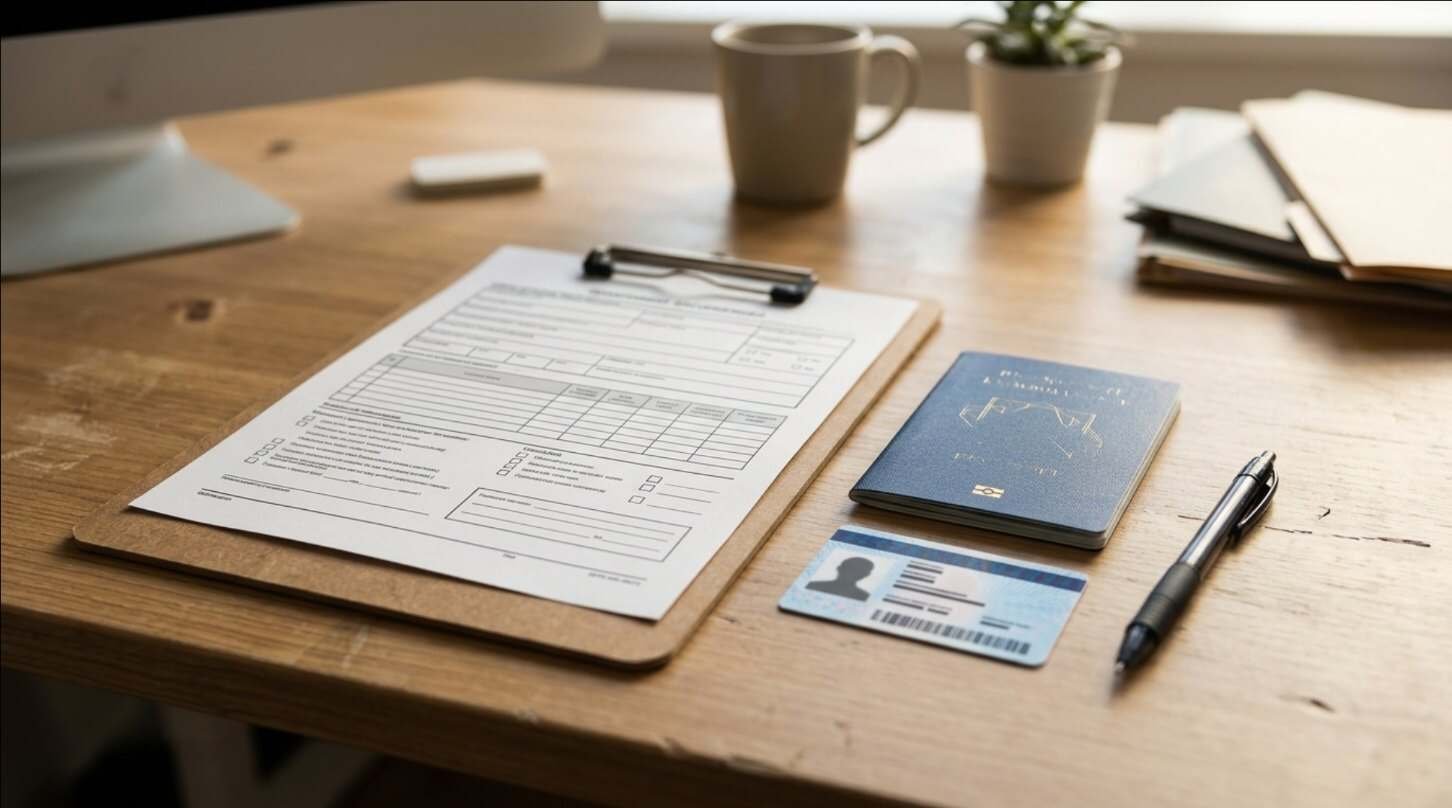
Every employer in the United States completes a Form I-9 for each person hired, and the form splits the work between two people on two different clocks. The employee fills out Section 1 by the end of the first day of work. The employer finishes Section 2 within three business days. Most mistakes on the form come from mixing up who does which part, or from treating the document check as a place where the employer gets a say.
The two deadlines
Section 1 belongs to the employee. USCIS states that employees “must complete and sign Section 1 of Form I-9 no later than their first day of employment,” and adds that they may complete it any time after accepting the job offer, according to the USCIS page on Section 1. The federal regulation uses slightly different wording: the employee completes Section 1 “at the time of hire”. In practice the first day of employment is the outer limit, and an early start right after the offer is accepted is allowed.
Two details on Section 1 matter for small payrolls. A Social Security number is optional for the employee, with one exception: it is required if the employer participates in E-Verify, per the same USCIS page. And an employee who needs help reading or completing the form can use a preparer or translator, but the employee still signs.
Section 2 belongs to the employer. The employer, or an authorized representative, examines the employee’s documents and completes Section 2. USCIS’s employer handbook says this must happen “within three business days of the date employment begins”. The regulation matches, requiring Section 2 within three business days of the hire.
A short job changes the arithmetic. The same handbook page says that when an employer hires someone for less than three business days, Section 2 is due no later than the first day of employment. A one-weekend event hire, for example, falls into that rule rather than the three-day window.
Section 2 can be completed before the first day, too. USCIS notes that the employer may review documents and complete Section 2 at any time once Section 1 is done, per the page on Section 1 above.
Who counts as a new hire
Not every change on the payroll starts a new I-9. The regulation says an employer is not treated as having hired a person who is continuing in employment with a reasonable expectation of resuming work. Its examples include approved leave, promotions, demotions, pay raises, temporary layoffs, strikes, transfers within the same employer and seasonal employment, as summarized from 8 CFR 274a.2(b)(1)(viii).
Whether an expectation of return is reasonable is decided case by case. The regulation points to factors such as regular and substantial employment, compliance with leave policies and the employer’s history of recalling workers. A business that rehires seasonal staff each year is therefore in a situation where the answer depends on the facts, and the regulation text is the place to check before assuming either way.

The three document lists
Section 2 rests on documents the employee presents. The form sorts them into three lists, and the employee shows either one List A document, or one List B document plus one List C document. All must be unexpired.
List A documents prove both identity and work authorization. USCIS’s list of acceptable documents includes a U.S. passport or passport card, a Permanent Resident Card, a foreign passport with a temporary I-551 stamp, and an Employment Authorization Document with a photograph (Form I-766), among others, according to the USCIS acceptable documents page.
List B documents prove identity only. The page names a driver’s license or ID card issued by a state, an ID card issued by a government agency, a school ID with a photograph, a voter registration card, a U.S. military card or draft record, and a Native American tribal document, along with several others. For people under 18 who cannot present another listed document, school records, clinic or hospital records and day-care records are accepted.
List C documents prove work authorization only. These include an unrestricted Social Security card, a Certification of Report of Birth from the Department of State, and an original or certified copy of a birth certificate bearing an official seal and issued by a U.S. state, county, municipality or territory. The same page lists the U.S. Citizen ID Card (Form I-197) and certain DHS-issued employment authorization documents.
The pairing explains why a driver’s license alone is not enough. It establishes who the person is, but not that the person may work, so it needs a List C partner such as a Social Security card. A passport covers both questions at once.
The acceptable documents page also lists receipts, which apply when a document has been lost, stolen or damaged and a replacement is pending. The rules for how long a receipt stays valid differ by list, and the full USCIS page should be read before relying on one.
What the employer may and may not ask for
The choice of document belongs to the employee. The USCIS handbook leaves little room: the employer “must allow the employee to choose which documentation they will present,” and cannot specify which documents from the lists an employee will show. An employer who announces that only a driver’s license and Social Security card will do is violating that instruction.
The employer’s job is narrower. The handbook says a document must be accepted if it “reasonably appears to be genuine and relates to the person presenting it”. Reviewing means looking at the real item, in the employee’s presence. The handbook states that, in general, documents are reviewed in the employee’s physical presence, and that when examining documents this way, copies are not acceptable, with the exception of certified copies of birth certificates.
Copies kept for the file are a separate matter. USCIS says making photocopies or electronic images of the reviewed documents is generally optional, but it must be done consistently. The page on retaining copies of documents warns that copying some workers’ documents and not others, based on national origin, citizenship or immigration status, may violate anti-discrimination laws. E-Verify employers are required to keep a copy of certain documents when an employee presents them, and the page names passports, passport cards, Green Cards and Employment Authorization Documents.

Remote document review
Section 2 normally means a face-to-face look at the originals. A Federal Register notice from July 2023 created an optional alternative for employers who are participants in good standing in E-Verify, available beginning August 1, 2023.
Under that procedure the employee first sends clear copies of the documents, front and back where applicable, and then presents the same documents in a live video interaction. The employer marks a box on the form to show the alternative procedure was used and keeps the copies. Employers using it must create E-Verify cases for new hires, and must still offer physical examination to an employee who cannot or does not want to use the video route.
That leaves employers outside E-Verify with the in-person rule. A business with a remote hire and no E-Verify enrollment has to examine the originals in person, either personally or through an authorized representative, the term the USCIS handbook uses for the person who completes Section 2.
Which edition of the form to use
The form carries an edition date and an expiration date. According to E-Verify’s announcement of the 01/20/25 edition, the revision renamed the fourth citizenship checkbox in Section 1 to “An alien authorized to work,” revised the descriptions of two List B documents, and added statutory language and an updated privacy notice to the instructions. The announcement says the 01/20/25 edition expires 05/31/2027 and that older editions remain valid until their own expiration dates.
A separate E-Verify notice says the expiration date of the 08/01/23 edition was moved from 07/31/2026 to 05/31/2027, as stated on the page about the extension. The two announcements are not perfectly aligned on what electronic systems had to change and when, and the USCIS Form I-9 page itself could not be read during research for this article. Anyone downloading the form should confirm the edition and expiration date printed on the current USCIS version before using it.

Reverification and retention
Some employees have work authorization that expires. The regulation is direct: reverification must occur “not later than the date work authorization expires”, and an employee whose authorization lapses without reverification may no longer be employed.
The retention clock has two parts. USCIS says the form must be kept for “three years after the date of hire, or one year after the date employment ends, whichever is later”. The page gives the practical result: an employee who worked less than two years means three years from the first day of employment is the controlling date, while an employee who worked more than two years means one year after the last day of work.
Where the forms live is up to the employer within limits. Paper forms with original handwritten signatures can be kept on site or at an off-site facility, and microfilm or microfiche copies are acceptable. The forms must be producible within three business days of an inspection request. Copies or electronic images of an employee’s documents also have to be kept as long as the employee works for the business and for the required period afterward.
Inspections follow a fixed pattern. According to ICE’s Form I-9 inspection fact sheet, an inspection begins with a Notice of Inspection, and employers get at least three business days to produce the forms. Technical failures get at least 10 business days to correct before they count as substantive, and uncorrected substantive violations can bring a monetary fine. The fact sheet gives no dollar amounts. It states that they are adjusted annually under federal law and directs readers to the current Federal Register.
A small employer’s practical routine tends to come down to three habits: employee completes Section 1 on or before day one, a named person finishes Section 2 inside the three-business-day window, and every form goes into a file organized by termination date so the retention deadline can be read off it. The general record-keeping question for a small business is covered in what records a small business keeps and for how long, and the wider set of state and federal steps for a first employee is in hiring a first employee in New York.
For informational purposes only — consult a licensed attorney, tax professional or financial advisor.
Sources
- https://uscis.gov/node/41765
- https://uscis.gov/i-9-central/form-i-9-resources/handbook-for-employers-m-274/40-completing-section-2-employer-review-and-verification
- https://www.uscis.gov/i-9-central/form-i-9-resources/handbook-for-employers-m-274/40-completing-section-2-employer-review-and-verification/41-retaining-copies-of-documents-your-employee-presents
- https://www.uscis.gov/i-9-central/form-i-9-resources/handbook-for-employers-m-274/100-retaining-form-i-9
- https://www.uscis.gov/i-9-central/form-i-9-acceptable-documents
- https://www.ecfr.gov/current/title-8/chapter-I/subchapter-B/part-274a/subpart-A/section-274a.2
- https://www.govinfo.gov/content/pkg/FR-2023-07-25/html/2023-15533.htm
- https://www.e-verify.gov/about-e-verify/whats-new/minor-changes-to-form-i-9-and-e-verify-updates
- https://e-verify.gov/about-e-verify/whats-new/uscis-extends-form-i-9-expiration-date
- https://www.ice.gov/factsheets/i9-inspection
- https://www.youtube.com/watch?v=uXo0HUbT5FA
All pages fetched November 8, 2026.