

On June 23, 2015, a federal judge in Washington named Amit Mehta finished a 128-page opinion on whether the two biggest food distributors in the country could become one. His answer was no. The merger, he wrote, “would eliminate head-to-head competition between the number one and number two competitors in the market for national customers,” according to the Federal Trade Commission’s account of the case. The Heritage Diner is not a national customer. It has one location and a parking lot that floods when it rains hard, and it still got something out of that ruling, which was a second rep to say no to.
Two trucks instead of one
Sysco agreed to buy US Foods for $8.2 billion in December 2013, the Wikipedia history of US Foods records. The FTC sued to stop it in February 2015. Its case was that the merged company would have held about 75 percent of sales to national broadline customers, the chains, buying groups and contract feeders with locations everywhere, and that nobody else had a footprint big enough to push back. The two companies offered to hand 11 distribution centers to Performance Food Group, then the third-largest broadliner, and the judge turned that down too.
Sysco walked away. On July 1, 2015, the commission closed the case by a 5-0 vote, and its chairwoman, Edith Ramirez, said the deal “would have likely increased prices paid by restaurants, hotels, cafeterias, and hospitals across the country.”
Restaurants come first on that list. It was the only time I can remember a federal agency putting us ahead of hospitals.
From a horse and wagon to Rosemont
The company that survived the ruling has had more owners than a used flat-top. Its roots go back to John Sexton & Company, founded in 1883, which delivered by horse and wagon and moved to diesel trucks after 1924, per the same Wikipedia entry. Beatrice Foods bought Sexton in 1968 for $37.5 million. In 1983 it merged with S.E. Rykoff to form Rykoff-Sexton. Ahold bought U.S. Foodservice in April 2000 for $3.6 billion, and in 2007 the private equity firms Clayton, Dubilier & Rice and KKR took it over for $7.1 billion. The stock went public again in May 2016, raising about $1 billion. Headquarters is Rosemont, Illinois, and Dave Flitman has been chief executive since November 2022.
The size today, from the company’s fiscal 2025 earnings release of February 12, 2026: net sales of $39.4 billion, up 4.1 percent, and about 250,000 customer locations. Cases sold to independent restaurants rose 3.3 percent for the year and 4.1 percent in the fourth quarter. That second number is the one aimed at a place like mine. A national house growing its independent business is a national house sending more reps through more side doors.

A New York house in Perth Amboy
US Foods’ page for New York City sends a reader to a division called Metro New York, and the body of the page puts it in Perth Amboy, New Jersey. In 2012 the site was set to get a rooftop solar array expected to make more than 10 million kilowatt hours a year, close to 85 percent of the facility’s power, Trellis reported, with a separate company, Swan Creek MPA, owning the panels and selling the energy back.
The New York business was built partly by buying up the neighbors. Wikipedia lists the July 2011 purchase of Vesuvio Foods, an Italian distributor to pizzerias and restaurants around the city, then Quandt’s Foodservice in eastern New York in 2013, Jeraci Foods of Elmsford in 2016 and Renzi Foodservice upstate in 2023. In March 2020 it paid $970 million for Smart Foodservice Warehouse Stores, which now run as US Foods CHEF’STORE, its own walk-in, cart-pushing answer to the cash-and-carry.
Which house serves a given Suffolk address, and on which days, is the rep’s first answer to get in writing. Perth Amboy is on the far side of Staten Island from here, and a truck from there to Mount Sinai has a lot of bridge and expressway between it and my back door.
Seventeen questions and an app
The Become a Customer form runs seventeen fields. It wants meals served per day, whether the restaurant is self-operated or part of a management group, what the place is best known for, how often it takes deliveries and roughly what it spends each week. One field asks, “Who is your primary foodservice distributor?” Another asks whether the restaurant is on a pricing contract. It is the most honest form in the food business. Before anybody quotes a price, they want to know who they are trying to beat.
After the form comes the app. The MOXē page lists ordering by image, payment of up to 75 invoices in one transaction, payments scheduled up to 14 days ahead, inventory counts that work offline, credit and return requests, and alerts for order cutoffs and for a truck 30 minutes out. On the February 2026 earnings call, Flitman described AI-driven ordering inside MOXē, where a customer or seller uploads a document or a picture and the system turns it into an order, Digital Commerce 360 reported. The same report counts the company’s small-truck delivery program, Pronto, in 46 markets, with 10 to 15 more planned for 2026.
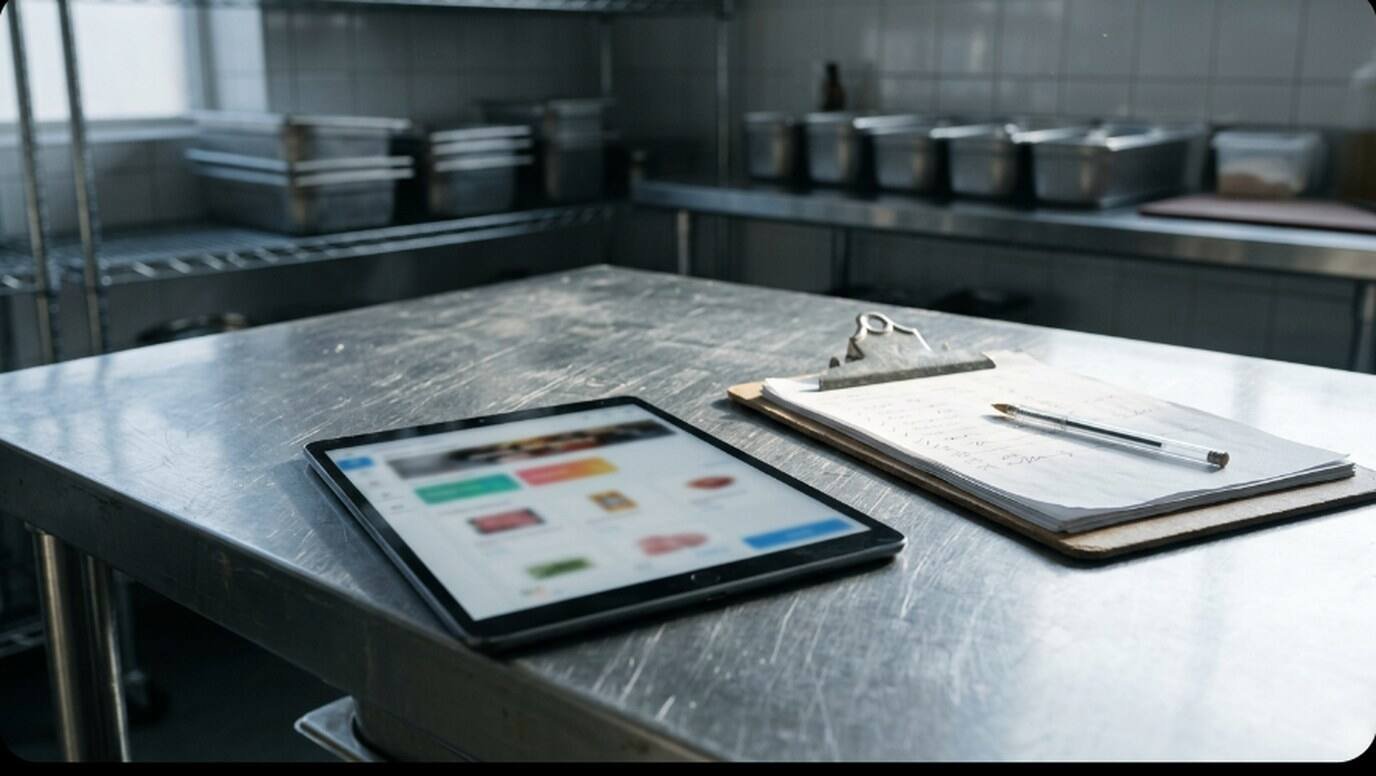
The last US Foods rep who came through had the app open before he sat down. He asked if he could take a picture of my order guide, the clipboard that hangs by the walk-in with grease on the corners, and I let him, mostly to see what would happen. The phone thought for a second and came back with a cart. It got the eggs right and the American cheese right. It read my handwritten “6/10 fry oil” as something else entirely, and the rep laughed and fixed it with his thumb. My shoulders came down a little. A machine that can’t read my handwriting is in the same position as every cook I have ever hired.
Twenty items on a legal pad
I have sat across from a US Foods rep more than once, and the meeting always ends at the same place, which is the legal pad. Twenty items down the left side, the ones a diner burns through every week: eggs, bacon, American cheese, fry oil, hamburger rolls, coffee, to-go containers. Same brand, same pack size, one column per house. The catalog holds hundreds of thousands of products and my kitchen buys a few hundred. The pad is where those few hundred get priced honestly.
The second column on that pad has been Marathon Foodservice since the diner opened, and the third has changed over the years. That’s the job. A national rep in a kitchen like mine doesn’t have to win the account to be worth the coffee, because what he really has to do is make the people already on the truck sharpen a pencil.
- Price the same items at each house, same brand and pack, and repeat it every quarter, not once.
- Get delivery days, cutoff and minimum in writing.
- Ask how substitutions show up on the invoice and how a credit is requested when a case comes in short.
- Ask who covers when the rep is on vacation.
A pad only works if the list behind it is real. The restaurant order guide template is the list, and receiving a delivery before signing is what keeps a good price from turning into a bad one at the back door.

The second merger and the buyback
Ten years after the ruling, US Foods tried a different partner. It signed an information-sharing agreement with Performance Food Group on September 16, 2025, and the two ended talks on November 24, 2025, Transport Topics reported. A combined company would have ranked above Sysco. PFG’s chief executive, George Holm, pointed to “a comprehensive evaluation of regulatory considerations and synergies.” Flitman said ending the talks was “in the best interest of US Foods and its shareholders,” and US Foods announced a $1.25 billion share buyback.
So the line Judge Mehta drew in 2015 held, at least at the top. Three big national houses, still separate, still sending reps. I have spent years telling other owners that this is the whole point, that a kitchen with three bids is a kitchen with leverage.
Then I look at the third column on my own pad. The court protected the fight between number one and number two for the chains. Nobody was in a courtroom when the regional houses got bought one at a time: Vesuvio, Jeraci, Renzi, and a warehouse chain turned into CHEF’STORE. In March 2026 Sysco agreed to buy Restaurant Depot for $29.1 billion, Greater Long Island reported, which I wrote about in the Sysco profile and which reaches straight into the cash-and-carry run a lot of us use to check the reps. The big three stayed three. The names underneath them keep disappearing into the big three’s paperwork.
My pad from 2010 is in a drawer under the register somewhere, with a column for a house I can’t find a sign for anymore. Owners who keep the old sheets: how many of the names in your third column still deliver under their own name?
For informational purposes only — consult a licensed attorney or financial advisor.
Sources
- Federal Trade Commission, “Following Sysco’s Abandonment of Proposed Merger with US Foods, FTC Closes Case” (July 1, 2015)
- Wikipedia, US Foods
- US Foods, “US Foods Reports Fourth Quarter and Fiscal Year 2025 Earnings” (Business Wire via Barchart, February 12, 2026)
- US Foods, Metro New York location page
- Trellis, “US Foods Turns to Solar Power for Site Serving Metro New York” (February 20, 2012)
- US Foods, Become a Customer
- US Foods, MOXē
- Digital Commerce 360, “US Foods adds AI ordering as ecommerce drives Q4 sales growth” (February 13, 2026)
- Transport Topics, “Performance Food Group, US Foods Call Off Merger Talks” (November 24, 2025)
- Greater Long Island, “Sysco buys Restaurant Depot for $29.1B — a jolt for Long Island indie restaurants” (March 30, 2026)


