

A walk-in cooler gets counted properly when the shelves are put in order first and the counting happens second, on a sheet that is laid out the way the shelves are. I have taken inventory in a walk-in myself, at the family restaurant where I work, the Heritage Diner in Mount Sinai. This post describes a method for doing it and sorts out which parts of that method come from published guidance and which parts are plain procedure, because the two are different kinds of claim.
Fix the shelves before counting anything

Counting a cooler that is out of order produces a number that is wrong in a hard-to-find way. Items hide behind other items. A case of something sits half open under something else. The same product appears in three places and gets counted once, or twice, or three times depending on who is standing there. So the first job is not to count. It is to arrange.
The National Restaurant Association has a piece on reorganizing walk-ins that sets out a shelf order. Ready-to-eat items go above raw foods. From the top, the article lists prepared and ready-to-eat foods that will not be cooked further, then fish and seafood, then whole cuts of raw beef and pork, then ground raw beef and pork, and last, on the bottom shelf, raw poultry. The principle underneath it is that foods needing a lower cooking temperature sit above foods needing a higher one, so that a drip lands on something that is going to be cooked hotter than whatever it came from.
Parts Town, an equipment supplier, makes the same point in its guide to organizing commercial cold storage: it says to store meats on the lowest shelf to prevent dripping and cross-contamination. Two sources written for different readers agree on the order, which makes it one of the few things in this post I would treat as settled.
The same two sources agree on clearance. Parts Town says to keep items off the floor, with the lowest shelf at least six inches up, and it suggests keeping products three to six inches from walls and between items so air can move. The National Restaurant Association’s piece gives six inches off the floor as well. Spacing is not only a food safety matter. It is a counting matter, because a shelf where every item can be seen is a shelf where every item can be counted.
Labels, and the rule that makes counting easy
Labels do two jobs at once. The National Restaurant Association’s article says labels on containers should include the type of food and the date it was placed in storage, and it adds that each should show a use-by date. The Parts Town guide goes further and says it is essential to label everything that goes into cold storage, with what the item is, when it went in and its expiration date.
A cooler where everything is labeled is a cooler where nobody has to ask what a container is. During a count, that removes the commonest source of delay, a person holding an unmarked deli container and asking the room what is in it.
First in, first out is the rotation that goes with the labels. Both guides describe it the same way: new stock goes behind older stock, so the older product is used first. An article from National Checking on kitchen storage techniques, published in May 2021, calls it one of the best ways to reduce food waste and says it requires strict organization.
Counting benefits from this in a direct way. If the oldest product always sits at the front, then when you count and see a date on the front item that is older than you expected, you know rotation has failed somewhere. The count has found a problem that has nothing to do with quantity.
Build the count sheet from the shelves
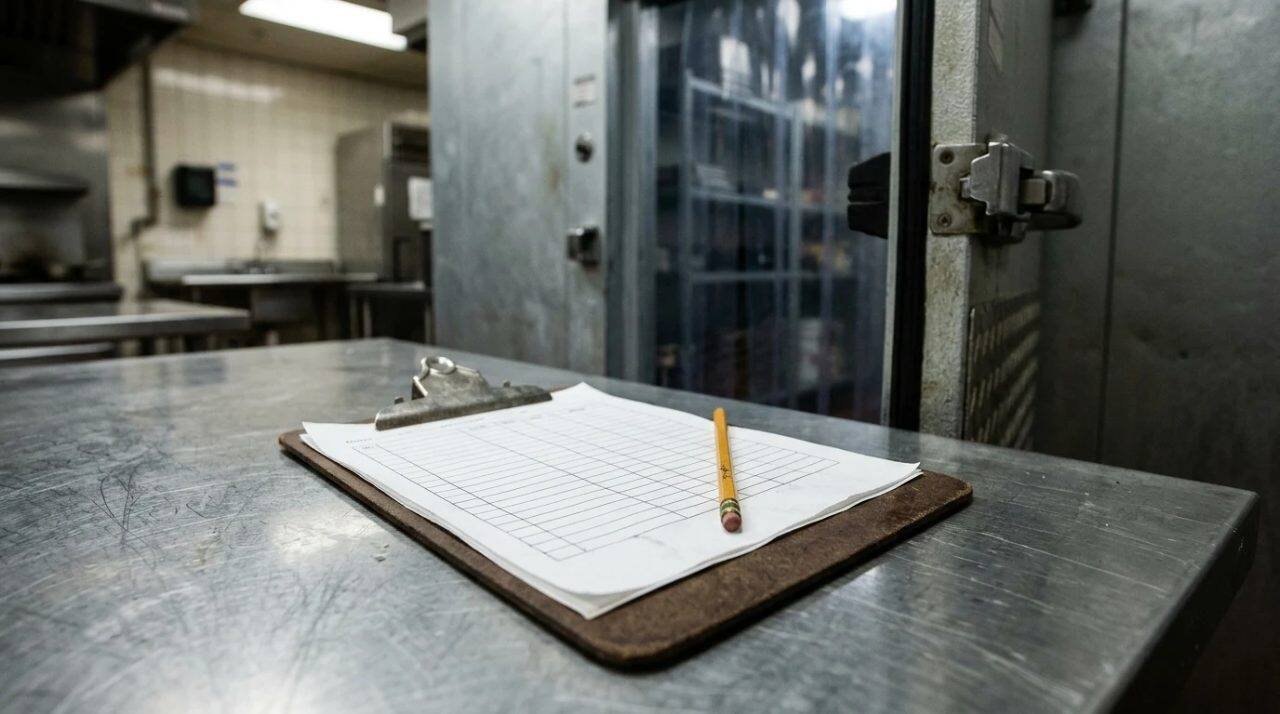
The published sources I read do not cover how to take the count itself. Parts Town says its guide does not address inventory counts, and the other two pieces do not either. What follows is a method, not a citation, and you should weigh it as one.
Make the sheet follow the cooler. Stand at the door and walk the shelves in a fixed route, left to right and top to bottom, and list the items in the order you meet them. A sheet organized alphabetically makes the counter jump around the room. A sheet organized by the route lets the counter’s feet and the pen move together. Within the route, group items by shelf, because shelf order is also the safety order described above, and any item found on the wrong shelf shows up as a line that does not match.
Each line needs four things: the item, the unit it is counted in, the count and a spot for a note. The unit matters more than people think. A case of something, a half-case and a single bag are three different units, and the sheet has to say which one is meant. Settle on one unit per item and write it on the sheet once. If a product comes in cases but is used by the pound, choose the one the kitchen thinks in, because that is the one that will be used to reorder.
Leave a column for the date on the front item. It costs a second per line and gives you the rotation check described above.
The count itself
Two people count faster and more accurately than one, with one calling and one writing. The caller says the item and the number out loud, the writer repeats it, and anything unusual gets a note on the spot. Reading back is dull and prevents the small mistakes of mishearing a thirteen as a thirty.
Count one shelf at a time and finish it. A sheet half-filled across the room from one half-counted shelf is the usual way a number gets missed. Move the product only when you have to, and put it back in the same place and the same order. If a case is open, count the open units and the sealed ones separately and write both.
Anything that seems off gets recounted at the time, not afterward. A recount costs a minute with the shelf in front of you and costs a guess after you have left.
Do the count at the same point in the week each time, ideally after a delivery has been put away or just before the next one arrives, and pick one and stay with it. A count taken right after a delivery shows what you have to work with. A count taken right before one shows what you actually used. Both are valid and they answer different questions, so mixing them gives you numbers that cannot be compared.
Temperature while you are in there

A count is also the moment someone is standing in the cooler with time to look at the thermometer. The sources I read give different ranges, which is worth saying openly. The National Restaurant Association’s article says a walk-in should be between 34 and 38 degrees Fahrenheit. Parts Town says refrigerators should run at or below 40 degrees. The National Checking piece says coolers should sit between 35 and 45 degrees.
Those three do not agree, and they are not issued by a health authority. The number that governs a food business is the one in its local health code, which I did not read for this post. Use the count as a reminder to check it, write the reading on the sheet, and look up the figure your inspector will use. The National Restaurant Association’s piece says to check temperatures at least daily and record them on a chart on the unit, and the National Checking article says to check temperatures and door seals daily and schedule regular technician visits.
Using the numbers
A count is only a list until it is compared with something. The simplest comparison is last week’s sheet. If a line went from six to six, either nothing was used or the product is not moving, and either answer is worth a look. If a line went from six to zero in a week, the kitchen is one delivery from a problem.
From there you can set a level for each item, the amount below which you reorder. That is a decision, and it depends on how often a supplier delivers and how long a product keeps. A special on the board is one way to deal with a line that is stacking up.
The honest caution is that a clean sheet is not a guarantee of anything. The count captures what is on the shelf at one moment. It does not capture what was thrown away, comped, eaten by staff or spoiled, and a kitchen that wastes a lot can have a tidy-looking count and still be losing money. The National Checking piece treats waste as the main reason to rotate and label, and a count that never mentions waste is only half a report.
For informational purposes only. Storage temperatures and labeling requirements vary with your local health code and your inspector; consult your local health department and, for cost questions, a licensed accountant.
Sources
- National Restaurant Association, Reorganize walk-ins before reopening restaurants: https://www.restaurant.org/articles/news/reorganize-walkins-before-reopening-restaurants
- Parts Town, How to organize your commercial kitchen and cold storage: https://www.partstown.com/about-us/how-to-organize-commercial-kitchen-cold-storage
- National Checking, Kitchen storage techniques to reduce restaurant food waste: https://www.ncco.com/blog/pos-essentials/kitchen-storage-techniques