
An About page answers one question for a stranger holding a credit card: who is on the other end of this website? Small shops tend to write it last, in a hurry, and fill it with adjectives. The page improves the moment it stops describing the shop and starts describing the work. One disclosure before the rest: I use my own business, Marcellino NY, as a live example below. It has been my business since 2010, I make and sell handmade leather briefcases through it, and I have a financial interest in the site.
Say who made the thing
Search engines ask the same question
Google’s guidance on creating helpful, reliable, people-first content is framed around three questions: who created the content, how it was created and why. On the first, it asks whether it is “self-evident to your visitors who authored your content.” It recommends accurate authorship information such as bylines where readers would expect them, and bylines that lead to more information about the person. It warns against fabricated creator profiles, such as made-up names or generated headshots, and calls that deception.
That guidance is written for articles, but the shop version of it is plain. A name, a face and a place on the About page are the shop’s byline. The same page lists links to an author page or the site’s About page as one way content shows trustworthiness, and says those pages should give background on the author or the site publishing the content. The About page is doing a job for the whole site.
Why the shop exists, in one honest sentence
The third question, why, is described by Google as perhaps the most important. The answer it wants is that content is created primarily to help people. For a shop the equivalent is a sentence about what the shop is for. Not “passionate about quality.” A reason a person could repeat: who it makes things for, what it makes and what it will not make.
Lead with the story

What the guides agree on
A Storetasker guide to About pages, from December 2023, lists the parts of a good page: purpose beyond making money, a brand story, real people, social proof, unique visuals, calls to action and edited meta content for search. It recommends putting the story near the top, because leading with it makes the content more memorable, and it says people prefer to buy from other people and not from faceless corporations.
A guide for handmade sellers from Growing Your Craft, updated in February 2026, adds structure to the story. Start with one or two sentences saying who you are, what the brand is and what you make. Then how you got started and what inspired the products. Then the process. Then relevant experience, such as years of practice, to build trust.
Order matters more than polish
A visitor reading the About page is deciding, usually in seconds, whether to keep reading. The first screen should say who and what. Everything after is for the person who stayed. A long history of the founder’s childhood, placed before the first mention of what the shop sells, is a page written for the founder.
Show the work

Process beats finished product
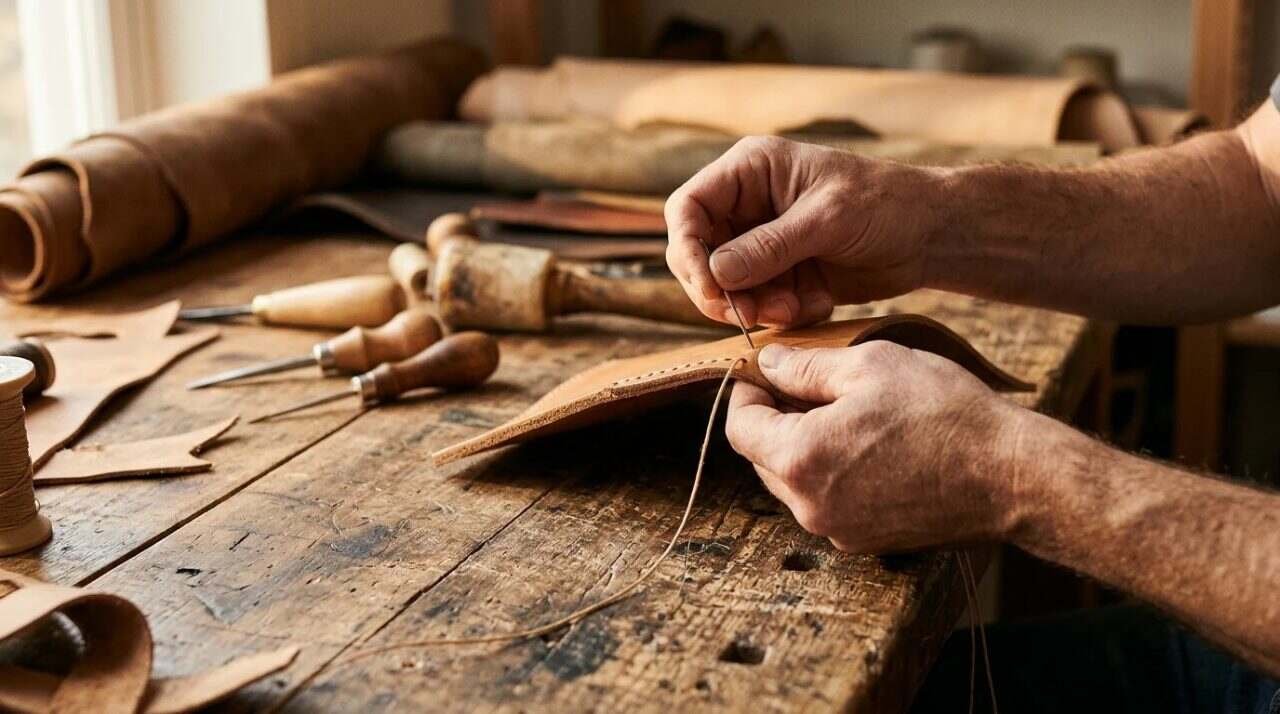
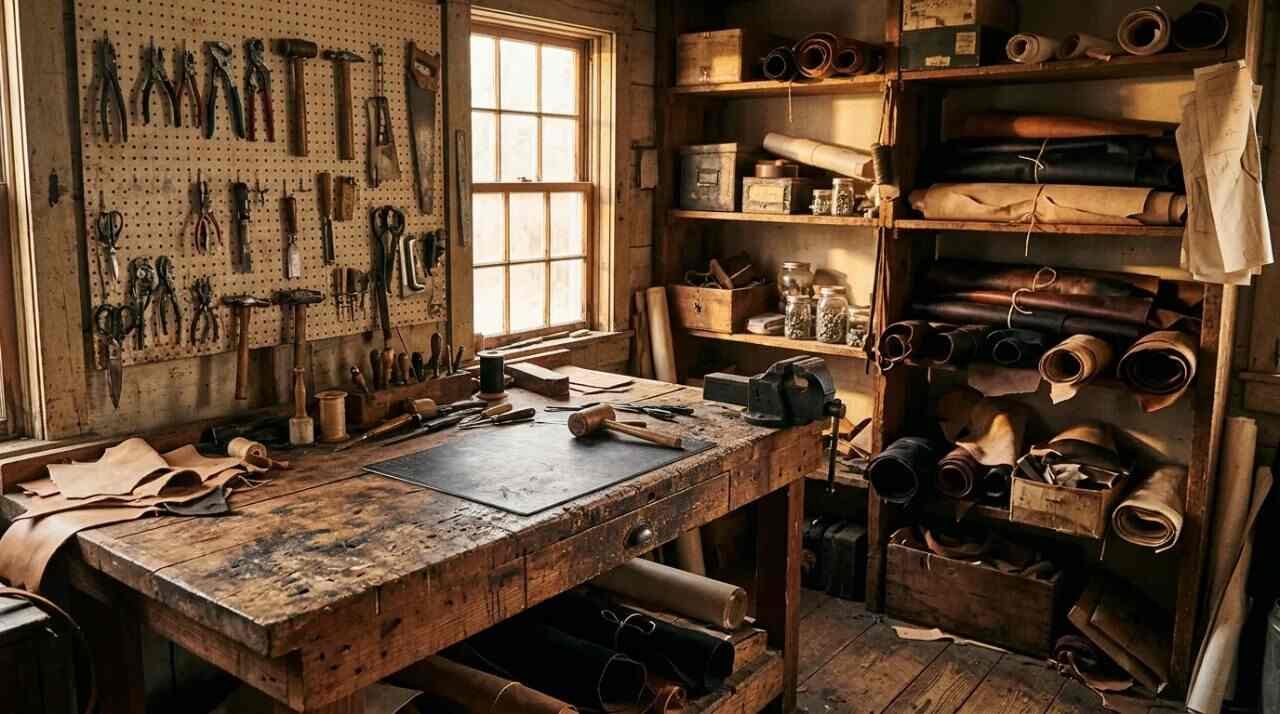
The handmade guide argues that your creative process is the strongest way to set a shop apart from mass-produced goods and from generated ones. It recommends behind-the-scenes photos and not only the finished studio shot, and gives a work desk with some clutter, sketches or raw materials as the kind of image to use. It suggests a short video of your hands making the product, which it calls “proof of handmade.”
The Storetasker guide says something similar from the sales side: unique pictures, not stock photos, hold more attention. A stock photo on an About page is worse than no photo, because it announces that the page is about nothing in particular.
Photographs of the person
People prefer people. Storetasker puts it as people preferring to buy from other people instead of faceless corporations. One good photograph of the maker at the bench, taken in the real shop, does more than three paragraphs. Photograph the hands, the tools and the room.
Name everyone who helps
The family member who packs the boxes
The Growing Your Craft guide tells sellers to list everyone who helps with the shop, down to a relative who only packs boxes, and says “Transparency is key.” It also says to connect your social accounts and keep your handles consistent with the shop name so customers can find and tag you.
This is useful for a reason beyond honesty. A shop that says “it’s just me” in a way that is not true gets caught the first time an order arrives in someone else’s handwriting. A shop that says who does what looks bigger, not smaller, and reads as more stable.
Write it like a person talks
Not a sales pitch
The same guide lists the mistakes. Formal or technical language: write conversationally and read the text aloud. Sales-pitch tone: product feature lists belong in the product descriptions, and the About section should not be a sales pitch. Long paragraphs: keep them to roughly two to five sentences. Typos. And generic machine-written text: it says shoppers can tell, and recommends heavy editing so the page sounds like you.
The test I would add is to read the page and take out every sentence a competitor could copy. What remains is the page. If nothing remains, the shop has not yet decided what it is.
Claims need a home
If the page says something large, a visitor will look for proof. A claim with no photo, name, date or link behind it asks the reader to take your word. Most readers will not.
Storetasker’s list gives the same idea a name, social proof: endorsements, awards, certifications or ratings for top products. For a small shop that can be as modest as a customer’s note shared with permission, a press mention with a link, or a trade certification with its number. Anything that a stranger could check is worth more than another adjective.
The page also has a search listing
The same guide says to edit the page’s meta title and description so search engines can rank it. That is the small print under the page’s name in a search result, and for a shop whose name is common it may be the first line a stranger reads. Write it as a plain sentence naming the shop, the place and what it makes.
What happens after the page
A next step
Storetasker lists calls to action among the elements of a good page: buttons that send visitors to the products or to a contact page. An About page that ends without a link strands the person it just convinced. The links can be quiet. A line near the bottom that says where to see the work and how to ask a question is enough.
Contact details
Put a way to reach a person on the page or one click away: an email address, and a phone number or form if the shop answers them. The page is where a hesitant buyer turns into a person asking a question, and they will not look for a hidden contact page.
One example, read live
What Marcellino NY’s About page has on it
I read the Marcellino NY About page before writing this, and I will describe only what is visibly on it. It belongs to my own business, so what follows is an inventory, not a verdict. Parts of the page have been edited over time, and the version a visitor sees today may not match what was on it in August 2026.
It opens with a hero section: a headline, a line of supporting text and two buttons, one to meet the maker and one to ask about a custom piece. Under it sits a photograph of the maker at the workbench, punching leather with a mallet, with a caption. A section about the brand follows and links to a longer page about the maker. A section called Why Marcellino sets out four short points: hand stitching, English bridle leather that is vegetable tanned, the sort of buyer who seeks the pieces out, and limited production. At the bottom there is a long photo gallery of finished pieces, hides, tools and the shop. An email address sits in a banner at the top of the site.
Measured against the guides above, the page has a story section, a photograph of the person at the bench, a process-minded gallery and next-step buttons. What it does not do is name anyone else who helps, and its voice is more formal than the Growing Your Craft guide recommends. Those are the two edits I would test first.
Review it on a schedule
Storetasker suggests reviewing the page once or twice a year. That is about right. An About page goes stale in small ways: a price mentioned, a product line that has ended, a photo of a shop that has been rearranged.
For informational purposes only. Advice on search engine guidance and web copy comes from published guides and does not guarantee any result; consult a licensed attorney about advertising claims and disclosures.
Sources
- Google Search Central, Creating helpful, reliable, people-first content: https://developers.google.com/search/docs/fundamentals/creating-helpful-content
- Storetasker, How to Write an About Us Page that Makes an Impact on Shopify (December 27, 2023): https://resources.storetasker.com/blog/how-to-write-an-about-us-page-that-makes-an-impact-on-shopify
- Growing Your Craft, How To Write Etsy Shop About Section (updated February 1, 2026): https://www.growingyourcraft.com/blog/how-to-write-etsy-shop-about-section-templates-examples
- Marcellino NY, About page: https://marcellinony.com/about/
- YouTube, The MOST Important Pages For Your Website + Tips To Writing Your Website Copy!, Ashlyn Writes: https://www.youtube.com/watch?v=mxa6zE0-JLM