
A station procedure is the recipe for the cook, not the dish: where things go, what gets checked, what happens when a check fails, who to find. I have written them for a restaurant line myself, and I developed training sessions for restaurant managers and staff at Nanos Media, a technology integration and consulting group I owned. This post sets out what a one-page station procedure needs, using public food safety and workplace safety sources for the parts that are not a matter of taste.
One station, one page
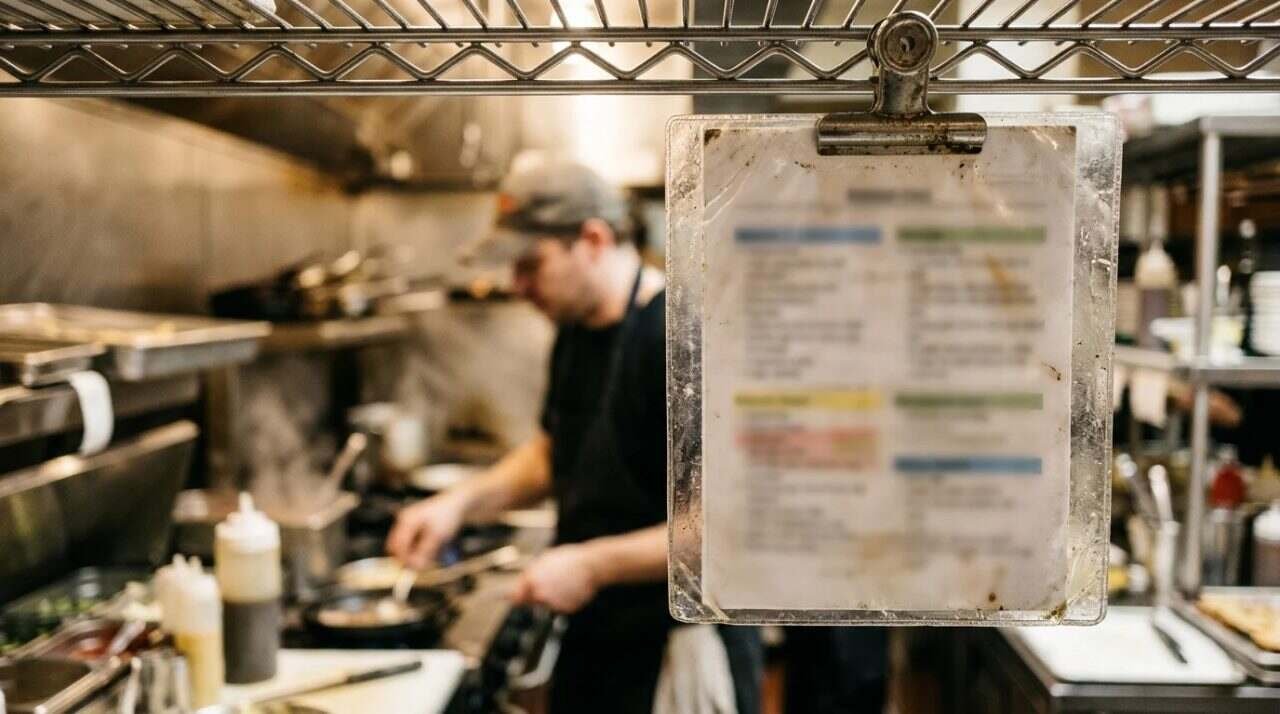
The unit of a procedure is the station: grill, fry, sauté, garde manger, expo, dish. A procedure for the whole kitchen gets written once and read never. A procedure for one station fits on a single page, hangs at the station, and gets read by the person standing there at four in the afternoon.
The page needs four parts in a fixed order, so a cook can find the line they need without reading the rest:
- Setup, before service: what comes out, in what quantity, at what temperature, in what container.
- Checks during service: what is looked at, how often, and what the limit is.
- When a check fails: what the cook does, who is told, what happens to the food.
- Breakdown: what is wrapped, labeled, stored, cleaned and written down.
That order is borrowed, loosely, from the way food safety planning is described by the Food and Drug Administration. Its page on HACCP principles and application guidelines lays out seven principles, among them monitoring, corrective action and record keeping. The guidance was adopted in 1997 and is a framework, not a restaurant manual, so the point is the order of thought and not the paperwork. Find the hazard, set a limit, watch it, decide in advance what to do when it fails, and write down that you did.
The checks that need a number
Some lines on a station page are preferences. A few are not, and those should carry a number. The U.S. Department of Agriculture’s Danger Zone page gives the range at 40°F to 140°F, where bacteria multiply fastest. It says never to leave food out of refrigeration over two hours, and that above 90°F food should not be left out more than one hour. Hot food should stay at or above 140°F and cold food at or below 40°F.
Those numbers belong on the page as limits, not as advice. A cold well at 40°F or below is a limit. A steam table at 140°F or above is a limit. “Check the cold well” is not.
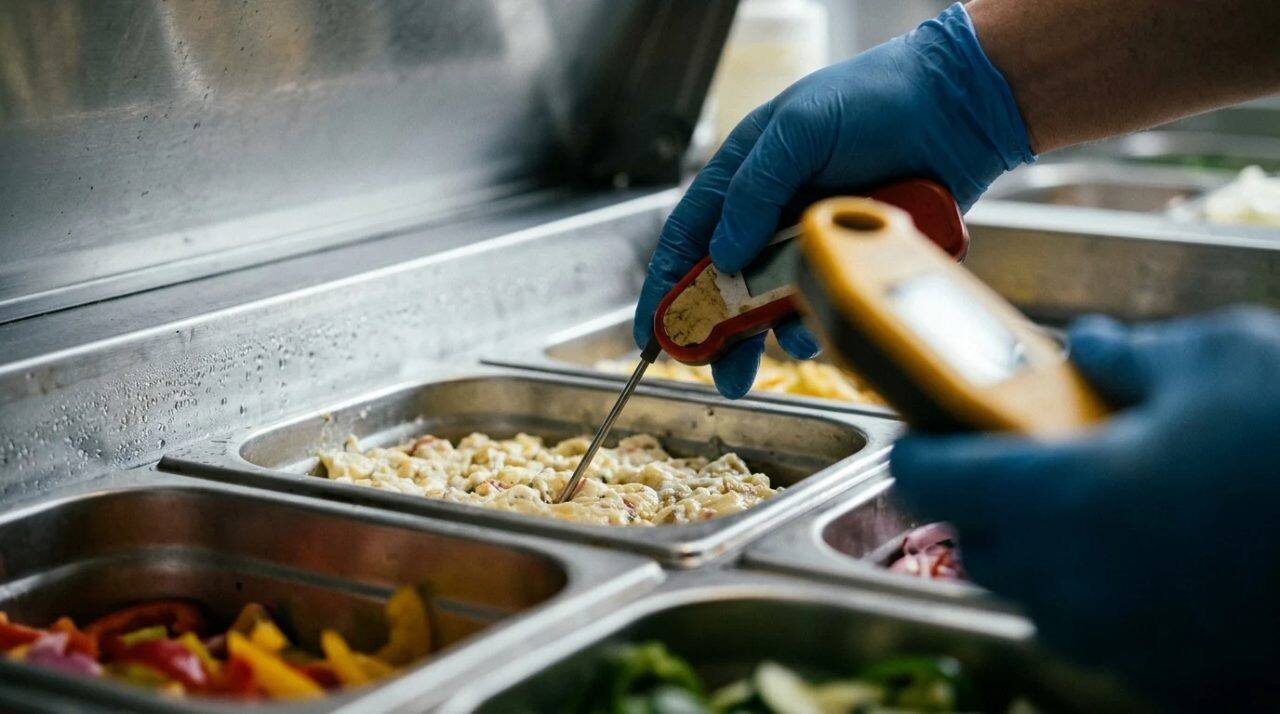
The HACCP guidance describes monitoring as a planned sequence of observations or measurements to assess whether a control point is under control. The word planned is the useful one. A station page that says “check temperatures” has no plan in it. One that says “probe the cold well at open, and again at the start of each rush, and write it on the sheet” does.
Corrective action is the line most station pages skip. The guidance says that when a limit is missed, the response should correct the cause, decide what happens to the affected product, and record what was done, and that the plan should specify these actions in advance. On a station page that becomes one sentence per limit. If the cold well reads above 40°F, move the product to the walk-in, tell the chef, and write down the time. The cook should not have to invent the sentence while the tickets are printing.
What the cross-contamination research says about written policies
A written procedure is easy to dismiss as paper. There is some evidence that the paper matters. Food Safety Magazine reported in November 2023 on a CDC study of restaurant characteristics associated with cross-contamination. It says contamination actions were more frequent in restaurants without policies on when and where to wash hands, or on minimizing bare-hand contact with ready-to-eat foods, and more common where managers lacked food safety certification or workers lacked food safety training.
Two other findings in that article belong on the page next to the first. Independently owned restaurants were more likely to show these actions, and the article links that to chains’ greater resources, training and standardized procedures. And contamination actions were observed more often in restaurants with more experienced managers, which the article attributes, tentatively, to possible complacency or burnout, and says needs more research.
That last finding is the argument for writing the page down. Experience lives in a person’s hands, and a person who has done something a thousand times does it from memory, including the shortcuts. A procedure on the wall is a second opinion that does not get tired.
It is also fair to say what the study does not show. The article describes associations, not proof that a written policy causes cleaner hands. A restaurant can have the page on the wall and still drift. The page works because someone reads it aloud in training and checks it afterward.
Safety for the cook, not only the food
A station page that covers only the food leaves out the person. The Washington State Department of Labor and Industries keeps a page on restaurant, food and beverage industries, and it is a Washington agency, so its legal citations do not apply in New York and I have not checked what New York requires. As a plain list of hazards, though, it is useful. It names slips and falls from spills and cluttered floors, burns from hot surfaces and hot oil, cuts from knives and unguarded machine parts, and strains from heavy or awkward lifting.
The page describes a general approach worth stealing: identify the hazards, then reduce the risk through engineering controls, administrative controls and personal protective equipment. At a station that translates into three lines. What is physically arranged to reduce the hazard, such as where the fryer basket hangs. What the rule is, such as who changes oil and when. What the cook wears or uses, such as gloves or a cutting glove.
Each station has a hazard that is its own. A fry station has hot oil. A prep station has knives and a slicer. A dish station has a wet floor. Writing the single worst one at the top of the page, in plain words, does more than a paragraph of general caution.
Allergens go on the page too

Allergen handling is a station question because cross-contact happens at a station, with a spoon, a board or a pair of gloves. A Virginia Department of Health handout, Keep Your Guests Safe From Food Allergens, lists the nine major food allergens as wheat, peanuts, tree nuts, milk, eggs, shellfish, fish, sesame and soybeans. For food service workers it gives four verbs: know the allergens and the signs of a reaction, avoid letting allergens contaminate other foods during storage, preparation and service, notify customers in writing when one of the nine is in a dish, and call 911 if you suspect a reaction.
A station page can carry those verbs in its own terms. Which dishes at this station contain which of the nine. Which tools are set aside for allergy orders. Who is told when an allergy ticket comes in. The handout is Virginia’s, and rules about notification differ by jurisdiction, so the local health department’s current rule decides what the page must say.
Writing it so it gets used
Most station pages fail on length. A good one has a heading, four short parts, a few numbers, and a name at the bottom: who wrote it, who approved it, and the date. The date is not decoration. The FDA’s page on the Food Code describes a model that agencies use to develop or update their own rules, so a procedure written against last year’s local rule may be wrong this year.
A few rules for the writing itself:
- Use the verbs a cook uses. Probe, label, wrap, pull, wipe.
- Put numbers where the limit is a number, and nowhere else.
- Keep the whole page to one side of one sheet.
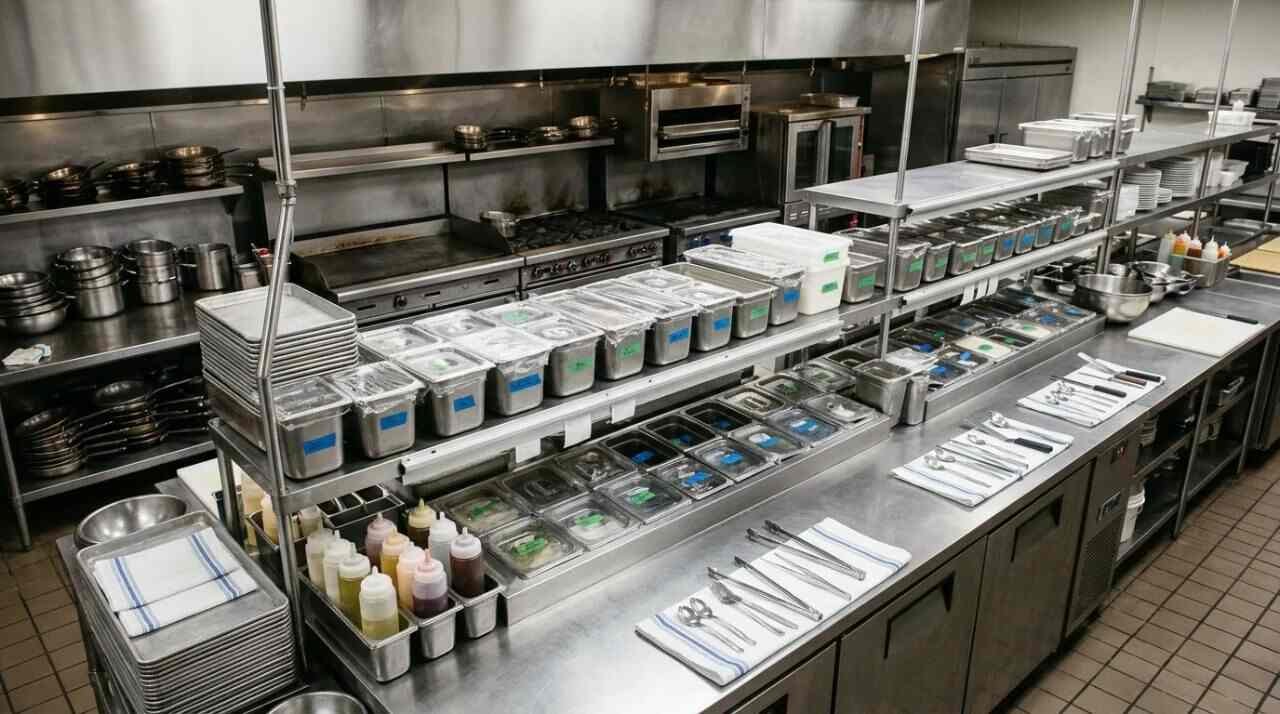
- Photograph the finished station and tape the photo to the page, so setup is something to match and not something to read.
- Walk a new cook through the page once at the station, then ask them to teach it back.
That last step is worth the ten minutes. A procedure nobody has said aloud is a procedure nobody has found the holes in.
The honest limit of all this is that a station page describes the way the work should go on a normal night. The night that breaks the page is the one with a missing cook, a full house, and a delivery on the dock. A good page does not prevent that night. It makes the first minute of it less confused.
For informational purposes only. Food safety and workplace safety rules are set by local, state and federal agencies and change, so check the current requirements with your health department and workplace safety regulator, and consult a licensed attorney or insurance advisor on employee safety and liability questions.
Sources
- FDA, HACCP Principles & Application Guidelines (adopted August 14, 1997): https://www.fda.gov/food/hazard-analysis-critical-control-point-haccp/haccp-principles-application-guidelines
- USDA Food Safety and Inspection Service, Danger Zone (40°F – 140°F): https://www.fsis.usda.gov/es/node/3295
- Food Safety Magazine, CDC Study Highlights Restaurant Characteristics Most Associated With Food Cross-Contamination (November 2, 2023): https://www.food-safety.com/articles/9001-cdc-study-highlights-restaurant-characteristics-most-associated-with-food-cross-contamination
- Washington State Department of Labor and Industries, Restaurant, Food and Beverage Industries: https://lni.wa.gov/safety-health/safety-topics/industry-topics/restaurants
- Virginia Department of Health, Keep Your Guests Safe From Food Allergens (2023): https://www.vdh.virginia.gov/content/uploads/sites/127/2023/07/9-Food-Allergens-2023-rap.pdf.pdf
- FDA, FDA Food Code: https://www.fda.gov/food/retail-food-protection/fda-food-code