

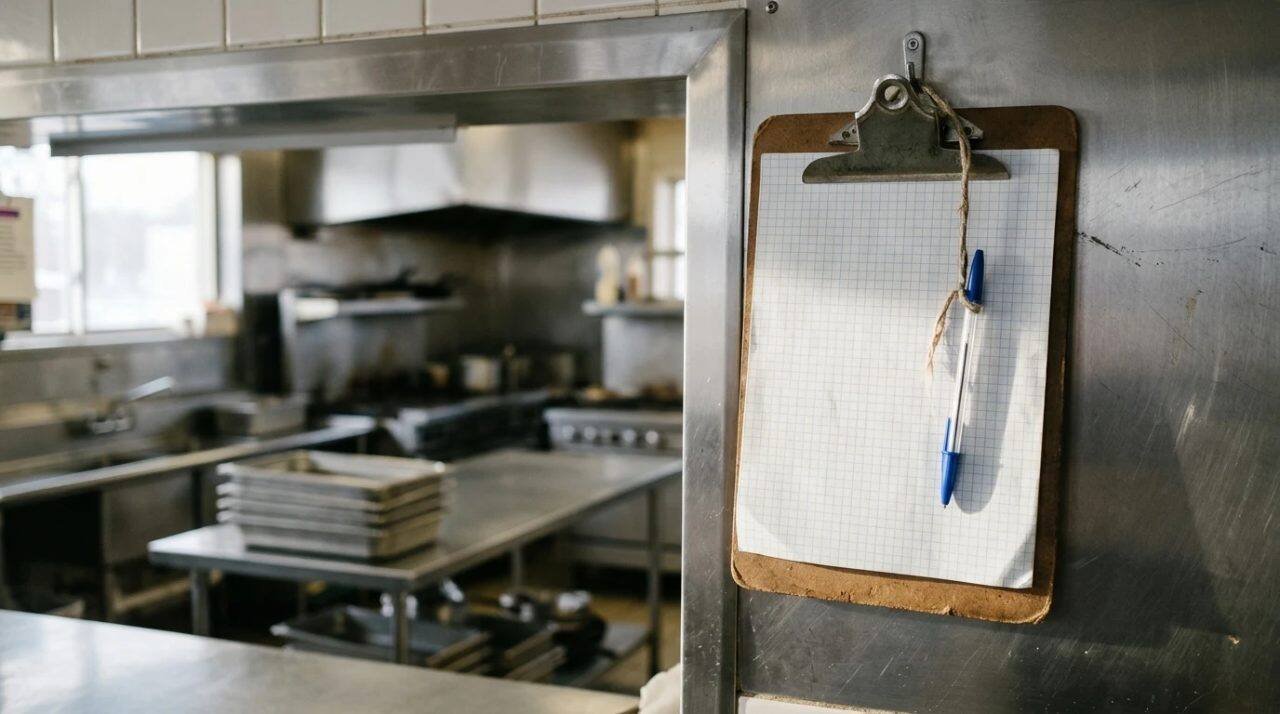
A prep list is a sheet of paper that tells the kitchen what to make before the doors open, and how much. It sounds too plain to need a how-to. I have built these lists, and the plainness is the trap, because a list that says “cut veggies” gets exactly that: some vegetables, cut, in a quantity nobody agreed on.
Start from the menu, one dish at a time

Every dish gets split in two
WebstaurantStore’s guide to kitchen prep lists begins where the work begins, with the menu. Go through it dish by dish and ask which parts can be made ahead and which have to happen when the ticket prints. Its example is a plate of hot wings. Thawing the wings, portioning them in groups of six or twelve and making the sauce are prep. Dropping them in the fryer and plating them are cook-to-order. Only the first group belongs on the list.
That split is the whole method, and it is harder than it looks on a long menu. A diner menu runs to dozens of items, and most of them share components. The same diced onion goes into three dishes. The same sauce sits under two. If the list is written dish by dish, the onion shows up three times with three different quantities, and a prep cook ends up chopping it three times or, worse, once and wrong. So write the dish-by-dish pass first, as a working sheet, and then collapse it into components. One line for onions, with the total for every dish that uses them.
The same article reminds readers to cover everything on the plate, including appetizers, salads, desserts, garnishes, toppings and sauces. Garnishes are where lists leak. Nobody thinks of lemon wedges as a recipe until the lemons are gone at eleven on a Saturday.
Leave off what cannot be made ahead
A prep list that includes cook-to-order steps stops being trusted, and a list nobody trusts gets ignored. Fries blanched in advance are prep. Fries in the basket are service. Keep the line clean and the cooks will keep reading it.
Par levels turn the list into numbers

What par means on a prep sheet
The Webstaurant guide puts the division of labor in one sentence: “The prep tasks define what needs to be done, while the par levels tell you how much needs to be done.” A par level, in its words, is the amount of an ingredient or prepared item you want on hand for a given day and shift. The arithmetic for the cook is subtraction. Par minus what is already on the shelf is what gets made.
Toast’s guide to restaurant prep lists says the same thing from another angle and adds where the numbers come from: historical sales, upcoming reservations and day-of-week patterns. Its example is a taco night needing more prepped guacamole than a Monday.
Why a weekly list beats seven daily ones
A weekly list is really a grid of par levels, one column per day, with the tasks down the side. That is the version that survives a busy week, because the numbers are set once, in a calm hour, instead of being guessed at six in the morning with the first delivery truck backing in.
Most restaurants have a shape to their week. Some days are heavy and some are slow, and the heavy days repeat. A column for each day lets the Friday par be bigger than the Tuesday par without anyone arguing about it on Friday. It also exposes the days that do not follow the pattern. A holiday week, a local event, a school break all push the numbers around, and a weekly grid makes it easy to see which column needs to be overwritten and which can run as written.
Starting numbers for a new list
Webstaurant is blunt about a new restaurant with no history: begin with estimates, track sales for a few weeks to see the trends, and adjust. Pars come down on slow days and go up for items that sell out. That advice is right and it is also humbling, because the first version of any prep list is wrong. The point is to write the wrong number down where it can be corrected, rather than carrying it in one cook’s head.
What goes on the sheet

Columns that earn their space
Toast lists the pieces most prep lists carry: the date and shift, the dish name or menu category, the ingredient or component, the quantity required, the par level, a check-off column and the initials of whoever did the work. Webstaurant describes a grid with the food item first, then the par, then spaces for what is on hand, what was prepped and the total.
Put those together and you get a sheet I would defend:
- Item, written the way the kitchen says it, with the cut or form: “onion, small dice,” not “onions.”
- Par for the day
- On hand at the start of the shift
- To prep, which is par minus on hand
- Done, with initials
- Station, as a grouping across the page or a separate sheet per station
Toast lists vague instructions as the first common mistake, and the example it gives is the one I started with, “cut veggies” with no item, quantity or cut. It also lists failing to update the list, ignoring par levels and not training the staff on the sheet. None of those is exotic. All of them are what happens in week three.
Paper or screen
Toast says plainly that paper lists still work, and that digital tools can sync across devices, keep a history of what was prepped and connect with inventory and ordering. A clipboard on a hook by the pass costs nothing and does not need a password. A spreadsheet printed each morning keeps the history and the print is the clipboard. Either way the sheet should hang where everyone can see it, which is Toast’s advice as well.
Assigning the work and checking it
One name per task
A task with no name on it belongs to whoever feels guilty first. Toast recommends assigning tasks to specific people to prevent confusion and create accountability, and organizing the list by station or cooking method so each cook reads only the part that is theirs. Webstaurant has cooks record what they prepped and initial the sheet when done.
The initials do two jobs. They tell the opening manager what is finished. They also tell the next person to ask a question about a mistake: a short list of who did what is the cheapest training tool in the building, because the question can be asked at the right time and about the right pan.
Five minutes at the start of the shift
Toast suggests a brief review of the list at the start of each shift and a check that every task is complete before service. This is a good place to be honest about the downside. A review takes time out of a morning that has none to spare, and on a calm day it will feel like theater. It pays on the other days, the ones where the usual prep cook is out and the person covering has never seen this kitchen. The list is then the only thing standing between that person and a guess.
Dates on every container
The seven-day rule
Prep produces food that sits in a cooler, and food that sits in a cooler needs a date. An FDA document on date marking covers ready-to-eat, time and temperature controlled food that is prepared in the establishment and held for more than 24 hours. It says such food may be held at 41°F or colder for a maximum of seven days, and it ties the limits to controlling Listeria monocytogenes.
The same page says the Food Code does not require a particular label. A calendar date, a day of the week or a color code can all work, so long as the mark shows the date or day by which the food must be eaten, sold or thrown out. It also does not say outright which day counts as day one. I would not guess. Ask your local health department how it counts, and write the answer on the wall.
Labels belong on the prep list too
Webstaurant notes that each prepped item gets a label with the date, the time and the cook’s name. Toast says a consistent prep list supports food safety through proper labeling, storage and first in, first out rotation. So the last column of the sheet could be a check for “labeled and shelved.” It adds a few seconds to each line and takes away the argument about whose pan is whose.
Reading the week back
Adjust from what came back unused
Webstaurant says par levels should be adjusted over time using sales data. The cheapest sales data in the building is the pan of leftovers on Sunday night. If the same item is being thrown out every Wednesday, the Wednesday par is too high. If it is the first thing to run out every Friday, the Friday par is too low. Move the number by a little, not by a lot, and look again the next week.
A single strange week should not rewrite the sheet. A snowstorm that kept everyone home does not mean the Tuesday par was wrong. Altametrics, writing about par levels for ordering, warns against doubling pars on the strength of one crazy weekend, and the same caution applies to prep.
Where the list connects to the rest
The prep list sits between two other documents. Upstream is the order guide, which decides what arrives; I wrote about that in Writing a Weekly Order Guide for a Restaurant. Downstream is the cost of each dish, which depends on how much of a purchased item survives prep; How to Write a Recipe Costing Card covers that. A prep list that produces a lot of trim and waste is telling you something the costing card will later confirm in dollars.
Toast reports that a consistent prep list can reduce labor costs, minimize waste and improve consistency and ticket times. Those are the vendor’s claims, in an article that is also selling software, and I have no numbers of my own to add. What I can say is that the list is a short document that asks for a long habit. The cooks have to read it, the managers have to update it, and somebody has to throw out the old one on Monday.
For informational purposes only. Food safety rules vary by jurisdiction and change over time, so confirm date marking and holding requirements with your local health department.
Sources
- WebstaurantStore, Kitchen Prep Lists for Restaurants: https://www.webstaurantstore.com/article/583/kitchen-prep-lists.html
- Toast, Restaurant Prep List: https://pos.toasttab.com/blog/on-the-line/restaurant-prep-list
- FDA, date marking of ready-to-eat food (Food Code): https://fda.gov/media/127796/download
- Altametrics, How to Set Up Par Levels in a Restaurant: https://altametrics.com/blog/how-to-set-up-par-levels-in-a-restaurant.html
- YouTube, I Made the Perfect Prep List (for Total Station Domination), Justin Khanna: https://www.youtube.com/watch?v=mHlecuGSNRg
- Till Post, Writing a Weekly Order Guide for a Restaurant: https://tillpost.com/weekly-order-guide-restaurant/
- Till Post, How to Write a Recipe Costing Card: https://tillpost.com/recipe-costing-card/


